
Maritime Security Awareness Practice
$69.00
- Buy to unlock unlimited access to all Quiz questions and Answers in this Quiz.
- After purchase you can print a PDF of the whole quiz at any point. The PDF will contain the questions and the correct answers.
About this Exam
The Maritime Security Awareness (MSA) certification is a
fundamental requirement for all personnel working in a maritime environment,
not just those with specific security duties. It provides essential knowledge
to contribute to the overall security of a ship and its port facility. The
course is designed to empower every individual—from seafarers of all ranks to
shore-based staff—to recognize security threats and respond appropriately. It
aligns with international standards, particularly the International Ship and
Port Facility Security (ISPS) Code, ensuring that maritime operations remain
safe from acts of terrorism, piracy, and other criminal activities.
Successfully passing this exam is a critical first step for anyone aspiring to
a career at sea or within the port sector.
Ready to test your knowledge?
Buy Now to Access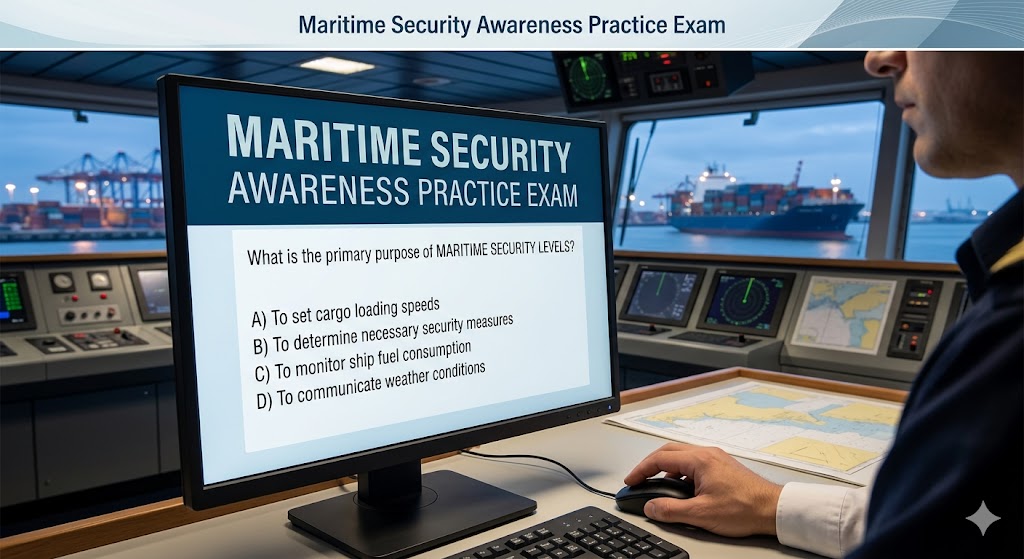
Additional Information
What the Course Entails and Exam Details
This comprehensive training focuses on developing a culture
of security vigilance. The syllabus typically covers a wide range of core
topics, including the fundamental principles of maritime security, the purpose
of the ISPS Code, and the distinct requirements of different Maritime Security
(MARSEC) Levels. Participants learn to identify various security threats, such
as weapons, dangerous substances, and devices, and to recognize behavioral
patterns of persons likely to threaten security, without resorting to
discriminatory profiling. The course also details the techniques used to
circumvent security measures and the necessary actions to be taken in the event
of a security incident. Understanding ship and port security plans, reporting
procedures, and emergency response protocols are also integral components of
the curriculum.
What to Expect in
the Final Exam
The final assessment for Maritime Security Awareness is
usually presented in a formal multiple-choice format. Candidates are required
to answer a set number of questions, often ranging from 20 to 30, which are
designed to test both their knowledge and practical application of the security
principles learned. The passing score is typically set between 70% and 80%,
reflecting the critical nature of the subject matter. A specific time limit is
enforced for the exam, which is generally 30 to 60 minutes. It is a closed-book
examination, meaning no external reference materials, notes, or digital devices
are permitted during the testing period. The exam is invigilated to ensure
integrity.
How to Study and
Exam Centers
Effective preparation for this exam involves a combination
of study methods. It is highly recommended to thoroughly review the standard
model course material provided by authorized training providers. Engaging with
official practice tests, such as the one referenced in this guide’s title, is
an excellent way to familiarize oneself with the question style and identify
areas requiring further focus. Creating flashcards for key terms, definitions,
and the specific requirements of MARSEC levels can significantly enhance
recall. You can take the official examination at various locations, including
accredited maritime training institutes, official online learning platforms
approved by maritime administrations, or authorized testing centers like
Pearson VUE. Online options often require an AI-assisted or human proctoring
system.
Job Opportunities
from the Course
A valid Maritime Security Awareness certification is a
primary key that unlocks numerous career paths within the vast maritime
industry. It is mandatory for virtually all roles onboard commercial vessels
and in required port facilities, ensuring global safety and regulatory
compliance.
Potential job opportunities include:
- Seafarer
(all ratings, including Deck, Engine, and Catering departments)
- Port
Operations Staff and Employees
- Cruise
Ship Crew (hospitality, entertainment, and support roles)
- Cargo
Vessel Crew and Staff
- Offshore
Oil and Gas Platform Worker
- Maritime
Logistics and Supply Chain Coordinator
- Marine
Surveyor or Inspector
- Ferry
and Passenger Vessel Operator
- Superyacht
and Luxury Yacht Crew
Frequently Asked Questions
Reviews
5.0
Based on 0 reviews
Leave a Review
No reviews yet. Be the first to review!