
Maritime Warfare Practice Test
$69.00
- Buy to unlock unlimited access to all Quiz questions and Answers in this Quiz.
- After purchase you can print a PDF of the whole quiz at any point. The PDF will contain the questions and the correct answers.
About this Exam
Welcome to your comprehensive guide on preparing for the
Maritime Warfare Practice Test. This resource is designed for individuals
seeking to validate and refine their understanding of maritime warfare
principles, tactics, and operations. Whether you are currently serving in a
naval capacity, aiming for a career in maritime security, or are a passionate
student of naval history and strategy, this practice test serves as a critical
diagnostic tool to assess your readiness for official qualifications or deeper
academic study. Its primary objective is to evaluate knowledge across diverse
dimensions of modern and historical naval engagements, enhancing critical
thinking skills relevant to the maritime domain. By utilizing this practice
exam, you can identify knowledge gaps, practice time management, and build
confidence before sitting for high-stakes assessments.
Ready to test your knowledge?
Buy Now to Access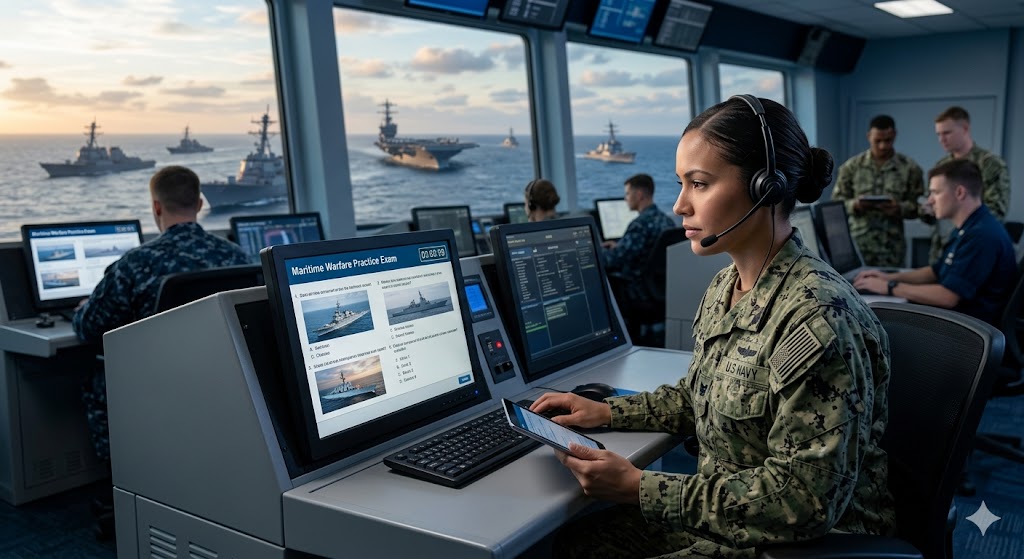
Additional Information
What the Course
Entails and Exam Details
This practice test draws upon a broad spectrum of topics
essential to modern maritime warfare. While specific syllabi vary for different
official certifications, this test generally covers core areas including:
Foundations of Maritime Strategy (including naval history and principles of sea
power), Surface Warfare (vessel types, sensors, weapons, and tactics),
Subsurface Warfare (submarine operations, anti-submarine warfare (ASW), and
stealth), Naval Air Operations (aircraft carriers, aircraft roles, and integration
with the fleet), Amphibious Warfare and Expeditionary Operations, Maritime Law
and International Regulations (including rules of engagement and exclusive
economic zones), Combined and Joint Operations with other military branches,
and the critical roles of Information Warfare, Cyber, and Electronic Warfare in
the maritime environment. The practice test aims to present scenarios and
questions that reflect these critical subjects.
What to Expect in the Final Exam
As a practice test, this assessment is typically
administered in a digital, multiple-choice format designed for efficiency and
broad knowledge checking. Candidates can expect a series of questions with four
potential answers, requiring a combination of factual recall and scenario-based
analysis. While passing scores are set by individual program administrators,
aiming for at least 70% to 80% correct answers is a strong benchmark. The time
allowed will vary depending on the length of the specific version you take, but
expect it to be timed to encourage rapid decision-making, simulating a real
test environment. Please note that this practice test is focused purely on
theoretical knowledge and does not replace potential practical evaluations,
simulations, or extensive field training required for many official maritime
qualifications.
How to Study and
Exam Centers
Effective preparation is key to success on any maritime
warfare examination. We recommend starting with a thorough review of
fundamental naval doctrines, tactical manuals, and reputable historical texts
covering significant maritime conflicts. Break down your study into manageable
sections, focusing on one domain (e.g., surface warfare) at a time. Utilize
flashcards for key terms, weapon systems, and principles. Regularly taking
practice tests like this one is invaluable; treat each attempt as the real exam,
and carefully review both correct and incorrect answers to understand the
rationale. Forming study groups with colleagues or fellow students can also
provide diverse perspectives on complex scenarios. Regarding exam centers, this
practice test is typically accessed online through dedicated learning portals,
maritime education platforms, or within official military training
institutions. Real, official examinations are often conducted at authorized
physical locations like military bases, naval academies, or recognized
commercial testing centers.
Job Opportunities
from the Course
Successfully preparing for and passing qualifications in
maritime warfare opens doors to diverse and rewarding career paths within both
government and private sectors. The deep understanding of maritime strategy,
operations, and security you develop is highly sought after for numerous roles.
These include opportunities such as Naval Officers in various specialized
branches (Surface, Subsurface, Aviators), Coast Guard personnel focused on
maritime safety and security, Marines specializing in amphibious operations,
Private Maritime Security Contractors, Analysts with government agencies or
defense think tanks specializing in maritime affairs, Merchant Marine Officers
(particularly those with security responsibilities), and intelligence analysts
focused on oceanic regions. Continued dedication to maritime warfare studies
significantly enhances professional development and leadership potential in
these dynamic fields.
Frequently Asked Questions
Reviews
5.0
Based on 0 reviews
Leave a Review
No reviews yet. Be the first to review!