
Mark Klimek Electrolytes and Endocrine Practice Test
$69.00
- Buy to unlock unlimited access to all Quiz questions and Answers in this Quiz.
- After purchase you can print a PDF of the whole quiz at any point. The PDF will contain the questions and the correct answers.
About this Exam
Mastering complex physiological concepts is essential for success in nursing school and on the NCLEX. The Mark Klimek Electrolytes and Endocrine Practice Test is a focused assessment designed specifically for nursing students. It is based on the highly effective, memory-aid driven teaching methods of Mark Klimek, a renowned expert in NCLEX preparation. This practice test is designed for anyone preparing for licensure as a Registered Nurse (RN) or Licensed Practical Nurse (LVN/LPN). It focuses heavily on test-taking strategies and critical thinking regarding fluid balance and hormonal control
Ready to test your knowledge?
Buy Now to Access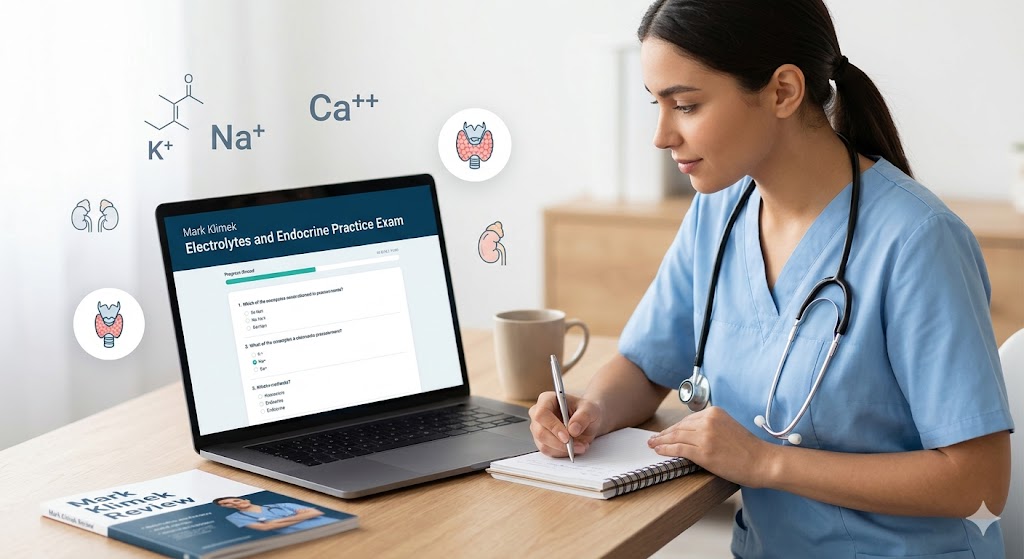
Additional Information
What the Course Entails and Exam Details
This practice test covers two critical and heavily tested
areas of nursing practice. In the Electrolytes section, you will be tested on
your understanding of potassium (Kalemias), sodium (Natrixs), calcium
(Calcemic), and magnesium imbalances. You must be able to recognize the unique
signs and symptoms associated with both deficit and excess. Crucially, you must
understand how these imbalances affect specific body systems, such as the
cardiac and musculoskeletal systems. The Endocrine section focuses on major
disorders of hormone regulation. Expect deep dives into thyroid function
(hyperthyroidism and hypothyroidism), adrenal gland disorders (Cushing’s
Syndrome and Addison’s Disease), and the management of Diabetes Insipidus and
SIADH. You will need to understand the pathophyisology, clinical
manifestations, and necessary nursing interventions for these conditions.
What to Expect in the Final Exam
This practice exam mimics the style of real NCLEX questions,
often adopting Mark Klimek’s unique perspective on prioritization and
prioritization rules. The format typically includes standard multiple-choice
questions. You may also encounter complex Select All That Apply (SATA)
questions, which require high confidence in your content knowledge. While
individual testing platforms vary, most practice sets provide detailed
rationales for correct and incorrect answers upon completion. Aiming for a high
passing score (typically 75-80% or higher) indicates a readiness to tackle
these topics on the actual licensure exam. Unlike the NCLEX, many practice
platforms do not enforce a rigid time limit, allowing you to focus on the
reasoning behind each answer choice.
How to Study and
Exam Centers
The best way to prepare is to first deeply review Mark
Klimek’s lectures, particularly Lectures 4 and 5 which cover these topics. He
offers very specific rules and memory tricks (e.g., "Kalemias do the same
as the prefix except for...") that must be understood, not just memorized.
Utilize active recall and create your own comparison charts for endocrine and
electrolyte disorders. Take this practice test several times, thoroughly
reading the rationales for every single question. This assessment is generally taken
online through third-party nursing test prep websites, often as part of a
larger NCLEX review package. Because it is an illustrative, unofficial practice
tool derived from Mark Klimek's materials, you will take it through authorized
online portals or as part of virtual review courses rather than physical
testing centers like Pearson VUE.
Job Opportunities
from the Course
While this specific practice test is not a standalone
certification, mastering this material is absolutely critical to passing the
NCLEX and launching your nursing career. Achieving a high score unlocks key
nursing career paths, including: Registered Nurse (RN), Licensed Practical
Nurse (LPN/LVN), Medical-Surgical Nurse, Emergency Room (ER) Nurse, Intensive
Care Unit (ICU) Nurse, Telemetry Nurse, Endocrinology Nurse Specialist, and
Orthopedic Nurse Specialist. Good luck in your preparation, future nurse!
Frequently Asked Questions
Reviews
5.0
Based on 0 reviews
Leave a Review
No reviews yet. Be the first to review!