
Maryland EMT Protocols Practice Test
$69.00
- Buy to unlock unlimited access to all Quiz questions and Answers in this Quiz.
- After purchase you can print a PDF of the whole quiz at any point. The PDF will contain the questions and the correct answers.
About this Exam
The Maryland EMT Protocols exam is a critical milestone for
emergency medical professionals operating within the state of Maryland.
This examination evaluates a candidate's mastery of the
specific medical guidelines and procedures established by the Maryland
Institute for Emergency Medical Services Systems (MIEMSS).
It is designed for prospective Emergency Medical Technicians
(EMTs) seeking their initial state licensure, as well as current EMS providers
who are moving to Maryland or completing their required recertification.
Passing this test demonstrates that an EMT is fully capable
of delivering safe, effective, and legally compliant pre-hospital care to
patients across the state.
Ready to test your knowledge?
Buy Now to Access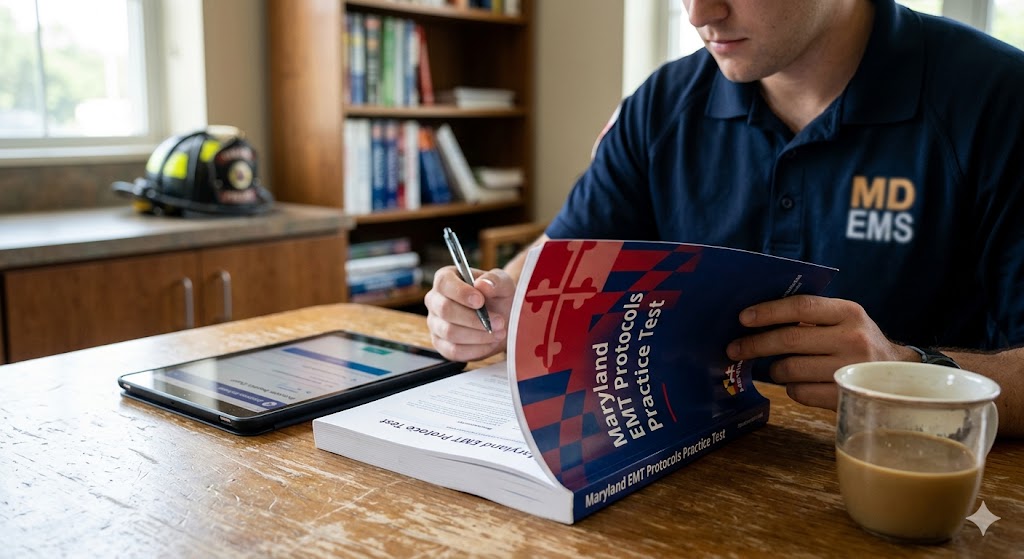
Additional Information
What to What the Course Entails and Exam Details
Preparing for the Maryland EMT Protocols involves a deep
dive into the official state medical guidelines.
The syllabus is comprehensively structured to cover adult
and pediatric patient care across a vast range of emergency situations.
Core topics include advanced airway management,
cardiovascular emergencies, trauma care, and medical emergencies such as
diabetic crises or allergic reactions.
Students will also master the specific pharmacology approved
for basic life support (BLS) providers in Maryland, learning exact dosages and
administration routes for medications like epinephrine, naloxone, and
albuterol.
FurthermoreExpect in the Final Exam
The final protocol exam is a rigorous evaluation designed to
test your critical thinking and memorization under pressure.
It typically consists of a multiple-choice format, heavily
featuring scenario-based questions that require you to apply protocol knowledge
to simulated patient encounters.
You can expect to face between 50 to 100 questions,
depending on the specific testing cohort and whether it is an initial or
refresher examination.
Test-takers are generally given a strict time limit of one
to two hours to complete the assessment.
To achieve a passing score, candidates must typically score
70% or higher, although aiming for an 80% ensures a comfortable margin of
safety.
Calculators and outside reference materials are strictly
prohibited, meaning memorization of critical flowcharts and medication dosages
is absolutely essential.
How to Study and
Exam Centers
Effective study strategies are the key to conquering the
Maryland EMT Protocols exam with confidence.
Start by thoroughly reading the latest edition of the
Maryland Medical Protocols for EMS Providers pocket guide, making sure to
highlight recent updates or changes in care standards.
Creating digital or physical flashcards for medication
dosages, vital sign parameters, and treatment algorithms is highly recommended
for active recall.
Additionally, taking timed practice exams is crucial, as it
helps build testing stamina and familiarizes you with the phrasing of
scenario-based questions.
When you are ready to take the official exam, it is
typically administered at authorized EMS training academies, community
colleges, or designated fire rescue training centers across Maryland.
For certain segments of state licensing and NREMT
certification, candidates may also be directed to schedule their computer-based
exams through local Pearson VUE testing centers.
Job Opportunities
from the Course
Successfully mastering the Maryland EMT Protocols and
securing your state certification unlocks a highly rewarding array of career
paths in the healthcare and public safety sectors.
The most direct career outcome is securing a position as a
911-response Emergency Medical Technician for county fire departments or
private ambulance services.
Many hospitals and medical centers actively hire certified
EMTs to work as Emergency Room Technicians, where they assist nurses and
doctors with triage, splinting, and acute patient care.
This certification also qualifies you for roles as an
Ambulance Driver or Transport Specialist, specializing in inter-facility
medical transports.
Furthermore, holding a valid Maryland EMT license is often a
mandatory prerequisite for advancing into roles like a Career Firefighter, a
911 Emergency Medical Dispatcher, or transitioning into a Paramedic training
program.
Frequently Asked Questions
Reviews
5.0
Based on 0 reviews
Leave a Review
No reviews yet. Be the first to review!