
Maryland Pesticide Applicator Category 3: Ornamental and Turf Practice Test
$69.00
- Buy to unlock unlimited access to all Quiz questions and Answers in this Quiz.
- After purchase you can print a PDF of the whole quiz at any point. The PDF will contain the questions and the correct answers.
About this Exam
The Maryland Pesticide Applicator Category 3: Ornamental and
Turf certification is designed for professionals who apply pesticides,
including herbicides, insecticides, and fungicides, to ornamental plants,
turfgrass, or both, in commercial settings across the state. This credential is
required by the Maryland Department of Agriculture (MDA) for anyone applying
restricted-use or general-use pesticides on properties they do not own, or as
an employee. This certification ensures that individuals have the necessary
knowledge and skills to manage pests effectively, protect the environment, and
comply with state laws and regulations in a crucial and visible green industry
sector.
Ready to test your knowledge?
Buy Now to Access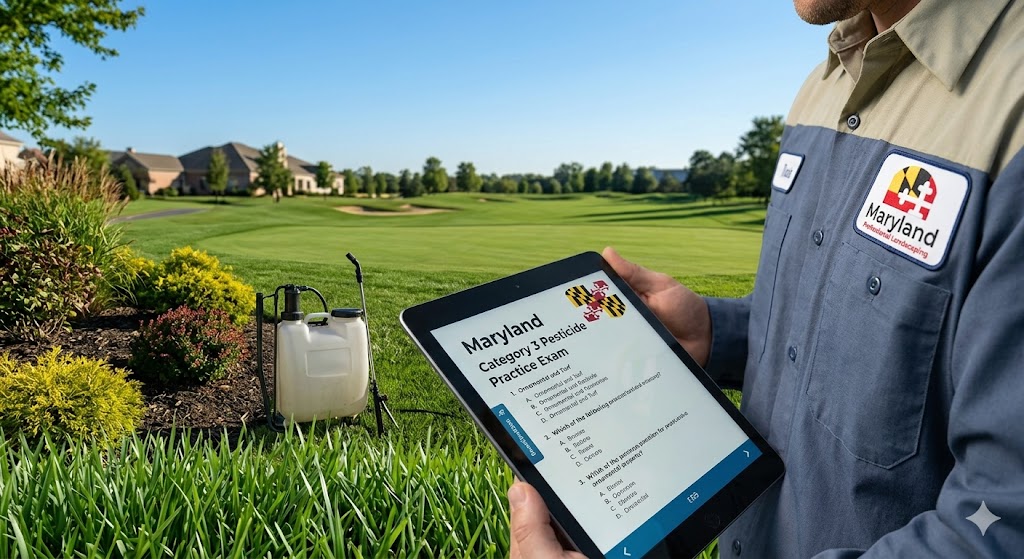
Additional Information
What the Course Entails and Exam Details
The study materials and subsequent exam cover a
comprehensive range of topics essential for the safe and effective application
of pesticides. Key areas include: a deep understanding of Maryland pesticide
laws and regulations; reading and interpreting pesticide labeling for safety
and legal compliance; identifying common ornamental and turf pests, such as
various weeds, insects, and plant diseases; understanding pest biology and
damage symptoms; knowledge of different types of pesticides and their modes of
action; utilizing integrated pest management (IPM) principles for
environmentally responsible control; safe pesticide handling, storage,
transportation, and disposal; understanding human and environmental hazards,
including groundwater protection and effects on non-target organisms; and
performing accurate calculations and proper pesticide application techniques,
including the use of various application equipment and calibration.
What to Expect in
the Final Exam
The final certification exam is a critical step in becoming
a certified applicator in Maryland. It is primarily presented in a
multiple-choice format, requiring candidates to select the single best answer
from several options. While the precise number of questions can vary slightly
per testing cycle, students should prepare for a substantial assessment,
typically featuring approximately 50 to 100 questions. A passing score of 70%
or higher is generally required. The exam is typically closed-book, and candidates
must complete it within a set time limit, often around 90 to 120 minutes. It is
essential to arrive early at the testing site and bring valid government-issued
identification.
How to Study and Exam Centers
Preparation is the cornerstone of success. Begin by
thoroughly studying the "Maryland Pesticide Applicator Core Manual"
and the specific "Category 3: Ornamental and Turf" study guide, both
available from the Maryland Department of Agriculture (MDA). Take the Maryland
Pesticide Applicator Category 3 Practice Test multiple times to familiarize
yourself with the question style and content. Review state pesticide laws and
regulations, pay close attention to pesticide label examples, and use
flashcards for key terms, pests, and concepts. The actual certification exam is
administered through the Maryland Department of Agriculture. Examinations are
held at the MDA headquarters in Annapolis, or at designated regional offices
throughout the state on specific dates. Online testing options or
computer-based testing at authorized locations might also be available;
candidates should always check the official MDA website for the most up-to-date
schedule and testing procedures, and to register for their preferred date.
Job Opportunities
from the Course
Earning the Maryland Category 3: Ornamental and Turf
certification unlocks significant career paths and advancement opportunities in
the green and service industries. It is often a primary requirement for
professionals in the following roles: certified pesticide applicator for
commercial landscaping companies, professional turf and lawn care technician,
greenskeeper or superintendent assistant at golf courses, grounds maintenance
manager for parks or commercial properties, industrial or institutional pest control
specialist, nursery or garden center professional, and landscape contractor.
This certification not only demonstrates technical competence but also shows a
commitment to legal and ethical pesticide use, making candidates highly
competitive and valuable in a wide array of service-oriented fields in
Maryland.
Frequently Asked Questions
Reviews
5.0
Based on 0 reviews
Leave a Review
No reviews yet. Be the first to review!