
Maryland Pool Operator Practice Test
$69.00
- Buy to unlock unlimited access to all Quiz questions and Answers in this Quiz.
- After purchase you can print a PDF of the whole quiz at any point. The PDF will contain the questions and the correct answers.
About this Exam
The Maryland Pool Operator certification is a vital
credential for individuals looking to manage and maintain public and
semi-public swimming pools and spas within the state. Designed for pool
managers, service technicians, and facilities management personnel, this
certification ensures operators possess the technical knowledge required to
keep aquatic facilities safe, clean, and in compliance with state health
regulations. Earning this license signifies a commitment to public safety and
proper water chemistry management, making it an essential requirement for many
aquatic facility roles throughout Maryland.
Ready to test your knowledge?
Buy Now to Access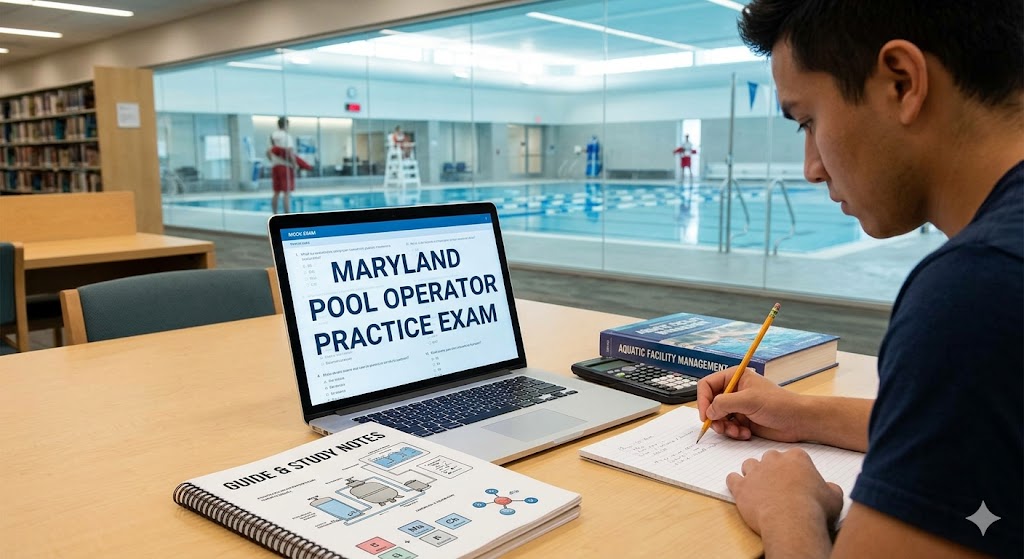
Additional Information
What the Course Entails and Exam Details
To prepare for the exam, candidates typically complete a
state-approved training course, such as the Certified Pool & Spa Operator
(CPO) program or a similar curriculum. This comprehensive syllabus covers
foundational aquatic facility management topics. You will dive deep into
essential areas including water circulation and filtration systems, human
health and safety protocols, and a heavy emphasis on water chemistry,
disinfection, and balancing. Expect to master the physics and math required to
calculate water volume, turnover rates, and precise chemical dosages to address
common water quality issues. The course also details local and state-specific
codes and regulatory standards that all Maryland pool operations must follow.
What to Expect in the Final Exam
The Maryland Pool Operator final exam is a structured
assessment of the knowledge gained during the training course. It typically
takes the form of a multiple-choice examination, which is often an open-book
and open-note test. The duration allows approximately three hours to complete
the section. A critical requirement for passing is demonstrating a proficiency
score, usually requiring a minimum of 74%, or successfully answering at least
37 out of 50 questions. Rules usually permit the use of a calculator for the
mathematical calculation portions. It is essential to ensure you are familiar
with all regulatory standards that might appear in the exam.
How to Study and Exam Centers
Preparation for success involves more than just attending
the class; it requires active study and strategic practice. Utilize this guide
as your study base, but supplement it by reviewing your training handbook,
highlighting critical formulae, and creating summary notes for quick reference
during the open-book exam. Dedicate time to practicing the water volume and
chemical adjustment calculations until you are confident in your methodology.
For the exam itself, you have several options depending on the course provider
you choose. Many authorized training schools throughout Maryland offer the
course and exam in a physical, instructor-led classroom setting. Online options
are also increasingly common, with the course delivered via a primer followed
by virtual classroom sessions and an online-proctored exam. For information on
local centers or state-approved online portals, consult the Maryland Recreation
and Parks Association or directly contact approved training providers.
Job Opportunities
from the Course
A certified Maryland Pool Operator license is highly sought
after by employers in the aquatics and hospitality industries, opening doors to
a variety of stable and rewarding career paths.
- Certified
Pool Operator
- Pool
Manager
- Aquatic
Facility Manager
- Swimming
Pool Service Technician
- Recreation
Supervisor
- Lifeguarding
and Facilities Coordinator
- Water
Park Operations Manager
- Maintenance
Site Supervisor
- Regional
Pool Operations Director
Frequently Asked Questions
Reviews
5.0
Based on 0 reviews
Leave a Review
No reviews yet. Be the first to review!