
Maryland Psychology Jurisprudence Practice Test
$69.00
- Buy to unlock unlimited access to all Quiz questions and Answers in this Quiz.
- After purchase you can print a PDF of the whole quiz at any point. The PDF will contain the questions and the correct answers.
About this Exam
The Maryland Psychology Jurisprudence Exam is a mandatory
hurdle for psychologists seeking licensure in the state.
This assessment is designed to verify that candidates
possess a comprehensive understanding of Maryland's laws, regulations, and
ethical standards that govern the practice of psychology.
Crucially, it is not an exam on psychological theory or
clinical skills; rather, it focuses strictly on the legal framework you will
operate within as a licensed psychologist in Maryland.
It is designed for individuals who have already met the
educational and supervised experience requirements and are in the final stages
of the licensure process.
By successfully navigating this exam, you demonstrate your
commitment to ethical practice and public safety within the state.
Ready to test your knowledge?
Buy Now to Access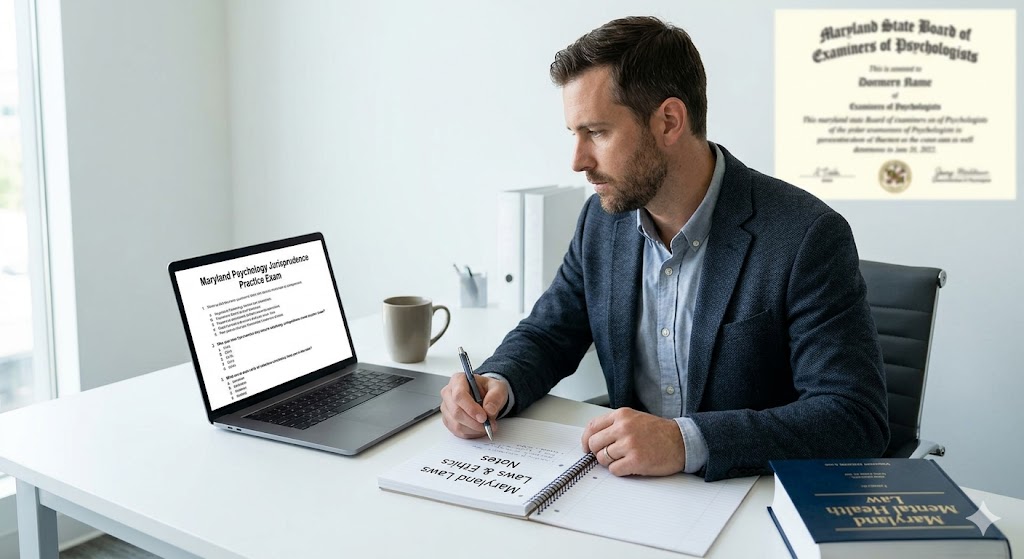
Additional Information
What the Course Entails and Exam Details
Preparing for the Maryland Psychology Jurisprudence Exam
involves a thorough study of several core legislative documents and regulatory
codes.
The key "syllabus" for this exam is defined by
Maryland's statutory and regulatory environment.
You must deeply understand the Maryland Psychology
Associates Act (Health Occupations Article, Title 18).
Additionally, candidates are tested on the Code of Maryland
Regulations (COMAR), specifically Title 10, Subtitle 36, which details Board
regulations and ethical guidelines.
Key topics covered include: scope of practice for
psychologists and psychology associates, licensing requirements, professional
conduct and ethical obligations, patient rights, confidentiality and exceptions
(like mandatory reporting), record-keeping standards, disciplinary procedures,
and the specific functions of the Maryland Board of Examiners of Psychologists.
Mastering these laws ensures you can navigate complex legal
situations in your practice.
What to Expect in the Final Exam
The Maryland Psychology Jurisprudence Exam is primarily
administered as a multiple-choice assessment.
It typically focuses on the application of the laws you have
studied, presenting scenarios and asking for the legally correct action
according to Maryland regulations.
The passing score is determined by the Board and may be
subject to adjustment, but candidates are generally required to achieve a high
level of proficiency, often around 75% or 80%, reflecting the critical
importance of understanding these laws.
A generous time limit is usually provided, such as 90 to 120
minutes, which is typically sufficient to carefully consider each scenario and
question.
Specific rules regarding the use of materials (sometimes it
is an open-book exam for certain resources) and testing environment are
detailed by the Board and must be followed precisely.
How to Study and
Exam Centers
Actionable study strategies are paramount for success on
this jurisprudence exam.
First and foremost, download official copies of the Maryland
Psychology Associates Act and COMAR regulations from the Maryland Board of
Examiners of Psychologists website.
Do not rely on third-party summaries; study the original
legal text carefully, taking detailed notes and creating flashcards for key
definitions, procedures, and timelines.
Utilize practice tests, like this Maryland Psychology
Jurisprudence Practice Exam, repeatedly to become familiar with the style
of question and the specific application of the law.
Pay close attention to nuances in the regulations, such as
reporting deadlines and exceptions to confidentiality.
The Maryland Psychology Jurisprudence Exam is generally
taken through secure online portals provided directly by the Board or via
authorized third-party testing services.
Always check the current official Board communications for
the precise location, registration process, and scheduling options.
Job Opportunities
from the Course
Passing the Maryland Psychology Jurisprudence Exam is the final
legal step to obtaining licensure, unlocking every career path for a
psychologist in the state.
It is not a course that provides new job skills, but rather
the essential key that activates your entire professional qualification.
Successfully completing this requirement directly enables
you to secure a wide range of job opportunities, including:
Licensed Psychologist in Private Practice
Clinical Psychologist in Hospitals and Healthcare Systems
Counseling Psychologist in Community Mental Health Centers
School Psychologist in Maryland K-12 Districts
Neuropsychologist in Specialized Clinics
Forensic Psychologist working with the Legal System
Academic Psychologist/Professor in Maryland Universities
Psychological Consultant for Organizations
Board-Certified Behavior Analyst (BCBA-D) with Psychology
Licensure
Health Service Psychologist (HSP)
Earning licensure transforms your potential into
professional reality.
Frequently Asked Questions
Reviews
5.0
Based on 0 reviews
Leave a Review
No reviews yet. Be the first to review!