
Massachusetts 3rd Class Engineer Practice Exam
$69.00
- Buy to unlock unlimited access to all Quiz questions and Answers in this Quiz.
- After purchase you can print a PDF of the whole quiz at any point. The PDF will contain the questions and the correct answers.
About this Exam
The Massachusetts 3rd Class Engineer license is a crucial
step for individuals aiming to establish a career in stationary engineering and
power plant operations within the Commonwealth.
This certification is designed for entry-level professionals
who will operate and maintain boilers, steam engines, turbines, and other
auxiliary equipment in facilities such as hospitals, industrial plants,
universities, and large commercial buildings.
Successfully passing this exam demonstrates your
foundational knowledge of safe operating procedures, thermodynamics, and state
regulations required to supervise high-pressure engineering systems under the
guidance of higher-class engineers.
It is a prerequisite for advancing to 2nd and 1st Class
Engineer licenses, making it an essential milestone for professional growth in
this field.
Ready to test your knowledge?
Buy Now to Access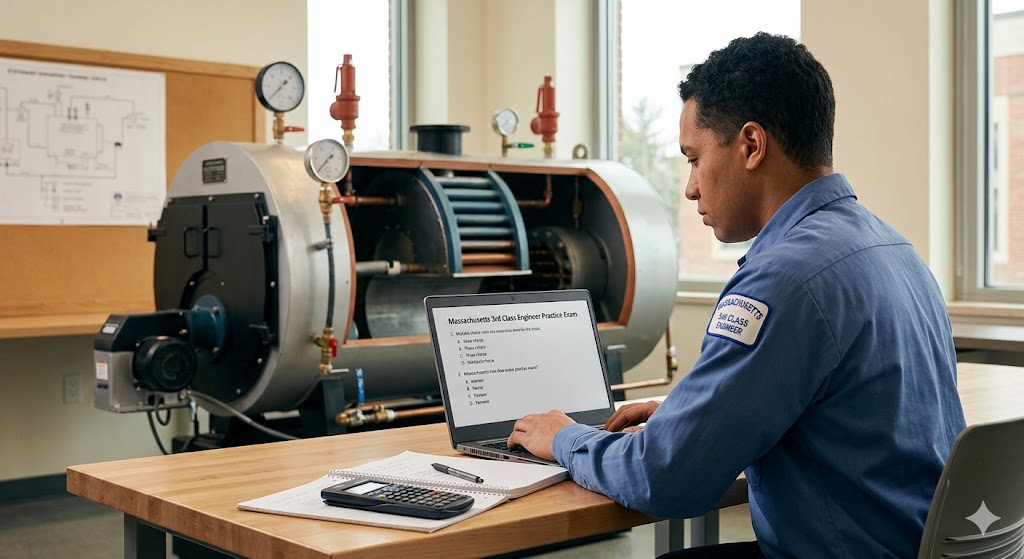
Additional Information
What the Course Entails and Exam Details
This study guide and practice exam cover the core competency
areas specified by the Massachusetts Department of Fire Services (DFS), Office
of the State Fire Marshal.
The syllabus primarily focuses on the theoretical knowledge
and practical applications necessary for the safe operation of stationary
equipment.
Key topics covered include basic mathematics and
thermodynamics relevant to steam generation.
You will need to demonstrate understanding of various boiler
types, their construction, and detailed operational procedures for startup,
normal operation, and shutdown.
Significant emphasis is placed on boiler safety, including
the operation of safety valves, water level controls, and combustion safety
systems.
Additionally, the exam covers auxiliary equipment such as
pumps, feedwater heaters, and turbines, as well as basic electricity and
refrigeration principles.
A critical component of your preparation must involve
studying the Massachusetts General Laws (MGL) Chapter 146 and the associated
regulations (522 CMR) governing power plant operation.
What to Expect in the Final Exam
The actual Massachusetts 3rd Class Engineer license exam is
a proctored assessment administered directly by the Massachusetts Department of
Fire Services.
It is a closed-book exam, and applicants are typically not
permitted to bring external reference materials into the testing area.
The exam format usually consists of multiple-choice
questions designed to test both theoretical understanding and practical
problem-solving skills based on operational scenarios.
Candidates can expect approximately 50 to 100 questions.
A minimum passing score of 70% is generally required to
qualify for licensure.
The time limit for completing the exam is strictly enforced,
typically ranging from two to four hours depending on the number of questions.
It is essential to arrive well before your scheduled time
slot, as late arrivals may not be admitted and could forfeit their application
fee.
How to Study and
Exam Centers
Preparation for the 3rd Class Engineer exam requires
diligent study and a mix of theoretical review and practical understanding.
Begin by thoroughly reviewing the Massachusetts regulations
(522 CMR) and MGL Chapter 146, as regulatory compliance is heavily stressed in
the exam.
Utilize standard industry textbooks on stationary
engineering, boiler operation, and thermodynamics, such as those recommended by
organizations like the American Technical Publishers (ATP).
Consistently taking practice exams, like this one, is one of
the most effective ways to identify knowledge gaps, familiarize yourself with
the question format, and improve your time management skills.
We recommend creating detailed study notes and flashcards
for key formulas, safety protocols, and regulatory requirements.
If possible, seeking mentorship from experienced 1st or 2nd
Class Engineers who are familiar with the Massachusetts licensing process can
provide invaluable practical insights.
Exam Centers: Unlike many national certifications,
the Massachusetts licensing exams are not administered through third-party
providers like Pearson VUE.
You must schedule and take the exam at a designated
Massachusetts Department of Fire Services (DFS) facility.
The primary examination location is typically the DFS
headquarters in Milford, Massachusetts.
DFS occasionally offers exams at alternate state facilities,
so always confirm the location specified on your officially scheduled
examination notification.
Applicants must register in advance through the DFS Office
of Public Safety and Inspections (OPSI) by submitting the appropriate
application and licensure fee.
Job Opportunities
from the Course
Successfully obtaining your Massachusetts 3rd Class Engineer
license opens the door to numerous vital roles in facility operations and
maintenance across the state. This license is mandatory for legally operating
high-pressure boilers and associated systems in Massachusetts. Candidates who
earn this certification qualify for positions such as:
- Stationary
Engineer
- Power
Plant Operator
- Boiler
Operator
- Facilities
Maintenance Engineer
- Building
Engineer
- Operations
Engineer
- Energy
Plant Technician
Frequently Asked Questions
Reviews
5.0
Based on 0 reviews
Leave a Review
No reviews yet. Be the first to review!