
Massachusetts 4G Hoisting License Practice Exam
$69.00
- Buy to unlock unlimited access to all Quiz questions and Answers in this Quiz.
- After purchase you can print a PDF of the whole quiz at any point. The PDF will contain the questions and the correct answers.
About this Exam
The Massachusetts 4G Hoisting License Practice Exam is your essential preparation tool for achieving the restricted hoisting license required to operate specific excavation and general-purpose machinery within the Commonwealth. A 4G license is critical for individuals who need to operate machines like excavators, loaders, and backhoes, but without the dynamic high-lift capabilities of larger, unrestricted cranes.
This exam preparation resource is designed for equipment operators, construction laborers, municipal workers, and landscaping professionals who must validate their competence and safety knowledge before they can legally operate this equipment on Massachusetts jobsites. This practice exam focuses specifically on the knowledge gaps unique to 4G restrictions, ensuring you don't over-prepare for content outside your license scope while mastering the safety, regulations, and operational specifics that the state requires.
Ready to test your knowledge?
Buy Now to Access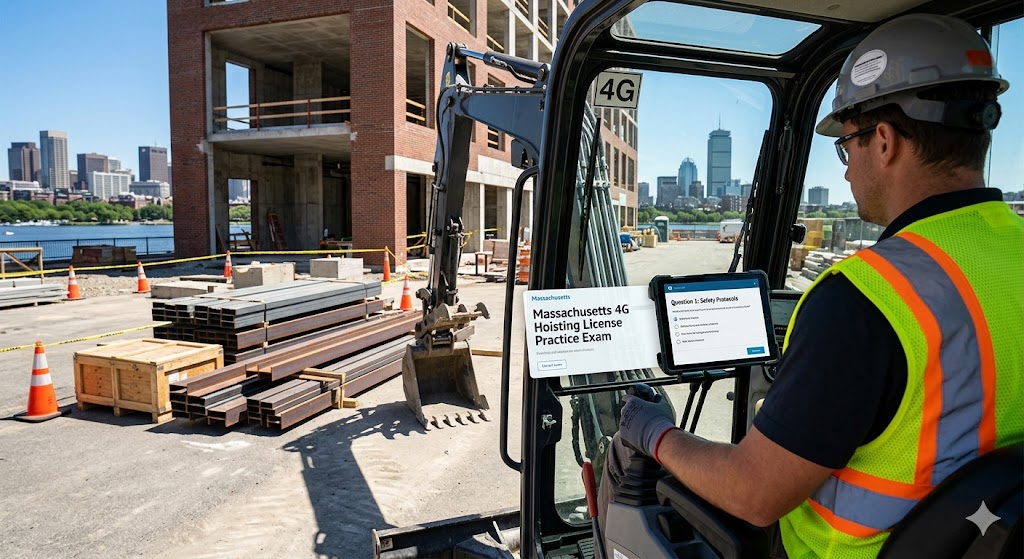
Additional Information
What the Course Entails and Exam Details
This comprehensive study guide prepares candidates to
demonstrate proficiency across several core domains crucial to the safe and
legal operation of restricted 4G machinery. The curriculum aligns with the
material tested by the Massachusetts Department of Public Safety (DPS) and
focuses on practical application rather than high-lift crane dynamics.
- Massachusetts
Hoisting Regulations (CMR 520 6.00): Comprehensive review of state
laws governing hoisting licenses, operator responsibilities, licensing
tiers, and regulatory compliance.
- Safety
Standards (OSHA 1926 Subpart CC & ANSI): Detailed understanding of
Occupational Safety and Health Administration (OSHA) regulations and
American National Standards Institute (ANSI) guidelines relevant to
excavation and standard material handling machinery, including proper
signaling.
- General
Machinery Operations: Focus on the safe and efficient operation of 4G
equipment, including pre-operation inspections, load charts, stability
triangles, soil classification, trenching safety, and backfilling.
- Restriction-Specific
Knowledge: Specific emphasis on understanding the 4G restriction
scope—why you cannot use this machinery for dynamic high-lifts or
personnel lifting, and how to identify forbidden configurations.
- Maintenance
and Inspection: Procedures for routine maintenance and state-mandated
inspections to ensure equipment integrity.
What to Expect in the Final Exam
While our practice exam provides an excellent
simulation, the official final licensing exam is administered directly by the
Massachusetts Department of Public Safety (DPS). It is a rigorous,
computer-based test designed to confirm you possess the requisite knowledge to
operate heavy machinery safely.
The actual 4G licensing exam is typically composed of 50
multiple-choice questions. Candidates are given a maximum time limit of
90 minutes to complete the assessment. To pass and receive your license,
you must achieve a minimum passing score of 70%. The questions vary in
difficulty and cover the regulatory framework, equipment safety, and
restriction limitations. The DPS maintains specific testing rules, which
strictly prohibit outside resources, communication, or reference materials
during the examination. Passing this exam qualifies you to hold the restricted
4G Hoisting License in Massachusetts.
How to Study and
Exam Centers
Preparation is paramount, and a structured study plan is
essential for passing the 4G exam on your first attempt. Utilize our Massachusetts
4G Hoisting License Practice Exam multiple times. Focus not just on
selecting the correct answers, but on reading the detailed explanations
provided for both correct and incorrect choices. This deepens your
understanding of the regulations and safety principles.
Additionally, obtain and carefully review the official
Massachusetts Hoisting License study materials provided by the DPS. Pay close
attention to the specific wording of CMR 520 6.00 and OSHA construction safety
standards. Create digital or physical flashcards for complex regulations or
equipment load definitions. Join online forums where operators discuss
real-world scenarios that often mirror exam questions. Practice these
techniques until you consistently achieve 90% or higher on practice assessments
under timed conditions.
The final licensing exam cannot be taken online; it must be
completed at a designated state testing center. When you are fully prepared,
you must apply to the Massachusetts Department of Public Safety to schedule
your examination. The DPS provides a list of approved examination sites across
the Commonwealth. These are often dedicated testing facilities or authorized
educational institutions equipped to deliver computer-based assessments in a
controlled environment.
Job Opportunities
from the Course
A Massachusetts 4G Hoisting License significantly enhances
your employability and earning potential within the thriving Massachusetts
construction and utility sectors. It demonstrates that you possess a verified
level of safety and competence recognized by the state. Holding this restricted
license opens doors to a variety of essential operational roles, allowing you
to advance from general labor to skilled machine operation.
Career paths that require or strongly prefer this
certification include:
- Heavy
Equipment Operator (Restricted to 4G machinery like excavators and
loaders)
- Backhoe/Excavator
Operator
- Trenching
and Excavation Specialist
- Construction
Site Laborer (Qualified for specific machine tasks)
- Landscaping
Equipment Operator
- Municipal
Public Works Operator
- Underground
Utility Installation Technician
Frequently Asked Questions
Reviews
5.0
Based on 0 reviews
Leave a Review
No reviews yet. Be the first to review!