
Massachusetts Certified Peer Specialist (CPS) Practice Exam
$69.00
- Buy to unlock unlimited access to all Quiz questions and Answers in this Quiz.
- After purchase you can print a PDF of the whole quiz at any point. The PDF will contain the questions and the correct answers.
About this Exam
The Massachusetts Certified Peer Specialist (CPS)
certification is a vital credential that honors individuals with lived
experience of mental health conditions or traumatic distress. It is designed
for those who have reached a significant stage in their own recovery and wish
to leverage that unique wisdom and understanding to support others navigating
similar pathways. This certification formalizes their role within the mental
health workforce, empowering them to provide hope, mutual support, and advocacy
as equals rather than clinicians. If you are passionate about helping peers
thrive by sharing your story of resilience and community integration, this path
is for you.
Ready to test your knowledge?
Buy Now to Access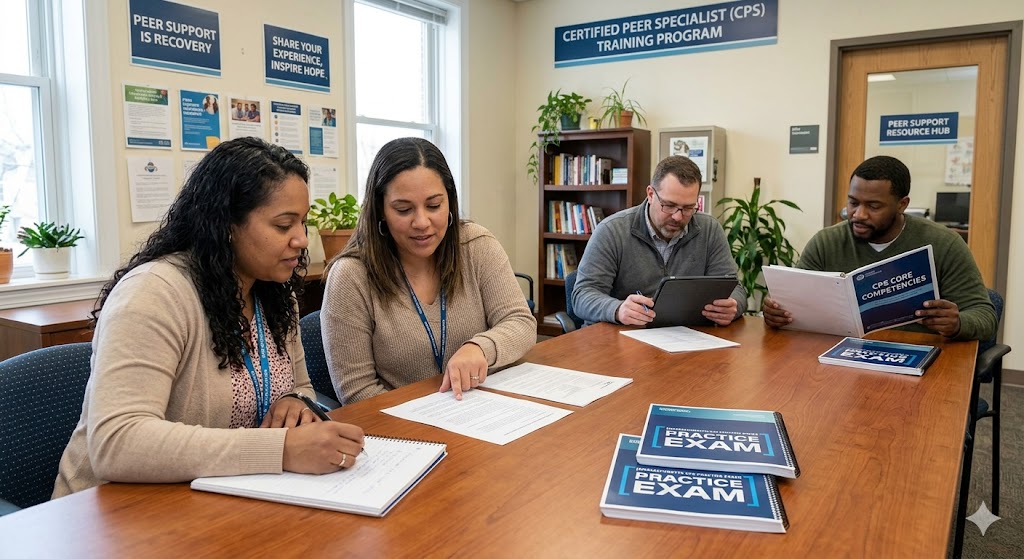
Additional Information
What the Course
Entails and Exam Details
Achieving CPS certification in Massachusetts begins with
completion of an Department of Mental Health (DMH)-approved training program.
This core curriculum—often 60 to 75 hours—covers the essential knowledge
required to practice ethically and effectively. The coursework emphasizes key
domains: recovery philosophy, active listening, story telling for advocacy,
trauma-informed care principles, cultural responsiveness, group facilitation,
boundaries and ethics, and navigating wellness and management strategies. The
comprehensive training is designed to build the skills you will need both in
the workforce and for the final certification exam.
What to Expect in the Final Exam
Following successful completion of the training program, you
must pass the final Massachusetts CPS certification exam. The exam is typically
a structured written assessment, administered in a multiple-choice and
scenario-based format. This requires you to apply the core concepts and ethical
frameworks you learned during training to real-world situations, showing your
ability to respond supportively, ethically, and non-clinically. While exact
passing scores and time limits can vary by approved testing entity (e.g., Kiva
Center, Transformation Center), you should expect a test lasting 2 to 3 hours,
with a minimum passing requirement usually set between 70% and 80%.
How to Study and
Exam Centers
Effective preparation is key to your success on the CPS
exam. Start by thoroughly reviewing your official training manuals and course
materials; these are the foundation of all test questions. Form a study group
with your fellow trainees to discuss challenging topics and practice scenario
analysis, emphasizing how to use the CPS Core Competencies in different
interactions. Engage with practice questions provided during your training, and
prioritize understanding 'why' an answer is correct based on peer support
philosophy rather than clinical diagnosis. For the final exam,
logistics—including scheduling, specific online portals, or physical testing
locations—are generally managed through the authorized organizations that
provide the MA CPS training.
Job Opportunities
from the Course
Earning your Certified Peer Specialist designation unlocks a
growing array of rewarding career opportunities within the Massachusetts
behavioral healthcare landscape. You will find positions in community clinics,
hospital emergency departments, mobile crisis teams, and peer-run respites.
While this certification does not require a college degree, it allows you to
fill roles that bill Medicaid for peer support services. Some typical job
titles include:
- Certified
Peer Specialist (CPS)
- Peer
Support Specialist
- Recovery
Coach
- Community
Health Worker (Peer Specialist focused)
- Advocate
(in Peer Respite settings)
- Peer
Recovery Ambassador
- Peer
Support Coordinator (Must be a CPS)
- Crisis
Center Staff
Frequently Asked Questions
Reviews
5.0
Based on 0 reviews
Leave a Review
No reviews yet. Be the first to review!