
Massachusetts Comprehensive Assessment System (MCAS) Biology Practice Test
$69.00
- Buy to unlock unlimited access to all Quiz questions and Answers in this Quiz.
- After purchase you can print a PDF of the whole quiz at any point. The PDF will contain the questions and the correct answers.
About this Exam
The Massachusetts Comprehensive Assessment System (MCAS) Biology Practice Test is an essential study tool designed for Massachusetts high school students preparing for the mandatory MCAS Biology exam. This state-mandated assessment evaluates students' proficiency in fundamental biological concepts, ensuring they meet the graduation requirement for science and technology. This comprehensive practice test mirrors the structure, question types, and rigor of the official MCAS, offering an invaluable opportunity for students to familiarize themselves with the exam format, gauge their current knowledge, and build the confidence necessary to excel. It is designed to support educators, parents, and students in targeting areas for improvement, ensuring a pathway toward successful academic achievement and graduation.
Ready to test your knowledge?
Buy Now to Access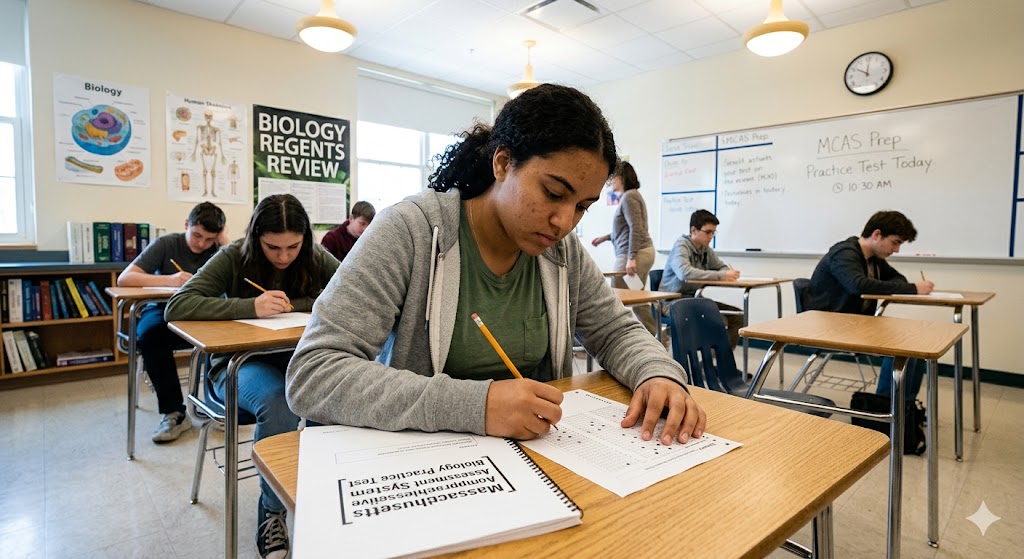
Additional Information
What the Course Entails and Exam Details
The underlying course for the MCAS Biology Practice Test
encompasses the detailed high school biology curriculum defined by the
Massachusetts Science and Technology/Engineering Curriculum Framework. The core
topics covered are extensive and critical for a foundational understanding of
the life sciences. Students must demonstrate competency in key areas, including
Molecules to Organisms: Structures and Processes (covering cell biology,
biochemistry, and human anatomy/physiology), Ecosystems: Interactions, Energy,
and Dynamics (encompassing ecology, population dynamics, and environmental
science), Heredity: Inheritance and Variation of Traits (focusing on genetics,
DNA, and reproduction), and Biological Evolution: Unity and Diversity
(including natural selection, adaptation, and evidence for evolution). This
comprehensive practice test ensures that all these essential domains are
addressed, reflecting the multi-faceted nature of the MCAS Biology curriculum.
What to Expect in the Final Exam
The final MCAS Biology exam is typically administered via a
computer-based platform, though paper-based options are available under certain
circumstances. It consists of multiple-choice questions, which evaluate
students’ recall and application of knowledge, and constructed-response
questions, requiring students to synthesize information and write detailed
explanations or analyze data. There are generally around 40 to 45
multiple-choice questions and a small number (usually four) of
constructed-response questions across two test sessions. Students are typically
allotted approximately 60 minutes per session to complete the test, although
actual time may vary slightly, and testing accommodations are provided for
eligible students. To pass the MCAS Biology exam and meet the state graduation
requirement, students must achieve a minimum threshold score, which is
determined by the Massachusetts Department of Elementary and Secondary
Education (DESE). Strict rules regarding cell phones and unauthorized electronic
devices are enforced during the actual test administration.
How to Study and Exam Centers
To optimize performance, students should utilize the
Massachusetts Comprehensive Assessment System (MCAS) Biology Practice Test
effectively. The recommended study strategy involves first taking the
full-length practice test under timed conditions to simulate the actual exam
experience. After completing the test, students must diligently review both
correct and incorrect answers using the provided answer key and explanatory
guides to identify specific content gaps. Remedial study can then be focused on
weak areas using class notes, biology textbooks, online tutorials, and other
educational resources provided by DESE. Students should also practice answering
constructed-response questions, focusing on clear explanations and
evidence-based reasoning. The official MCAS Biology exam is administered at
students' respective high schools in Massachusetts during designated testing
windows, typically in the spring. Online practice portals are provided by the
state to help students prepare, but the actual certified test must be completed
in a controlled school environment. Pearson VUE centers do not administer the
high school MCAS exams.
Job Opportunities from the Course
While the MCAS Biology exam is a critical graduation
milestone rather than a direct professional certification, achieving success in
this assessment and the foundational science course it represents is the first
essential step toward numerous rewarding career paths in the biological and
life sciences. The strong conceptual understanding validated by this exam
unlocks access to higher education programs in prestigious Massachusetts
colleges and universities, which leads to job opportunities in diverse fields.
Specific job titles and career paths this foundational
knowledge unlocks include:
- Registered
Nurse
- Biology
Teacher
- Medical
Laboratory Technician
- Wildlife
Biologist
- Biomedical
Engineer
- Biotechnologist
- Pharmaceutical
Sales Representative
- Physical
Therapist
- Physician
Assistant
- Veterinarian
- Environmental
Scientist
- Marine
Biologist
- Clinical
Research Coordinator
Frequently Asked Questions
Reviews
5.0
Based on 0 reviews
Leave a Review
No reviews yet. Be the first to review!