
Massachusetts Gun Laws & Firearms Safety Practice Exam
$69.00
- Buy to unlock unlimited access to all Quiz questions and Answers in this Quiz.
- After purchase you can print a PDF of the whole quiz at any point. The PDF will contain the questions and the correct answers.
About this Exam
Navigating the landscape of firearms ownership in
Massachusetts starts with a foundation of legal knowledge and safety training.
The Massachusetts Gun Laws & Firearms Safety Practice Exam is an essential
tool designed to prepare aspiring gun owners for the state’s mandatory
licensing requirements. This comprehensive study resource is specifically
tailored for Massachusetts residents seeking to obtain their LTC (License to
Carry) or FID (Firearms Identification) card, focusing on key safety principles
and the specific statutes of Commonwealth law. By utilizing this practice exam,
students can confidently assess their understanding of safe handling practices,
storage requirements, and the complex legal framework governing firearm
possession, transit, and use. It provides a robust, risk-free environment to
reinforce critical knowledge before undertaking the official state-approved
course and examination.
Ready to test your knowledge?
Buy Now to Access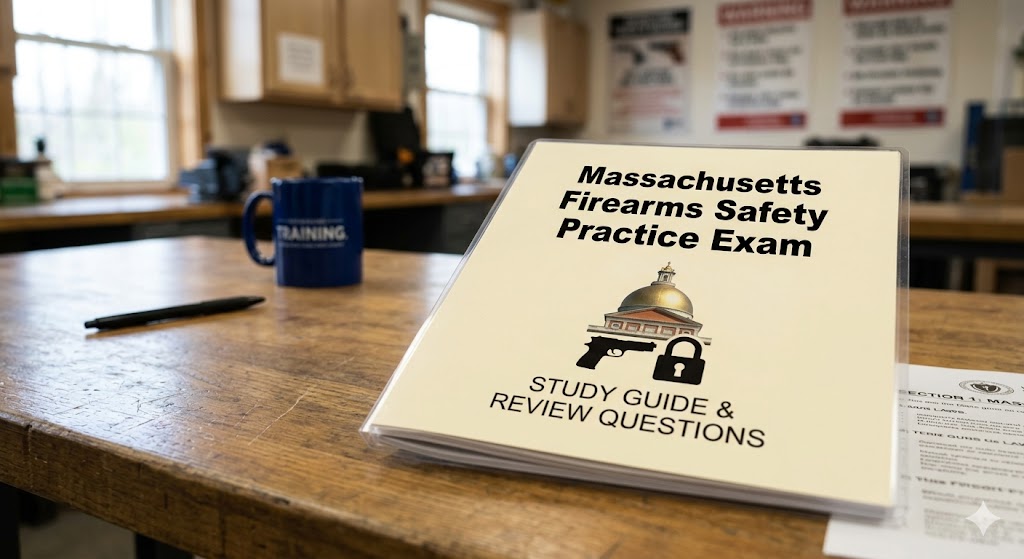
Additional Information
the Course Entails and Exam Details
This practice exam covers the essential curriculum of the
mandatory Massachusetts Basic Firearms Safety Course. Core topics emphasize the
fundamentals of safe gun handling, including the absolute rules of safety:
treat every firearm as if it is loaded, never point the muzzle at anything you
are not willing to destroy, keep your finger off the trigger until your sights
are on the target, and be sure of your target and what is beyond it. The
syllabus also details the mechanical operations of various firearm types, such
as pistols, revolvers, rifles, and shotguns, alongside maintenance procedures
and ammunition types. Crucially, a significant portion of the course and
subsequent questions focus entirely on Massachusetts-specific statutes. This
includes understanding state laws on firearm storage (e.g., locking devices and
gun safes), transportation, restricted areas, universal background checks, and
the legal definition of various firearms and large-capacity feeding devices.
What to Expect in the Final Exam
While individual authorized instructors may vary slightly,
the final exam for the Massachusetts Basic Firearms Safety Course typically
consists of 20 to 25 multiple-choice questions. A passing score is generally
set high, often requiring an 80% to 90% correct answer rate, reflecting the
serious nature of the subject matter. There is often no strict time limit
imposed, as the goal is to ensure mastery of the material rather than speed.
The primary focus is assessing your comprehension of the core safety rules and
crucial Massachusetts firearms laws rather than practical shooting skills,
which are usually evaluated during the live-fire component of the course. It is
a closed-book examination, emphasizing the retention of critical safety
protocols and legal definitions.
How to Study and
Exam Centers
Preparation is the cornerstone of success for both this
practice exam and the required certification. Students should begin by
thoroughly studying the official Massachusetts State Police basic firearms
safety curricula or equivalent materials provided by their instructor. Utilize
this Massachusetts Gun Laws & Firearms Safety Practice Exam repeatedly;
identify areas where you struggle and revisit the specific legal text or safety
principle associated with those questions. Creating digital flashcards for legal
definitions and the fundamental safety rules can reinforce memory retention.
The official exam and required safety course cannot be taken online; they must
be completed through a state-approved instructor or organization. Authorized
providers include certified National Rifle Association (NRA) instructors and
municipal police departments. Once you have completed the required course and
passed the official exam, the instructor will issue you a safety certificate,
which is a prerequisite for your LTC or FID application submitted through your
local police department.
Job Opportunities from the Course
Obtaining a Massachusetts License to Carry (LTC) or FID
card, which begins with passing this certification, is a vital credential for
several careers in public safety and private security within the Commonwealth.
Many municipal police departments require an LTC for potential recruits during
the hiring process. Furthermore, armed private security positions, protecting
armored vehicles, high-value assets, or executive personnel, strictly demand
that candidates hold a valid LTC. Opportunities are also available as a
state-certified Firearms Instructor, allowing you to teach the very safety
courses that are prerequisites for licensing. This certification also opens
doors for roles in environmental police and some specialized conservation
positions. Beyond professional utility, it is indispensable for any individual
working in firearms retail or gunsmithing.
Frequently Asked Questions
Reviews
5.0
Based on 0 reviews
Leave a Review
No reviews yet. Be the first to review!