
Massachusetts Hoisting License Practice Test
$69.00
- Buy to unlock unlimited access to all Quiz questions and Answers in this Quiz.
- After purchase you can print a PDF of the whole quiz at any point. The PDF will contain the questions and the correct answers.
About this Exam
The Massachusetts Hoisting License is a mandatory
certification required by the Commonwealth for any individual operating
hoisting machinery, such as excavators, cranes, backhoes, and forklifts, that
can lift more than 500 pounds or reach higher than 10 feet. Managed by the
Massachusetts Division of Occupational Licensure (DOL), this license is
designed to ensure that operators possess the technical knowledge and safety
awareness necessary to prevent accidents on busy construction sites and
industrial locations. This certification is essential for heavy equipment
operators, construction laborers, and municipal workers who want to operate
machinery legally within the state. Successfully acquiring this license proves
to employers that you are a serious professional dedicated to upholding
rigorous state safety standards and general laws.
Ready to test your knowledge?
Buy Now to Access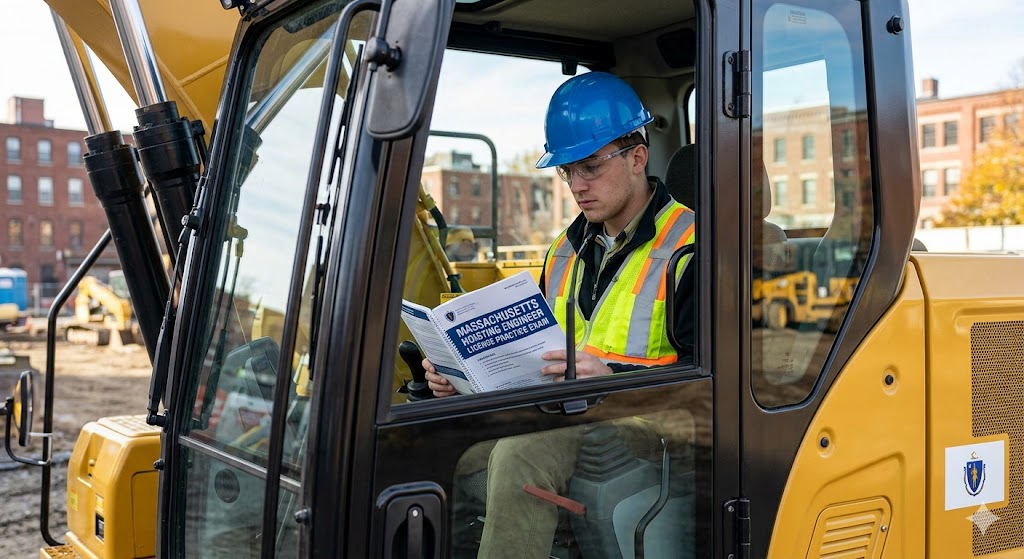
Additional Information
What the Course Entails and Exam Details
Preparing for the Massachusetts Hoisting License exam
involves deeply understanding both the general regulations and machine-specific
operations. The course syllabus typically covers the Massachusetts General Laws
(MGL) Chapter 146 and the associated regulations in 520 CMR 6.00, which dictate
licensing requirements, operator conduct, and safety protocols. Students must
learn comprehensive OSHA safety regulations, including 1926 subparts regarding
excavation, trenching, and crane safety. Additionally, materials will detail
proper rigging procedures, load chart interpretation, inspection practices, and
essential signaling methods for communication with ground crews. Beyond
regulatory knowledge, study materials address foundational machine principles,
soil mechanics, and understanding environmental hazards like overhead power
lines.
What to Expect in the Final Exam
The actual Massachusetts Hoisting License final exam is a
state-administered, proctored test that is typically composed entirely of
multiple-choice questions. It is important to note that Massachusetts currently
administers a written test, not a practical hands-on evaluation, so mastering
the written material is paramount. Candidates need to achieve a passing score
of at least 70% to receive their license, though maintaining a safety-focused
mindset might help you score even higher. While specific time limits are
enforced and vary slightly based on the restriction grade being applied for,
students are generally allotted sufficient time to read through and carefully
answer each regulatory and technical question.
How to Study and
Exam Centers
Actionable study strategies are key to passing on your first
attempt, and the most effective method is repeated engagement with a
specialized Massachusetts Hoisting License Practice Test. We highly recommend
using online simulators that offer practice questions formatted similarly to
the state exam, focusing particularly on state laws, definitions, and safety
distances, as these are frequent testing points. Review the official state
study materials and regulations thoroughly before attempting practice quizzes
to build a baseline knowledge. Unlike some certifications offered via remote
proctoring, the official licensing exam must be taken in person at a specific
state testing facility designated by the Department of Public Safety (DPS).
Once you apply through the state portal and satisfy prerequisites like a
medical examiner’s certificate, you will receive a date and location at one of
the approved regional examination sites throughout Massachusetts.
Job Opportunities
from the Course
A Massachusetts Hoisting License is often the defining
factor that transitions a worker from a general laborer to a skilled,
high-demand equipment operator. This certification is crucial for construction
companies, landscaping outfits, and utility providers who are under strict
legal obligation to hire only licensed operators. Securing this license can
unlock immediate employment opportunities in a wide variety of roles. These
positions often offer significantly higher pay and stronger job security due to
the specialized nature of the skill required. Potential career paths and job
titles for license holders include:
Construction Heavy Equipment Operator
Excavator Operator
Crane Operator
Rigging Specialist
Forklift Driver (for specific industrial categories)
Site Foreman or Supervisor
Municipal Public Works (DPW) Operator
Frequently Asked Questions
Reviews
5.0
Based on 0 reviews
Leave a Review
No reviews yet. Be the first to review!