
Massachusetts Multistate Pharmacy Jurisprudence Examination (MPJE) Practice Exam
$69.00
- Buy to unlock unlimited access to all Quiz questions and Answers in this Quiz.
- After purchase you can print a PDF of the whole quiz at any point. The PDF will contain the questions and the correct answers.
About this Exam
The Massachusetts Multistate Pharmacy Jurisprudence Examination (MPJE) is a rigorous, state-specific examination designed to assess a candidate's knowledge of the laws and regulations governing the practice of pharmacy.
Ready to test your knowledge?
Buy Now to Access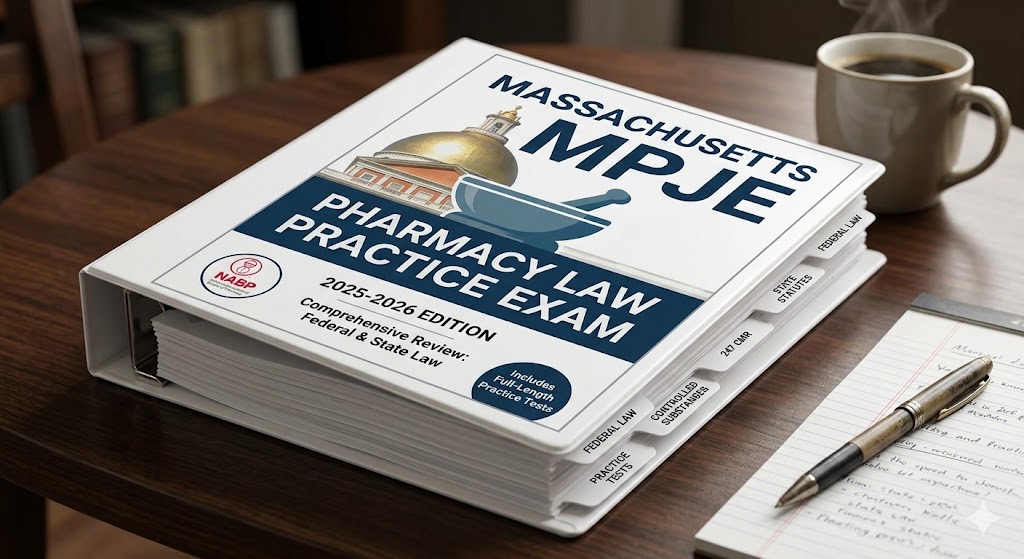
Additional Information
What the Course Entails and Exam Details
This examination does not have a formal "course,"
but rather, candidates must undertake a comprehensive self-study of the
specified legal areas. The MPJE blueprint, provided by NABP, outlines the
competency statements that the exam covers. These are organized into four major
domains, which include: Pharmacy and Pharmacist Practice (approximately 30%),
including licensure, scope of practice, and collaborative practice agreements;
the Medication Use Process (approximately 30%), covering prescribing, dispensing,
and counseling requirements for controlled and non-controlled substances;
Regulatory Authority and Legal Obligations (approximately 20%), which focuses
on the roles of the Board of Pharmacy, inspections, and discipline; and
Pharmacy Operations (approximately 20%), addressing requirements for physical
pharmacy facilities, record-keeping, and the security of patient information.
For Massachusetts, a specific focus is placed on common state-specific law
aspects, such as the distinct duties of pharmacy technicians, regulations for
nuclear and sterile compounding, and the strict biennial renewal of
collaborative practice agreements.
What to Expect in
the Final Exam
The final Massachusetts MPJE is a computer-adaptive test,
meaning the difficulty of the questions adjusts based on the candidate's
previous answers. The exam consists of 120 multiple-choice questions, of which
only 100 are scored; the remaining 20 are pretest questions used for future
exam development and do not affect the final result. Candidates have a strict
time limit of 2.5 hours to complete the examination. As a computerized adaptive
test, candidates must answer each question as it is presented and cannot skip
questions, change answers, or go back to previous sections. A critical point
for candidates is that skipping or not completing at least 107 questions will
result in no score being reported. The exam is scored on a Pass/Fail basis,
with the standard for passing determined by a panel of pharmacy experts.
How to Study and Exam Centers
Effective preparation for the Massachusetts MPJE requires a
strategic and dedicated study plan. A foundational step is to thoroughly review
the standard MPJE Competency Statements provided on the NABP website.
Candidates should prioritize studying the official, current versions of both
federal law (such as the Controlled Substances Act and DEA Pharmacist’s Manual)
and Massachusetts-specific legal sources. Primary resources for state law
include the 247 CMR (Code of Massachusetts Regulations), which is the principal
regulation set by the Massachusetts Board of Registration in Pharmacy, along
with the relevant chapters of the Massachusetts General Laws (MGL) and the
Board's published circular letters and joint policy guidelines. Practicing with
sample items and taking the Pre-MPJE, the official practice exam from NABP, is
highly recommended to understand the adaptive nature and formatting of the
examination. The final, official examination is administered only through
authorized Pearson VUE testing centers throughout the United States and its
territories, and candidates must first receive an Authorization to Test (ATT)
from NABP after registering with the state board.
Job Opportunities
from the Course
Successfully passing the Massachusetts MPJE is the final
regulatory hurdle to achieving pharmacist licensure in the state. Securing this
license opens a wide array of career opportunities within the pharmaceutical
and healthcare sectors in the Commonwealth.
- Licensed
Pharmacist (Retail/Community Pharmacy)
- Hospital
Pharmacist (Inpatient and Outpatient Services)
- Pharmacy
Manager of Record (PIC)
- Clinical
Pharmacist Specialist (e.g., Oncology, Infectious Disease)
- Long-Term
Care Pharmacist
- Nuclear
Pharmacist
- Compounding
Pharmacist (Sterile and Non-sterile)
- Regulatory
Affairs Specialist (Pharmaceutical Industry)
- Managed
Care Pharmacist (Insurance/PBM)
Academic Pharmacist (Teaching and Research
Frequently Asked Questions
Reviews
5.0
Based on 0 reviews
Leave a Review
No reviews yet. Be the first to review!