
Massachusetts Specimen Collection and Processing Practice Test
$69.00
- Buy to unlock unlimited access to all Quiz questions and Answers in this Quiz.
- After purchase you can print a PDF of the whole quiz at any point. The PDF will contain the questions and the correct answers.
About this Exam
This comprehensive study guide is designed to empower you for the important responsibilities of specimen collection and processing within the healthcare sector. It is specifically tailored for aspiring Phlebotomists, Clinical Laboratory Assistants, and other medical professionals in Massachusetts looking to excel in their field and gain recognized certification. This guide points you toward a highly effective practice resource that simulates key knowledge and procedures required by national and state standard certifications. By utilizing this resource, you ensure you are well-equipped with the skills needed to handle patient specimens safely, accurately, and professionally within the Massachusetts healthcare system. It is designed to build your confidence and readiness for your official final examination and your future rewarding career in medicine.
Ready to test your knowledge?
Buy Now to Access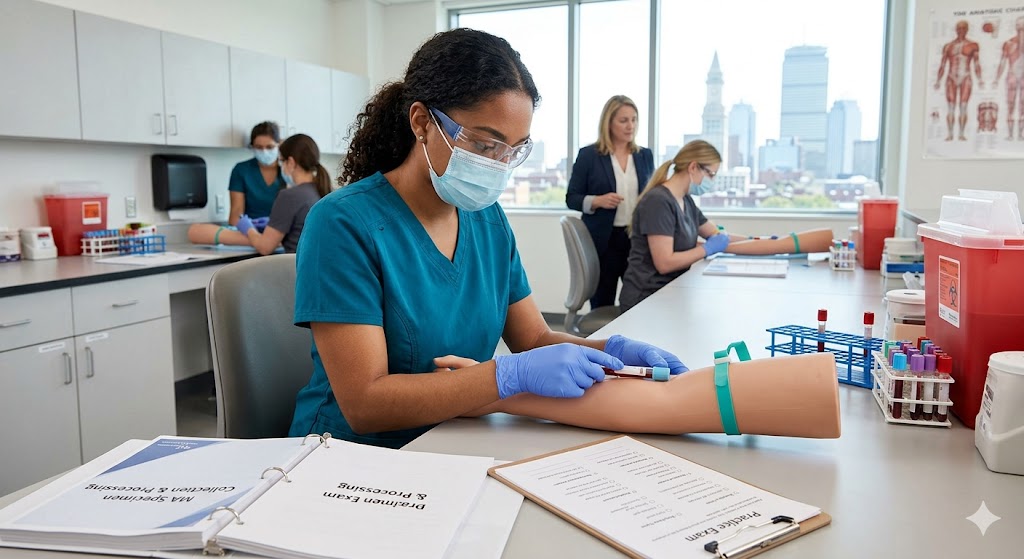
Additional Information
What the Course Entails and Exam Details
The core subject areas covered in a typical course or
certification program, and simulated by high-quality practice tests, include
several critical domains. You must master patient identification and
preparation, which involves strict protocols for accurate patient matching,
obtaining informed consent, and guiding patients on preparation requirements
such as fasting. Blood collection techniques are central to the role, requiring
comprehensive training in venipuncture and capillary sticks, including equipment
selection, proper technique, and preventing complications. Beyond blood, you
will learn procedures and guidelines for non-blood specimen collection, such as
urine, sputum, fecal matter, semen, and other body fluids. Critical knowledge
regarding specimen labeling, handling, and transport ensures proper labeling
immediately after collection, correct specimen handling regarding temperature
or light sensitivity, and efficient transport to the laboratory. Adherence to
safety protocols and infection control is mandatory, including Universal
Precautions, OSHA standards, proper disposal of biohazards, and the use of
personal protective equipment (PPE). You will also gain an understanding of
quality control and compliance, including standard operating procedures (SOPs),
regulatory guidelines like CLIA and HIPAA, and quality assurance practices to
maintain specimen integrity and patient confidentiality. Finally, you will
develop foundational knowledge of medical terminology and basic
anatomy/physiology relevant to the cardiovascular system and the human biology
involved in collection processes.
What to Expect in the Final Exam
It is essential to understand that this article guides you
to a practice resource to help you prepare. To achieve actual certification and
practice legally, you must take an official exam from a recognized certifying
body. For the official final certification exam, such as those via the NHA,
ASCP, NPS, or other relevant bodies, you can generally expect a computerized
examination format. This typically features a set number of multiple-choice
questions covering all domain areas listed above, though some exams may also
have a practical or skill-based assessment component. Passing score
requirements vary by certifying agency and program but generally range from 70%
to 80%. Official exams will have a predetermined time limit, which is often
between one and two hours for the written portion. Official exams are
administered under strict conditions, requiring you to provide specific
identification, arrive at a specific time, and adhere to rules regarding
allowed items in the testing area.
How to Study and
Exam Centers
Effective strategies for mastering the material include
consistent practice, dedicating regular study time, and focusing on using
practice tests for active recall rather than just passive reading. You should
carefully review the rationale provided in high-quality practice resources for
both correct and incorrect answers, as understanding why an answer is right or
wrong is crucial for long-term learning. Create a realistic study schedule by
dividing your material, such as textbooks and training notes, into manageable
sections. Utilize spaced repetition by revisiting key concepts and difficult
questions at increasing intervals to reinforce memory. As you near your test
date, simulate the real exam environment by taking full-length practice tests
under timed, distraction-free conditions. Focus on your weaknesses by paying
extra attention to categories where you struggle, finding additional resources
or consulting instructors for clarity. To begin the official process, you must
first access the specific practice test portal or platform provided by your
training program.
To take the actual official certification exam for
Phlebotomy, Laboratory Assisting, or a related role in Massachusetts, you must
first select a nationally recognized certifying body accepted in Massachusetts
and verify their eligibility requirements. Once registered and documentation is
provided, you can locate authorized exam centers in Massachusetts. Many major
certifying exams, like the ASCP, are administered at specialized, physical
computer-based testing centers such as Pearson VUE. You can search for specific
Pearson VUE testing centers on their website to find locations in cities like
Boston, Worcester, and Springfield. Furthermore, many clinical training
programs, community colleges, or vocational schools within Massachusetts are
authorized testing sites for specific certifications. Some certifying bodies
may also offer remote online proctoring options, provided you meet their
specific technical requirements.
Job Opportunities
from the Course
Successfully preparing for and obtaining certification in
specimen collection and processing, supported by this study guide and diligent
practice, can lead to various rewarding career paths across the Commonwealth.
- Phlebotomist:
A specialist expertly trained in drawing blood samples from patients for
tests, transfusions, donations, or research in hospitals, clinics, and
blood donation centers.
- Clinical
Laboratory Assistant (CLA): Performs a range of laboratory duties,
including processing patient specimens, maintaining equipment, entering
data, and assisting laboratory technologists.
- Medical
Assistant: Performs clinical and basic laboratory duties, including
specimen collection and processing, in physician offices and clinics.
- Lab
Specimen Processor: A dedicated role focused on receiving, verifying,
organizing, and preparing specimens (blood, urine, etc.) for laboratory
testing.
- Pathology
Laboratory Assistant: A specialized position supporting pathology
laboratories with duties including preparation and processing of diverse
specimen types.
- Research
Technician (Clinical or Laboratory): Involved in the collection, handling,
and analysis of specimens within clinical or research settings at various
institutions and universities across Massachusetts.
Frequently Asked Questions
Reviews
5.0
Based on 0 reviews
Leave a Review
No reviews yet. Be the first to review!