
Massachusetts Wildlife Rehabilitator Practice Exam
$69.00
- Buy to unlock unlimited access to all Quiz questions and Answers in this Quiz.
- After purchase you can print a PDF of the whole quiz at any point. The PDF will contain the questions and the correct answers.
About this Exam
The Massachusetts Wildlife Rehabilitator certification is a mandatory permit issued by the Massachusetts Division of Fisheries and Wildlife (MassWildlife) for individuals wishing to legally care for injured, sick, or orphaned native wildlife with the goal of releasing them back into the wild.
This permitting process is designed for compassionate individuals who possess a strong commitment to wildlife conservation, animal welfare, and public health.
The qualifying examination ensures that applicants have the fundamental knowledge necessary to provide humane and effective care while adhering to strict state regulations regarding wildlife handling and possession.
Ready to test your knowledge?
Buy Now to Access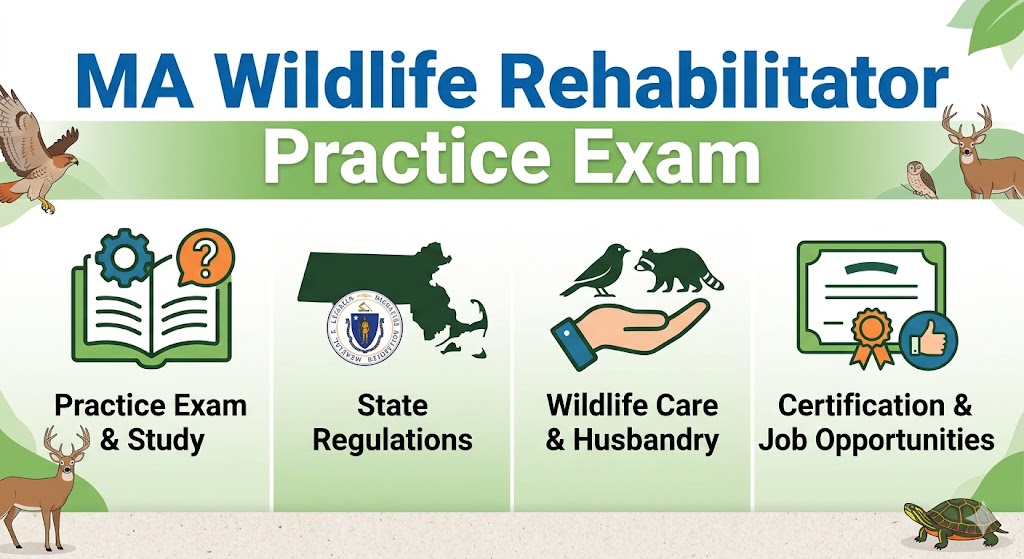
Additional Information
What the Course Entails and Exam Details
Preparing for the licensure requires comprehensive
self-study or participation in specialized workshops, as there is no single
standardized "course" required before taking the exam.
The subject matter covered in the study material and tested
in the examination includes, but is not limited to, the following core areas:
- Massachusetts
General Laws and Regulations: Deep knowledge of specific state
regulations (321 CMR 2.12) governing the capture, possession, transport,
treatment, and release of wildlife.
- Minimum
Standards of Care: Adherence to the standards set by the National
Wildlife Rehabilitators Association (NWRA) and the International Wildlife
Rehabilitation Council (IWRC) regarding housing, sanitation, and
veterinary care.
- Species
Identification and Biology: The ability to correctly identify native
Massachusetts mammals, birds, reptiles, and amphibians, and understand
their natural history, diet, and behavior.
- Basic
Medical Knowledge: Understanding concepts of wildlife triage, physical
examination, common injuries and diseases, parasitology, and basic
pharmacology relevant to wildlife.
- Zoonotic
Diseases and Public Safety: Protocols for managing diseases
transmissible from animals to humans (e.g., rabies, tularemia) and
ensuring public safety during rescues.
- Euthanasia
Criteria: Understanding the legal and ethical guidelines for
determining when euthanasia is the most humane option for an animal that
cannot recover or be released.
What to Expect in
the Final Exam
The official Massachusetts Wildlife Rehabilitator Exam is a
rigorous test of your readiness to handle the complexities of wildlife care.
Candidates should expect the following format for the state
proctored exam:
- Format:
The exam is primarily a written test consisting of multiple-choice and
true/false questions.
- Content
Split: The questions are often divided between regulatory knowledge
(the laws you must follow) and practical rehabilitation knowledge (animal
care).
- Passing
Score Requirements: Candidates must achieve a score of at least 80% to
pass and be eligible for the permit.
- Time
Limits: While typically not strictly timed in a high-pressure manner,
candidates are generally expected to complete the exam within a reasonable
two-to-three-hour window.
- Rules:
The exam is typically closed-book, meaning no study materials, phones, or
regulatory documents are allowed during the test.
How to Study and
Exam Centers
Success on the exam requires dedicated preparation using
official regulatory documents and standard rehabilitation texts.
Here are actionable study strategies and information on
taking the test:
Actionable Study Strategies:
- Master
the Regulations: The single most important document to study is 321
CMR 2.12 (Control of Certain Species of Wildlife). Read it repeatedly
until you understand every nuance of the law.
- Utilize
Official Study Guides: MassWildlife sometimes provides a recommended
reading list or study guide for applicants; ensure you request and utilize
these materials.
- Study
Standard Texts: Invest time in reading "Minimum Standards for
Wildlife Rehabilitation" published by the NWRA/IWRC.
- Use
Practice Exams: Taking practice tests specific to Massachusetts
regulations is crucial for identifying knowledge gaps and becoming
familiar with the types of scenario-based questions often asked.
- Network
with Mentors: Connecting with already licensed rehabilitators in
Massachusetts can provide invaluable practical insights that align with
testable concepts.
Exam Center Information:
The Massachusetts Wildlife Rehabilitator Exam is not taken
at commercial testing centers like Pearson VUE.
Instead, the exam is administered directly by MassWildlife.
Candidates must generally register to take the exam at
specific MassWildlife facilities, most commonly the Field Headquarters located
in Westborough, MA, or occasionally at regional wildlife offices upon prior
arrangement.
You must schedule your exam date in advance through the
MassWildlife permit office after submitting your initial application.
Job Opportunities
from the Course
While many wildlife rehabilitators in Massachusetts operate
as dedicated volunteers or run non-profit organizations, obtaining this permit
opens several professional pathways in conservation and animal care.
Possessing this specific licensure makes you a competitive
candidate for various roles, including:
- Licensed
Wildlife Rehabilitator (Non-Profit Founder/Director)
- Staff
Rehabilitator at established Wildlife Centers
- Wildlife
Center Manager or Operations Coordinator
- Animal
Control Officer (with wildlife specialization)
- Conservation
Educator or Naturalist at nature centers
- Veterinary
Technician (specializing in exotics and wildlife)
- State
Wildlife Biologist Assistant or Field Technician
Frequently Asked Questions
Reviews
5.0
Based on 0 reviews
Leave a Review
No reviews yet. Be the first to review!