
Massage for Special Populations Practice Test
$69.00
- Buy to unlock unlimited access to all Quiz questions and Answers in this Quiz.
- After purchase you can print a PDF of the whole quiz at any point. The PDF will contain the questions and the correct answers.
About this Exam
The Massage for Special Populations Practice Test is
a crucial diagnostic and preparation tool for licensed massage therapists
(LMTs) and advanced massage therapy students seeking specializing in this
rapidly growing and rewarding field. This exam focuses on equipping you with
the specialized knowledge, empathy, and adapted techniques needed to safely and
effectively work with diverse client groups with specific health
considerations. Understanding how to customize your approach is essential for
providing optimal care and building trust. Whether you are aiming for specific
certifications in medical massage, oncology massage, or simply want to enhance
your skills and expand your practice to serve a wider, often underserved
demographic, this practice test will assess your readiness and identify areas
for further study. It ensures you have the foundational understanding to
address unique physical and emotional needs responsibly.
Ready to test your knowledge?
Buy Now to Access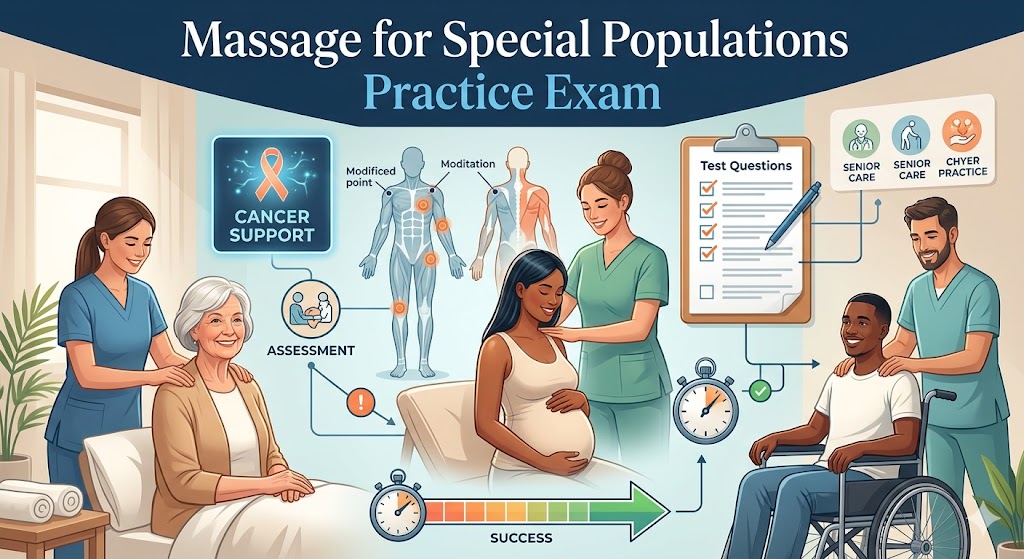
Additional Information
What the Course Entails and Exam Details
While this is a practice test, it meticulously
reflects the core content typically covered in advanced training programs
dedicated to massage for special populations. The actual courses and this
diagnostic exam assess your mastery of crucial topics across several key
special populations:
Core Topics Covered:
- Understanding
Special Populations: Comprehensive overview of the definition and
unique physiological, psychological, and social challenges faced by
various groups.
- Safety
and Assessment: Specialized client intake, physical assessment,
identifying absolute and relative contraindications, and critical thinking
skills for treatment planning.
- Specific
Special Populations:
- Geriatric
Massage: Modifications for age-related changes, dynamic pressure,
managing joint mobility, and addressing common conditions in older
adults.
- Prenatal
and Postnatal Massage: Understanding stages of pregnancy, positioning
(sidelying/elevated), deep vein thrombosis (DVT) precautions, and
addressing unique discomforts while promoting maternal and fetal safety.
- Oncology
Massage: Adapting techniques for cancer patients before, during, and
after treatment, understanding effects of chemotherapy, radiation, and
surgery, managing lymphedema risks, and fostering emotional support.
- Chronic
Illness and Pain Management: Tailoring approaches for conditions like
fibromyalgia, arthritis, multiple sclerosis, and chronic pain syndromes,
focusing on client comfort and communication.
- Physical
Disabilities and Orthopedic Considerations: Adaptations for mobility
challenges, visible or non-visible disabilities, and modifying touch for
altered sensation.
- Pediatric
Massage: Adjustments in pressure and duration for infants and
children, and understanding common childhood conditions and
communication.
- Communication
and Empathy: Developing advanced communication skills to facilitate
trust and ensure effective dialogue with vulnerable clients.
- Cultural
Competence: Respecting diverse backgrounds and perspectives on health
and touch.
Practice Exam Details: The practice test typically
mirrors the structure of many standardized professional exams, presenting a
randomized selection of 50 to 100 multiple-choice questions or case studies
designed to simulate the rigor and content of the actual certification exams.
By taking this timed practice, you can measure your current knowledge,
familiarize yourself with the question style, and pinpoint exact topics that
require additional review.
What to Expect in
the Final Exam
Since you are taking a practice test, you should
treat it as a dress rehearsal for your eventual official final certification
exam from organizations like the National Certification Board for
Therapeutic Massage & Bodywork (NCBTMB) or other state-recognized bodies
offering specialized endorsements. The specific format and rules can vary, but
here is what you can generally expect from the high-stakes final exam you are
preparing for:
- Format:
Official certification exams are almost exclusively multiple choice,
sometimes integrating case-based scenarios. Some advanced clinical
certifications might include an observed practical or objective structured
clinical examination (OSCE) component, but the initial barrier is
typically a comprehensive written test like the one you are practicing.
- Passing
Score: Requirements range between a scaled score of 70% to 75%
or higher to pass, depending on the testing entity and the level of
specialization. Review the specific guidelines of the credentialing
organization you are targeting.
- Time
Limit: Expect a strict time limit, typically 2 to 3 hours to
complete 100-150 questions. Time management is a key skill tested, and
practicing under time constraints is essential for success.
- Rules:
The official final exam will likely be a proctored, closed-book
exam, administered under secure conditions where no personal reference
materials, electronic devices, or unauthorized aids are allowed. Cheating
will result in immediate disqualification and potential loss of
professional licensure.
How to Study and
Exam Centers
Effective preparation for this comprehensive specialty
involves a combination of structured study, deep understanding of conditions,
and practical application simulation. Utilize these strategies to maximize your
success:
Actionable Study Strategies:
- Thorough
Rule Review: Deeply study current, evidence-based textbooks and
reference materials on anatomy, physiology, common pathologies, and
specialized protocols for each special population covered by your upcoming
exam. Pay special attention to contraindications and specific modification
requirements.
- Deepen
Condition Knowledge: Spend significant time researching the various
medical conditions relevant to special populations (e.g., cancer,
diabetes, arthritis). Focus not just on what they are, but how they affect
the body and what that means for safe touch application.
- Utilize
This Practice Test Rigorously: Don't just take this practice exam
once. Review every single question you answered incorrectly and
correctly. Read the detailed rationales provided to understand the
underlying reasoning and strengthen your critical thinking skills, which
are paramount in this field. Create flashcards for weak areas. Timed
attempts will build your pacing.
- Seek
Hands-on Mentorship/Clinicals: If possible, gain supervised clinical
hours or seek mentorship from an experienced LMT who regularly works with
special populations. Real-world experience, observing and practicing
adaptations under expert guidance, is invaluable and cannot be replicated
by study alone.
- Group
Study: Reviewing challenging cases and protocols with colleagues can
provide fresh perspectives and reinforce difficult concepts.
Exam Centers for Official Certification:
When you have built your confidence and mastered the content
through training and extensive practice, you will need to schedule your
official certification exam through the credentialing body. This final exam is
typically not taken where you did your initial training, but at
independent, standardized testing centers:
- Online
Portals: Credentialing organizations often have their own secure,
proctored online exam portals for computer-based testing,
accessible globally from authorized locations or sometimes from a secure
home environment using online proctoring services.
- Testing
Centers (e.g., Pearson VUE, Prometric): Many professional healthcare
and licensure exams are administered at specialized national or
international testing centers. You would typically register for a date and
location of your choice through their networks.
- Authorized
Schools: In some cases, specific massage schools or advanced training
institutes that host the specialization courses might also serve as an
authorized test site for particular exams, but this is less common for
national certifications.
- Verify
Requirements: Always double-check with the specific certification
provider (like the NCBTMB) for exact location and scheduling procedures.
The "exam center" for the practice test you are preparing with
is likely an online platform provided by the training organization or
study guide creator, giving you the flexibility to practice anywhere.
Job Opportunities
from the Course
Successfully mastering the content and achieving a specialty
certification in Massage for Special Populations can open doors to numerous
rewarding and often more stable career paths within the healthcare and wellness
sectors, making you a more valuable and versatile therapist.
- Certified
Oncology Massage Therapist: Working specifically in hospitals,
outpatient clinics, and cancer support centers.
- Prenatal/Geriatric
Massage Specialist: Catering to these distinct and growing
demographics in spas, private practices, or dedicated clinics.
- Medical
Massage Therapist: Collaborating within integrative healthcare teams
in settings like pain clinics, physical therapy offices, and
rehabilitation centers.
- Hospice
and Palliative Care Massage Therapist: Providing comforting touch for
clients with life-limiting illnesses, often in their homes or dedicated
facilities.
- Specialized
Spa Practitioner: Enhancing your marketability by offering specialized
services within higher-end or medical spas.
- Private
Practice Specialist: Attracting a loyal clientele seeking personalized
care for their specific health needs.
Frequently Asked Questions
Reviews
5.0
Based on 0 reviews
Leave a Review
No reviews yet. Be the first to review!