
Master in Counseling Comprehensive Practice Exam
$69.00
- Buy to unlock unlimited access to all Quiz questions and Answers in this Quiz.
- After purchase you can print a PDF of the whole quiz at any point. The PDF will contain the questions and the correct answers.
About this Exam
The Master in Counseling Comprehensive Practice Exam is a
critical milestone for graduate students completing their counseling degrees.
This exam acts as a capstone, assessing a student's preparedness to enter the
counseling field as a knowledgeable professional. It is primarily designed for
students enrolled in mental health counseling, school counseling, or marriage
and family therapy programs who are nearing graduation. The exam serves to
validate that future counselors have retained essential knowledge and are ready
for professional practice and licensure. Successfully passing this
comprehensive examination is often a requirement for graduation or serves as a
strong precursor to state licensure exams.
Ready to test your knowledge?
Buy Now to Access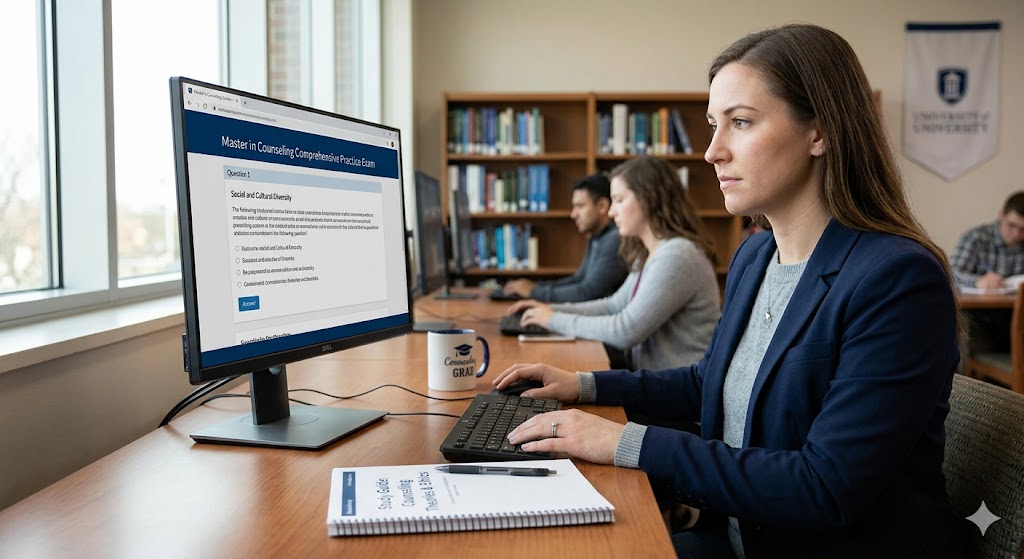
Additional Information
What the Course Entails and Exam Details
As a comprehensive evaluation of counseling mastery, the
exam covers the core curriculum areas defined by the Council for Accreditation
of Counseling and Related Educational Programs (CACREP).
Students must demonstrate thorough knowledge across these
eight critical domains:
- Professional
Counseling Orientation and Ethical Practice: Covering ethical
standards, legal issues, and the history of the profession.
- Social
and Cultural Diversity: Focusing on multicultural competencies,
advocacy, and diverse populations.
- Human
Growth and Development: Assessing understanding of developmental
theories across the lifespan.
- Career
Development: Including career theories, decision-making models, and
occupational information.
- Counseling
and Helping Relationships: Evaluating basic and advanced counseling
skills and major counseling theories.
- Group
Counseling and Group Work: Understanding group dynamics, leadership
styles, and group development stages.
- Assessment
and Testing: Covering statistical concepts, standardized testing, and
assessment techniques.
- Research
and Program Evaluation: Focusing on research methods, statistical
analysis, and program evaluation.
What to Expect in the Final Exam
Candidates should prepare for a comprehensive, standardized
computer-based testing environment.
The exam typically consists of 160 multiple-choice questions
in total. Out of these 160 items, 136 questions usually contribute to the final
score, while the remaining 24 are pilot items being vetted for future exams.
These pilot items are interspersed throughout the test and are not identified.
The standard time limit allowed for completion is usually
four hours, though accommodations may be available for candidates with
documented needs. It is important to note that there is no universal, national
passing score for this specific internal examination; individual academic
institutions set their own passing cut-off scores based on current statistical
data.
Students should familiarize themselves with the specific
rules provided by their university regarding allowed materials, breaks, and
security protocols during the exam.
How to Study and Exam Centers
Effective preparation is key to succeeding on the
comprehensive practice exam.
Begin your study plan by reviewing foundational textbooks
and lecture notes covering the eight CACREP core areas listed above. Utilizing
specific practice exams designed for counseling students is highly beneficial
for understanding the format and phrasing of the questions. Many students form
study groups to discuss complex ethical scenarios, review theories, and share
resources. Creating comprehensive study outlines, flashcards for key
terminology, and mnemonics for major developmental theories can greatly aid
retention.
In terms of where to take the exam, administration methods
vary by institution. Many universities administer the exam on-campus through
their own dedicated testing centers. Some academic programs may utilize
recognized professional testing vendors, such as Pearson VUE centers,
especially if the exam is coordinated through an external testing service. You
must coordinate directly with your academic advisor or department chair to
receive specific scheduling instructions and find authorized testing locations.
Job Opportunities from the Course
Passing the Master in Counseling Comprehensive Practice Exam
signifies a readiness to transition from student to professional.
This milestone is a prerequisite for graduating and pursuing
state licensure, which unlocks numerous career paths in various counseling
specializations. The career opportunities listed below are open to individuals
who have completed their master's degree and successfully passed their
comprehensive evaluations:
- Licensed
Professional Counselor (LPC) / Licensed Mental Health Counselor (LMHC) in
clinical mental health settings.
- Certified
School Counselor (K-12).
- Licensed
Marriage and Family Therapist (LMFT) (depending on specific degree
specialization).
- Substance
Abuse or Addiction Counselor.
- Crisis
Intervention Counselor.
- Career
Counselor in universities or private practice.
- Rehabilitation
Counselor.
- Grief
Counselor.
- Counselor
in community non-profit agencies or government sectors.
- Supervisory
or administrative roles within clinical settings (after gaining necessary
experience)
Frequently Asked Questions
Reviews
5.0
Based on 0 reviews
Leave a Review
No reviews yet. Be the first to review!