
Master Mechanical License Practice Test
$69.00
- Buy to unlock unlimited access to all Quiz questions and Answers in this Quiz.
- After purchase you can print a PDF of the whole quiz at any point. The PDF will contain the questions and the correct answers.
About this Exam
The Master Mechanical License represents the highest level
of certification achievable within the HVAC and mechanical trades.
This prestigious credential is specifically designed for
highly experienced technicians, journeymen, and mechanical professionals who
are ready to take their careers to the absolute peak.
Earning this license proves that you possess master-level
knowledge of mechanical systems, safety protocols, and local building codes.
For ambitious professionals, it is the ultimate stepping
stone required to pull municipal permits, bid on massive commercial projects,
and officially run your own independent mechanical contracting business.
Ready to test your knowledge?
Buy Now to Access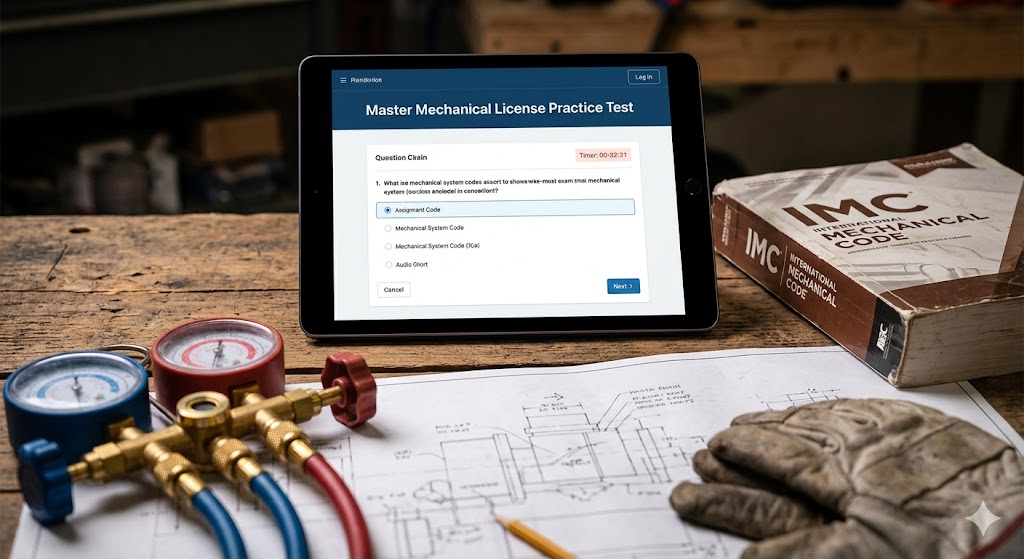
Additional Information
What the Course Entails and Exam Details
Preparing for the Master Mechanical License exam requires a
deep and comprehensive understanding of complex mechanical concepts.
The core syllabus heavily focuses on the design,
installation, maintenance, and alteration of heating, ventilation, air
conditioning, and refrigeration (HVAC/R) systems.
Candidates will explore advanced topics including commercial
exhaust systems, ductwork fabrication, hydronic piping, and complex fuel gas
systems.
A major portion of the study material entails mastering the
International Mechanical Code (IMC), the International Fuel Gas Code (IFGC),
and relevant local state codes.
In addition to code compliance, the course material tests
your practical skills in blueprint reading, heat load calculations, system
sizing, and advanced electrical troubleshooting.
What to Expect in
the Final Exam
The final exam is known for being rigorous, purposely
designed to test both your theoretical knowledge and your ability to navigate
code books efficiently under pressure.
Typically, the exam is an open-book format that consists
entirely of multiple-choice questions.
Depending on your specific state or municipality, you can
expect to face anywhere from 100 to 120 complex questions.
Time management is critical, as you will generally be given
a strict time limit of three to four hours to complete the test.
The passing score requirement is usually set at 70% or 75%,
demanding a high level of accuracy across all tested subjects.
Test-takers must strictly adhere to the rules, which usually
mandate that only approved, permanently bound reference books can be brought
into the testing room, while cell phones, loose papers, and programmable
calculators are strictly prohibited.
How to Study and Exam Centers
Success on this exam relies heavily on strategy and
familiarization with your reference materials rather than just rote
memorization.
Your primary study strategy should involve taking multiple
timed practice exams to build your test-taking endurance and simulate the
actual testing environment.
Since it is largely an open-book test, you must learn to
navigate the index of the IMC and IFGC rapidly.
Professionally tabbing your code books and highlighting key
sections—where permitted by your specific testing board—is highly recommended
to save valuable time.
When you are ready to sit for the test, the exam is
typically administered by standardized third-party testing agencies on behalf
of the state licensing board.
The most common exam centers include Pearson VUE, Prometric,
or the International Code Council (ICC) testing facilities.
While many states require you to take the exam in person at
a secure, proctored physical testing center, some jurisdictions are now
offering secure online proctoring options through specialized educational
portals.
Job Opportunities
from the Course
Earning your Master Mechanical License unlocks a highly
lucrative and authoritative tier of career opportunities.
Because you are legally recognized as a master of your
trade, employers and clients will trust you with the most complex and
high-paying projects.
Here are the specific job titles and career paths this
certification unlocks:
Master HVAC Contractor: Own and operate your own mechanical
business, pull your own permits, and bid on massive commercial and residential
contracts.
Mechanical Inspector: Work for municipal or state
governments to inspect ongoing construction projects, ensuring all mechanical
installations meet code compliance and safety standards.
Commercial HVAC/R Manager: Oversee the installation,
maintenance, and repair of complex refrigeration and mechanical systems in
large-scale facilities like hospitals, supermarkets, or data centers.
Mechanical Project Manager: Lead large construction teams,
manage project budgets, and ensure that mechanical installations perfectly
align with architectural blueprints.
Facilities Maintenance Director: Manage the overall building
operations, mechanical health, and maintenance staff for universities,
corporate campuses, or industrial manufacturing plants.
Frequently Asked Questions
Reviews
5.0
Based on 0 reviews
Leave a Review
No reviews yet. Be the first to review!