
Master Resilience Training (MRT) Practice Test
$69.00
- Buy to unlock unlimited access to all Quiz questions and Answers in this Quiz.
- After purchase you can print a PDF of the whole quiz at any point. The PDF will contain the questions and the correct answers.
About this Exam
The Master Resilience Training (MRT) program is the premier
resilience-building initiative within the United States Army.
It is designed to equip soldiers, their families, and Army
civilians with critical mental and emotional skills.
These skills enable individuals to thrive in adversity,
enhance performance under pressure, and maintain well-being throughout their
careers.
The core MRT course is an intensive train-the-trainer
program.
Select noncommissioned officers and other personnel are
trained to master these skills.
They then cascade this vital training to members of their
units and communities.
Think of this practice test resource as your essential
starting point.
It is a tool for mastering the fundamental concepts.
It prepares you to successfully navigate the intensive
certification process and become an invaluable asset as a certified Master
Resilience Trainer.
Ready to test your knowledge?
Buy Now to Access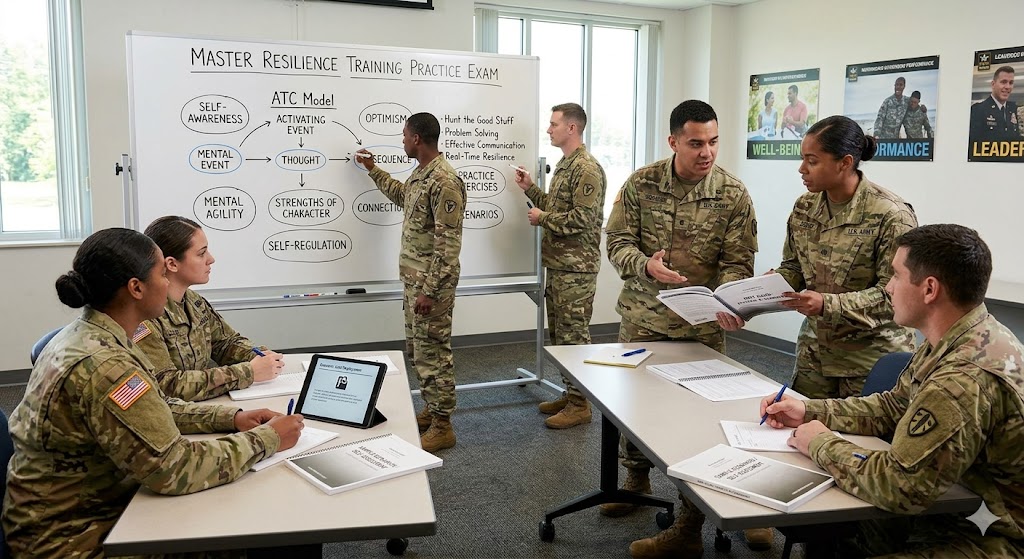
Additional Information
What the Course Entails and Exam Details
The official MRT course is a comprehensive, typically 10-day
intensive program.
It dives deep into the science of positive psychology and
resilience.
Candidates explore six core competencies: self-awareness,
self-regulation, optimism, mental agility, strengths of character, and
connection.
They are immersed in 14 specific resilience skills.
These include essential techniques like Goal Setting to
activate and sustain behavior.
They learn to "Hunt the Good Stuff" to cultivate
optimism.
Candidates master the ATC model.
This model involves understanding Activating Events,
Thoughts, and Consequences to enhance self-awareness.
They learn to avoid common thinking traps and detect
personal "icebergs" or deep-seated beliefs.
The curriculum covers problem-solving, real-time resilience
techniques, effective communication, and identifying and utilizing character
strengths.
Addressing the specific details: Importantly, the MRT
certification process does not culminate in a single, traditional
multiple-choice exam taken in a public center.
Assessment is continuous and performance-based throughout
the entire course.
Instructors and peer facilitators evaluate candidates on
their understanding.
They assess the ability to apply skills to real-world
scenarios.
And they judge the proficiency in teaching the skills
to others.
Therefore, specific, universally standardized pass scores,
rigid time limits for assessments outside course hours, or publicly detailed
exam rules (other than Army regulations) are not widely available for this
internal, practical program.
Completion and certification are dependent on demonstrated
competency across all aspects of the intensive training and practical
demonstrations.
What to Expect in
the Final Exam
While not a traditional test, the cumulative assessments at
the end of the MRT course serve as the critical "final exam" for
certification.
Candidates can expect several dynamic opportunities to
demonstrate their proficiency.
These extensive practical evaluations heavily feature:
- Practical
Teaching Demonstrations: Candidates are required to present and teach
multiple resilience skills to their peers and instructors. This is the
cornerstone of assessment. Evaluators judge clarity, engagement, and
effectiveness of delivery.
- Scenario-Based
Application: Individuals must apply specific resilience principles and
skills to navigate complex, realistic scenarios. This demonstrates
practical mastery and critical thinking.
- Peer
Coaching and Feedback: Proficiency in guiding others through
resilience exercises and providing constructive, effective feedback is
also evaluated.
- Knowledge
Checks: While primarily performance-based, candidates may encounter
embedded knowledge checks (written or oral) throughout the course to
verify understanding of key concepts.
Continuous evaluation, constructive feedback, and the
progressive development of teaching and facilitation skills are integral.
This practice resource helps candidates prepare
conceptually.
It builds confidence in knowledge recall and scenario
interpretation, preparing you for the real-time, interactive demonstrations of
proficiency that define success.
How to Study and
Exam Centers
How to Study: Successful candidates don't just study;
they practice and internalize.
- Deep
Content Mastery: Ensure you thoroughly understand each of the six core
competencies and all 14 resilience skills. Summarize key concepts in your
own words.
- Apply
Skills Daily: Integrate these techniques into your personal life.
Practice optimism. Identify thoughts and consequences. Utilize character
strengths. The more you live the skills, the easier they will be to
understand and teach.
- PRACTICE
TEACHING (Most Critical): This cannot be overstated. Teach the skills
to friends, family, or even practice aloud in front of a mirror. Record
yourself to refine your delivery. Simulate a classroom setting and
practice engaging an audience. Role-play scenarios with a partner.
- Form
Study Groups: Connect with peers preparing for the course. Practice
teaching to each other, role-play together, and provide honest, supportive
feedback. Different perspectives and shared knowledge are invaluable.
- Utilize
Conceptual Practice Tools: Use sample scenarios and questions. Create
your own scenario-based challenges. Re-teach entire skill modules. Frame
practice interactions with this resource in mind. Think of it as
simulating the thought processes you will need in real time.
Exam Centers: Due to the internal, military nature of
the program, there are absolutely no external or public exam centers for the
Master Resilience Training certification.
The entire intensive course, including all embedded
assessments and final evaluations, takes place in-person on selected major U.S.
Army installations globally.
Candidates are selected to attend and must successfully
complete the training program on-site.
There is no public registration portal (like Pearson VUE)
for this specific certification.
Job Opportunities
from the Course
Becoming a certified Master Resilience Trainer opens
distinct career enhancement pathways primarily within the U.S. Army structure.
- Master
Resilience Trainer (MRT) (Levels 1, 2, and 3, depending on experience and
further training)
- Resilience
Advisor or Coordinator within various Army commands
- Integrated
roles in Performance Centers (providing holistic training)
- Unit
leadership positions leveraging enhanced resilience and performance skills
- Positions
within Army training and doctrine commands focused on developing resilient
leaders and soldiers
While the official certification is specific to the military
context, the advanced leadership, communication, facilitation, performance
optimization, and emotional intelligence skills gained are highly valued and
incredibly transferable to numerous civilian fields.
These can include corporate wellness and training,
performance coaching, education, human resources, and organizational
development.
Master Resilience Training is a powerful and impactful
program.
Dedicating yourself to mastering the skills, and crucially,
perfecting your ability to teach them, is the key to success.
Utilize this practice resource to build a strong foundation.
Approach the intensive course with commitment and
enthusiasm, and get ready to become a certified leader in resilience and
performance enhancement.
Good luck!
Frequently Asked Questions
Reviews
5.0
Based on 0 reviews
Leave a Review
No reviews yet. Be the first to review!