
Master Your Fuel Gas Code Practice Exam
$69.00
- Buy to unlock unlimited access to all Quiz questions and Answers in this Quiz.
- After purchase you can print a PDF of the whole quiz at any point. The PDF will contain the questions and the correct answers.
About this Exam
The National Fuel Gas Code Practice Test is an essential preparatory tool designed for professionals aspiring to master the critical safety regulations governing fuel gas piping systems, appliances, venting, and associated equipment.
This comprehensive practice exam serves as a simulation for the formal certifications or licensing examinations based on NFPA 54 (or ANSI Z223.1).
It is specifically tailored for individuals working within the construction, plumbing, HVAC, or building inspection sectors who must demonstrate a thorough understanding of proper installation, maintenance, and safety protocols for natural gas and propane systems.
Passing this practice test indicates readiness to tackle official licensing exams and underscores a commitment to public safety and technical proficiency in fuel gas systems.
Ready to test your knowledge?
Buy Now to Access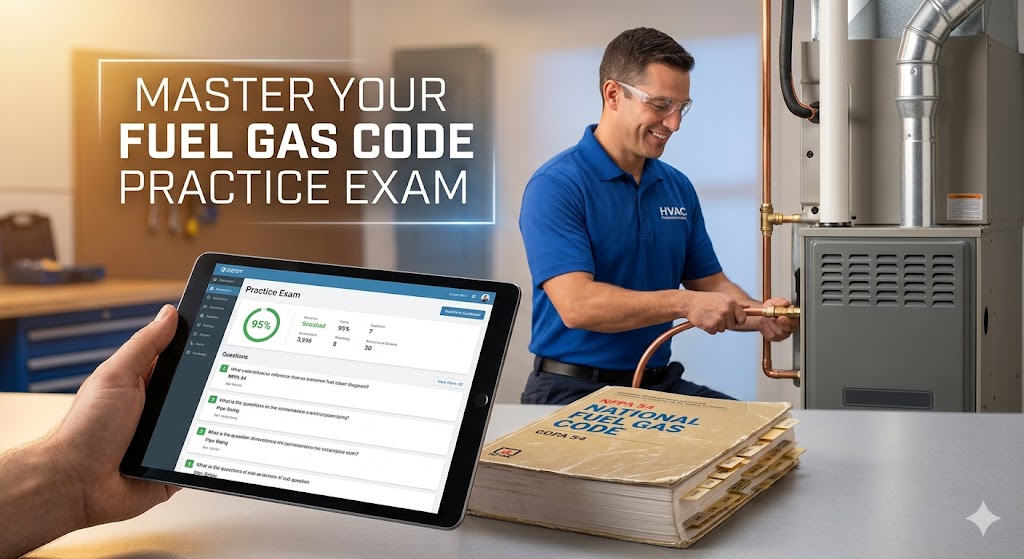
Additional Information
What the Course Entails and Exam Details
This guide focuses on the "National Fuel Gas Code" (NFPA 54), which establishes the absolute standards for the safe installation, operation, and maintenance of fuel gas systems.
The core domains covered by this practice test generally include comprehensive pipe sizing, layout, and material selection for varying pressures.
You will encounter extensive sections on installation requirements for fuel gas piping systems, including proper support, shielding, and protection from damage.
Equally important are the strict guidelines for the installation and connection of residential, commercial, and industrial appliances, ensuring sufficient combustion air.
The study content must thoroughly review venting system design, sizing, and termination to ensure harmful exhaust gases are safely removed from structures.
Crucial safety protocols regarding system testing, inspection, purging of gas lines, and maintenance procedures are central themes.
Successfully navigating this content confirms an individual's ability to interpret and apply the specific codes that prevent dangerous leaks, fires, or carbon monoxide accumulation.
What to Expect in the Final Exam
While "final exam" details can vary significantly depending on the specific licensing board (e.g., state-specific licenses, ICC, or plumbing certifications), this practice test closely mirrors the structure of standard professional exams.
The practice test typically follows a computer-based, multiple-choice format, presenting questions that simulate real-world code application and complex sizing scenarios.
Most related official examinations are timed, often ranging from two to four hours, requiring candidates to manage their time effectively across diverse topics.
The passing score for these official licensing assessments generally falls between 70% and 75%, reflecting a high requirement for competency.
Furthermore, these final exams are commonly "open-book," allowing applicants to reference the codebook; however, the questions test your speed and efficiency in finding and applying the relevant code section under pressure.
Our practice test is designed to refine these exact skills, preparing you for the rigor and time constraints of the formal certification process.
How to Study and Exam Centers
Effective preparation is key to success on the National Fuel Gas Code examination, which requires both rote knowledge and practical application.
The most effective strategy begins with securing a copy of the appropriate codebook (usually the current version of NFPA 54/ANSI Z223.1).
Do not rely solely on memory; practice navigating the codebook by indexing key sections on pipe sizing (using the charts), venting, and appliances.
Utilize flashcards to master terminology, fundamental definitions, and common sizing requirements.
Review detailed pipe sizing calculations manually, ensuring you can determine appropriate diameters based on pipe length, gas flow (BTU/hr or CFH), and allowable pressure drop.
Take advantage of practice exams specifically designed for the National Fuel Gas Code; use them in a timed setting to simulate test pressure.
To take the official final exam, candidates usually register through a state or local licensing board, or through authorized testing centers like Pearson VUE, Prometric, or local vocational schools and specialized safety training facilities.
Job Opportunities from the Course
Earning proficiency through the National Fuel Gas Code Practice Test, leading to official licensure, unlocks numerous lucrative career paths across the energy, construction, and inspection fields.
Potential job opportunities include:
Licensed Fuel Gas Fitter (Residential and Commercial)
HVAC Technician (Gas Appliance Specialist)
Journeyman or Master Plumber with Gas Endorsement
Pipefitter
Building and Code Inspector (Fuel Gas/Mechanical focus)
Gas Utility Service Technician
Pipeline Maintenance Worker
Combustion Safety Auditor
Industrial Maintenance Mechanic (for facilities utilizing gas systems)
Contractor (Heating, Ventilation, or Plumbing)
Project Manager for Mechanical Contracting Firms
Frequently Asked Questions
Reviews
5.0
Based on 0 reviews
Leave a Review
No reviews yet. Be the first to review!