
Mastering A&P Neurophysiology Practice Test
$69.00
- Buy to unlock unlimited access to all Quiz questions and Answers in this Quiz.
- After purchase you can print a PDF of the whole quiz at any point. The PDF will contain the questions and the correct answers.
About this Exam
The Mastering A&P Neurophysiology practice test is a
crucial preparatory resource designed for students enrolled in advanced Anatomy
and Physiology courses.
This comprehensive exam is specifically tailored for
individuals pursuing careers in healthcare, including nursing, physical
therapy, and pre-medicine.
It provides a robust assessment of a student’s understanding
of the fundamental principles governing the nervous system's function.
By successfully navigating this practice test, students can
identify critical knowledge gaps and refine their understanding before facing
higher-stakes course examinations.
Ready to test your knowledge?
Buy Now to Access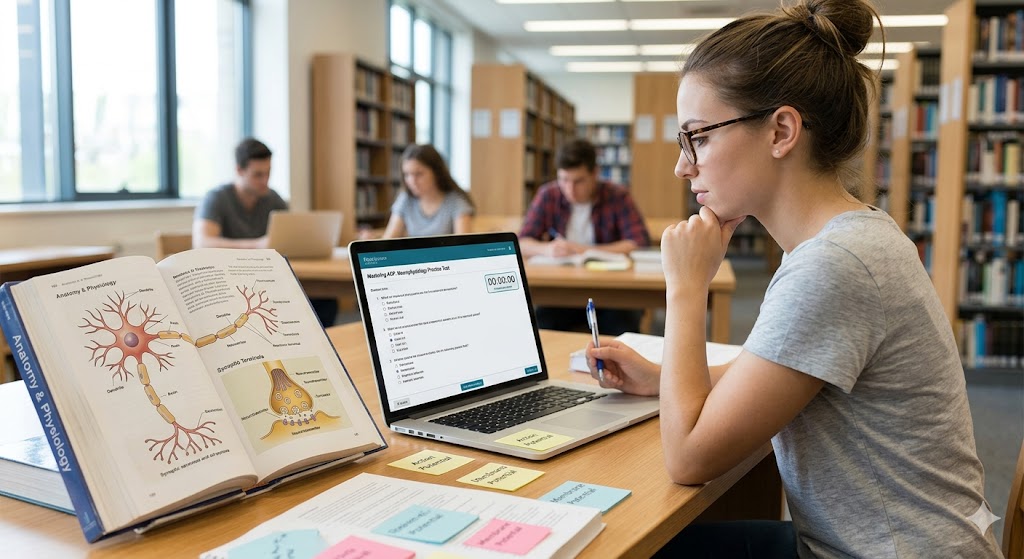
Additional Information
What the Course Entails and Exam Details
The neurophysiology component of Mastering A&P delves
deeply into the intricate mechanisms of neural communication and integration.
The core curriculum covered by this practice test generally
spans several major thematic areas.
Students must demonstrate mastery of cellular
neurophysiology, including the complex dynamics of membrane potentials and the
propagation of action potentials.
The test heavily emphasizes the processes occurring at the
synapse, including neurotransmitter release, receptor binding, and postsynaptic
integration.
Furthermore, the practice exam assesses knowledge regarding
the functional organization of the Central Nervous System (CNS) and the
Peripheral Nervous System (PNS).
Expect specific questions that challenge your ability to
integrate sensory input and explain the motor output pathways that control
muscle contraction.
What to Expect in
the Final Exam
While format specifics can vary by institution, the
Mastering A&P Neurophysiology practice test frequently mirrors the
structure of common academic examinations.
It is primarily a computer-based assessment, often featuring
a diverse array of multiple-choice and matching questions.
Crucially, some questions may require you to apply
theoretical knowledge to interpret physiological data or analyze diagrams of
neural circuits.
A key feature of these tests is a strict time limit,
designed to assess recall speed and physiological fluency.
Regarding passing scores, the threshold is usually
determined by the specific academic program, though 70% or higher is commonly
required for credit.
In some course settings, this practice exam may be
administered through the online learning management system (LMS) associated
with your textbook.
How to Study and
Exam Centers
An effective study strategy for neurophysiology demands a
balance between active recall and clinical application.
We highly recommend utilizing the practice resources
available within the Mastering A&P online platform, paying close attention
to "wrong answer" feedback.
Creating detailed conceptual diagrams that trace the flow of
ions during an action potential or depict synaptic transmission is essential
for visual learners.
Engaging with study groups to discuss complex physiological
scenarios can deepen your analytical thinking skills for case-based questions.
Because this practice test is inherently a digital resource
linked to the Pearson Mastering platform, you will take it through the specific
online portal provided by your instructor.
This is generally done via your personal computer in a
non-proctored environment, or it may occur within a designated testing center
or computer lab at your college or university.
Job Opportunities from the Course
While this specific practice test is not a professional
certification, it is a prerequisite for success in anatomical and physiological
coursework.
Achieving mastery in this area is a critical stepping stone
to professional certification and entry into dozens of lucrative healthcare
careers.
Proficiency in neurophysiology is the foundational building
block for students who become:
- Registered
Nurses
- Physician
Assistants
- Physical
Therapists
- Occupational
Therapists
- Respiratory
Therapists
- Medical
Doctors and Specialists (Neurologists)
- Chiropractors
- Surgical
Technologists
- Clinical
Neurophysiologists (with advanced degrees)
Frequently Asked Questions
Reviews
5.0
Based on 0 reviews
Leave a Review
No reviews yet. Be the first to review!