
Materials Engineer Accreditation Practice Exam
$69.00
- Buy to unlock unlimited access to all Quiz questions and Answers in this Quiz.
- After purchase you can print a PDF of the whole quiz at any point. The PDF will contain the questions and the correct answers.
About this Exam
The Materials Engineer Accreditation is a prestigious certification designed for civil engineers and professionals involved in construction material testing and quality control.
This credential validates your expertise in evaluating the physical and chemical properties of building materials to ensure they meet stringent industry standards.
It is ideal for ambitious engineers who want to specialize in infrastructure projects, public works, and quality assurance protocols.
Achieving this accreditation demonstrates your commitment to safety, structural integrity, and engineering excellence.
Ready to test your knowledge?
Buy Now to Access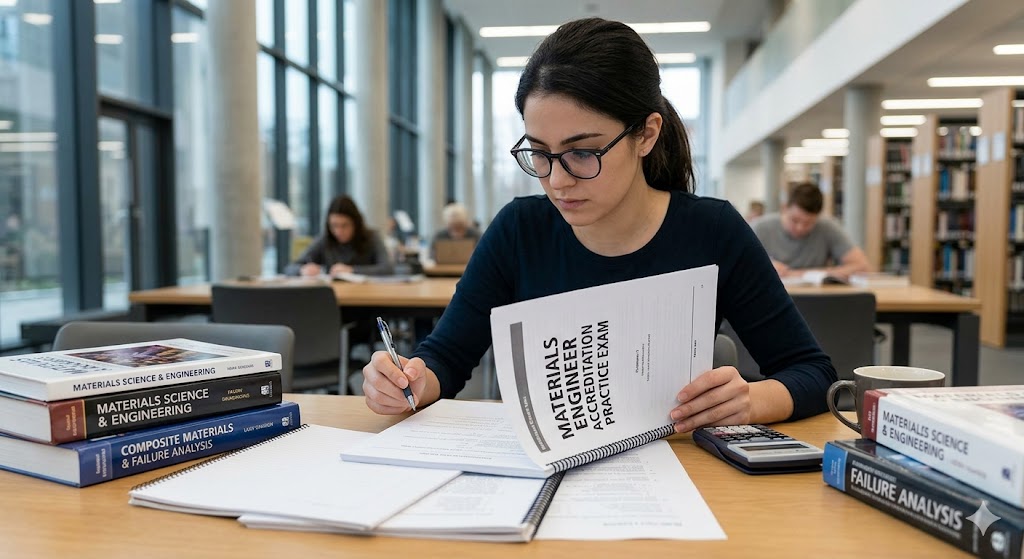
Additional Information
What the Course Entails and Exam Details
Preparing for this accreditation involves mastering a broad
spectrum of civil engineering materials and testing methodologies.
Candidates will dive deeply into the properties of concrete,
asphalt, soil, aggregates, and steel.
The syllabus extensively covers laboratory testing
procedures, field compaction methods, and quality control programming.
You will also need a thorough understanding of project
specifications, international building codes, and safety compliance standards.
Furthermore, the curriculum emphasizes data analysis,
requiring candidates to interpret test results accurately and make critical
structural recommendations.
What to Expect in the Final Exam
The final assessment is a rigorous examination designed to
test both your theoretical knowledge and practical application skills.
Typically, the exam consists of a written multiple-choice
section alongside a practical assessment or problem-solving module.
You will face challenging questions regarding material
properties, standard testing protocols, and on-site troubleshooting scenarios.
The test usually spans several hours, so time management is
incredibly critical for success.
Candidates are generally required to achieve a passing score
of at least 70 to 80 percent, depending on the specific accrediting body.
Calculators are normally permitted, but access to outside
reference materials is strictly prohibited under standard exam rules.
How to Study and
Exam Centers
Success on this exam requires a highly structured and
disciplined study strategy.
Begin by gathering official reference manuals, testing
standard codes, and accredited study guides.
Taking multiple practice exams is one of the most effective
ways to familiarize yourself with the question formats and identify your weak
areas.
Join study groups or online forums to discuss complex
engineering concepts and gain diverse perspectives from fellow professionals.
When you are ready, you can schedule your exam through major
testing networks like Pearson VUE or directly through your regional Department
of Public Works or Engineering Board.
Many authorized testing centers offer computerized formats,
so ensure you book your slot well in advance to secure your preferred date and
location
Job Opportunities from the Course
Earning your Materials Engineer Accreditation opens the door
to a wide array of lucrative and highly respected career paths.
You can pursue a role as a Lead Materials Engineer,
overseeing massive infrastructure developments and public works projects.
Another excellent path is becoming a Quality Assurance
Manager, where you will ensure construction firms comply with state and federal
regulations.
You might also find rewarding work as a Geotechnical
Engineer, evaluating soil and foundation conditions for new structures.
Additionally, this certification paves the way for positions
such as Laboratory Testing Director, Pavement Engineer, or Senior Construction
Consultant.
Ultimately, this credential gives you a distinct competitive
edge in the rapidly growing civil engineering and construction management
industries.
Frequently Asked Questions
Reviews
5.0
Based on 0 reviews
Leave a Review
No reviews yet. Be the first to review!