
MCAT Chemical and Physical Foundations of Biological Systems Practice Exam
$69.00
- Buy to unlock unlimited access to all Quiz questions and Answers in this Quiz.
- After purchase you can print a PDF of the whole quiz at any point. The PDF will contain the questions and the correct answers.
About this Exam
The Chemical and Physical Foundations of Biological
Systems section is a foundational component of the Medical College Admission
Test (MCAT).
It is a prerequisite for any student aspiring to gain
admission into medical school and pursue a career as a physician.
This section assesses your ability to combine
foundational concepts with scientific inquiry and reasoning, which are
essential skills for medical professionals.
Think of it as the ‘how’ and ‘why’ behind the biological
processes you will encounter in medicine.
Ready to test your knowledge?
Buy Now to Access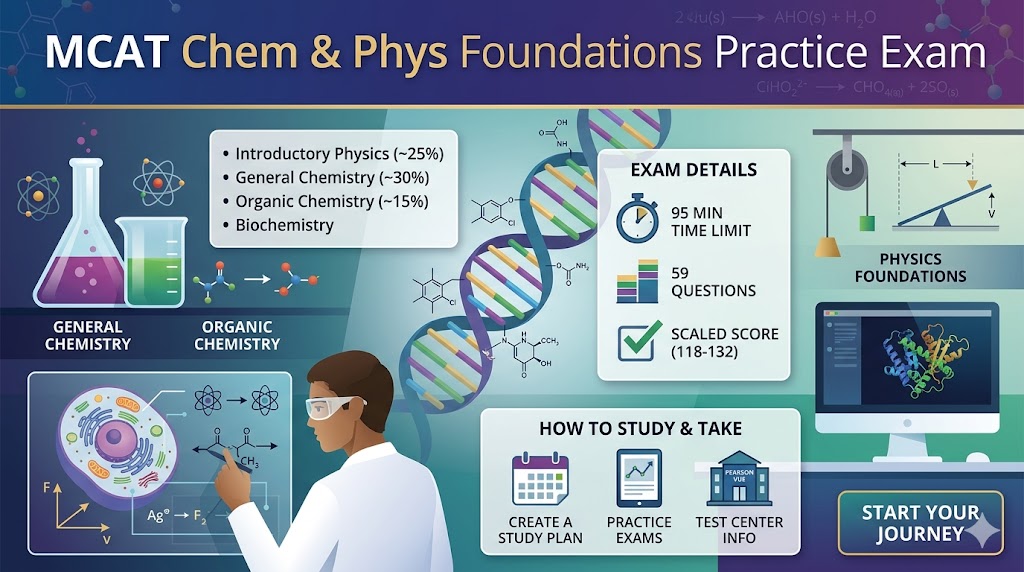
Additional Information
What the Course Entails and Exam Details
Preparing for this section requires an integrated
understanding of several scientific disciplines.
The material isn’t presented in isolation; you will be
required to apply chemistry and physics principles to biological scenarios.
Core content areas include:
- Introductory
Physics (approx. 25% of the section)
- General
Chemistry (approx. 30% of the section)
- Organic
Chemistry (approx. 15% of the section)
- Basic
Biochemistry concepts (the remaining percentage, along with introductory
biology, integrated throughout)
The exam will test your foundational concepts, scientific
reasoning and problem-solving skills, and your ability to reason about the
design and execution of research, including interpreting mathematical concepts
and data analysis.
What to Expect in
the Final Exam
You can expect a 95-minute time limit for this section.
It consists of 59 multiple-choice questions, which are
presented as a mix of passage-based and discrete questions.
Passages are typically about 200 to 300 words and are
followed by a series of four to seven questions.
Scoring for this section is reported on a scale from 118
to 132.
The scaled score is derived from your raw score (the
number of questions answered correctly), with no penalty for guessing.
Equating ensures scores have the same meaning across
different test forms.
How to Study and
Exam Centers
To succeed on this section, your study plan must include
both content review and extensive practice.
Mastering official AAMC materials is crucial, as they are
the most representative of the actual test.
The core of your preparation should involve taking
full-length practice exams, like the MCAT Chem & Phys Foundations Practice
Exam, under simulated testing conditions.
Review every single question from your practice exams,
understanding why correct answers are correct and, more importantly, why your
wrong choices were wrong.
This helps you identify knowledge gaps and refine your
scientific reasoning and pacing.
The final MCAT is not an online-only test; it is
administered at official Pearson VUE Professional Centers.
Registration and center selection are done through the
AAMC’s MCAT Registration System.
Job Opportunities
from the Course
It is essential to understand that obtaining a strong
score on the MCAT is not a certification for a specific job title.
Rather, it is a key credential for applying to medical
school and beginning the long but rewarding path to becoming a doctor.
A high score on this specific section demonstrates the
prerequisite knowledge required for medical curricula.
Successful completion of medical school and subsequent
residency and fellowship training can lead to the following career paths:
- Physician
(including countless specialties and subspecialties such as Family
Medicine, Internal Medicine, Pediatrics, Surgery, Anesthesiology,
Radiology, and many more)
- Surgeon
- Anesthesiologist
- Pediatrician
- Researcher
(MD or DO with a focus on clinical or translational research)
- Public
Health Expert (with a combined background)
Frequently Asked Questions
Reviews
5.0
Based on 0 reviews
Leave a Review
No reviews yet. Be the first to review!