
MCAT Critical Analysis and Reasoning Skills Practice Exam
$69.00
- Buy to unlock unlimited access to all Quiz questions and Answers in this Quiz.
- After purchase you can print a PDF of the whole quiz at any point. The PDF will contain the questions and the correct answers.
About this Exam
The MCAT Chemical and Physical Foundations of Biological
Systems practice exam is an essential preparatory tool designed for aspiring
medical students. This specific section of the Medical College Admission Test
(MCAT) evaluates a candidate's understanding of the basic chemical and physical
principles that underlie the mechanisms of living systems. It also tests the
ability to apply these principles together with biological concepts to solve
problems in the medical and health sciences. Mastering this section is critical
for pre-medical students, as it demonstrates the foundational scientific
reasoning required for success in medical school and as a future physician.
Taking simulated practice exams is the most effective way to build the stamina
and critical thinking skills needed to excel on test day.
Ready to test your knowledge?
Buy Now to Access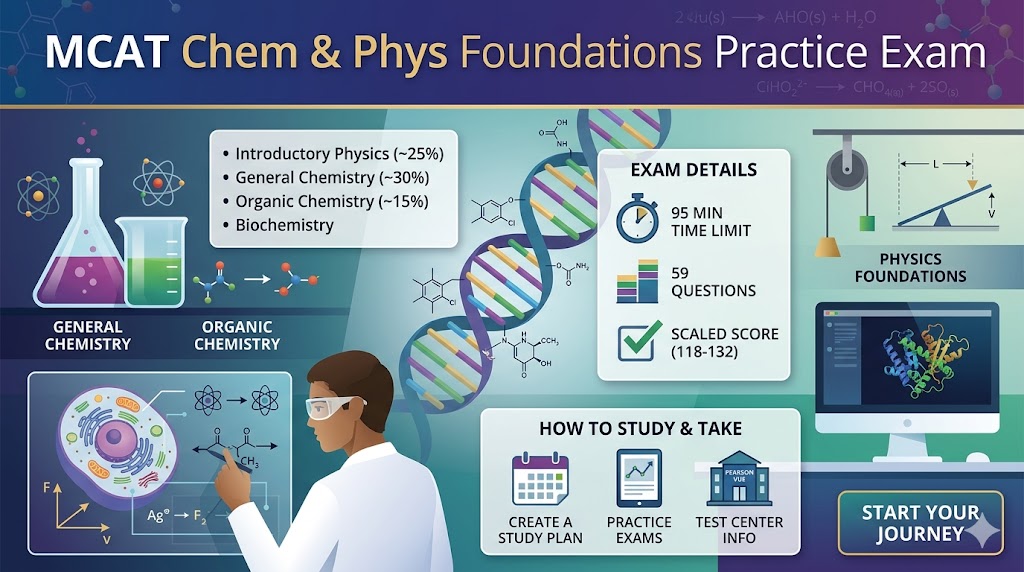
Additional Information
What the Course Entails and Exam Details
Preparing for this exam section requires a comprehensive
review of undergraduate-level sciences and their application to biological
contexts. The core syllabus covered in the Chemical and Physical Foundations
section encompasses several critical areas:
- General
Chemistry: Concepts such as atomic structure, periodic trends, chemical
bonding, stoichiometry, equilibrium, kinetics, thermodynamics, and
electrochemistry.
- Organic
Chemistry: Including molecular structure, nomenclature, stereochemistry,
reaction mechanisms of functional groups, and separation techniques.
- Physics:
Covering foundational concepts like translational motion, forces, work,
energy, fluids, circuits, optics, and nuclear physics, with a focus on
biological applications (e.g., blood flow, nerve impulse conduction).
- Biochemistry:
Focuses on the structure and function of biomolecules like proteins,
lipids, carbohydrates, and nucleic acids, as well as essential metabolic
pathways.
Furthermore, this section does not merely test recall; it
evaluates complex scientific inquiry and reasoning skills. Candidates must
demonstrate the ability to analyze and interpret data presented in passages and
figures, and apply scientific principles to new and unfamiliar situations,
often presented as real-world medical scenarios.
What to Expect in the Final Exam
On the official MCAT, the Chemical and Physical
Foundations of Biological Systems section follows a standardized,
computer-based format. Candidates will be presented with a total of 59
multiple-choice questions.
These questions are structured in two formats:
- Passage-based
questions: Approximately 10 distinct passages are provided, followed by
4-7 questions related to the information within the passage and the
candidate's outside knowledge.
- Discrete
questions: There are approximately 15 independent questions that are not
associated with a passage.
The time limit for this section is 95 minutes. This
requires rapid, accurate reading and efficient problem-solving. No calculator
is permitted during the exam, meaning numerical estimations and mental math are
crucial skills to develop. Scoring for the MCAT is not based on a predetermined
percentage. Raw scores (number correct) are converted to a scaled score ranging
from 118 to 132 for this section. A total MCAT score (the sum of all four
sections) ranges from 472 to 528. A competitive score generally falls well
above the midpoint (500), but requirements vary significantly by medical
school.
How to Study and
Exam Centers
Effective preparation for this section combines content
mastery with practical application.
Actionable Study Strategies:
- Take
Full-Length Practice Exams: Simulate the actual test environment by taking
full, timed practice exams under realistic conditions. This builds mental
stamina and helps identify content gaps.
- In-Depth
Review: When reviewing practice exams, don't just check the correct
answers. Analyze why you got questions wrong (content error,
misreading, or timing).
- Focus
on Passage Analysis: Practice extracting critical information from dense,
scientific passages quickly. Identify the main argument, methodologies
used, and key findings.
- Master
Mental Math: Practice rapid estimation and manipulation of scientific
notation, as you will not have a calculator.
- Content
Bridging: Don't study subjects in isolation. Practice applying physics
concepts to chemistry problems, and chemical concepts to biological
systems.
How to Take the Exam:
- Practice
Exams: Official practice materials can be purchased through the AAMC
(Association of American Medical Colleges) website and are accessed via an
online portal. Numerous reputable third-party companies (e.g., Kaplan,
Princeton Review) also offer online practice exams.
- Final
Exam Centers: The official MCAT is not taken at home. It is administered
globally at physical testing centers managed by Pearson VUE. Students must
register in advance through the AAMC website and select a specific date
and authorized Pearson VUE location. It is crucial to register early, as
seats fill up fast.
Job Opportunities
from the Course
While the MCAT is an entrance exam and not a
certification that grants immediate employment, achieving a strong score,
supported by rigorous practice, is the indispensable key to unlocking numerous
prestigious medical career paths.
Preparing for and excelling on this exam is the first
definitive step toward careers including:
- Doctor
of Medicine (MD)
- Doctor
of Osteopathic Medicine (DO)
- MD-PhD
Researcher (Joint clinical and research careers)
- Medical
Scientist (Focusing on clinical trials and development)
- Biomedical
Engineer (Applying physical principles to medical innovation)
- Healthcare
Administrator (Strong scientific foundation enhances decision-making)
- Scientific
Writer/Editor (Communicating complex medical concepts)
- University
Professor in Medical Sciences (Following doctoral studies)
Frequently Asked Questions
Reviews
5.0
Based on 0 reviews
Leave a Review
No reviews yet. Be the first to review!