
Mechanical Restraints, Aikido, Accountability and Control Practice Test
$69.00
- Buy to unlock unlimited access to all Quiz questions and Answers in this Quiz.
- After purchase you can print a PDF of the whole quiz at any point. The PDF will contain the questions and the correct answers.
About this Exam
The Mechanical Restraints, Aikido, Accountability and Control certification exam provides a critical validation of skills for professionals who must manage physically challenging situations with a blend of technical capability and ethical responsibility.
It is specifically designed for individuals in dynamic, high-accountability environments, such as law enforcement officers, private security personnel, correctional officers, loss prevention specialists, and healthcare workers in secure settings.
This qualification certifies your ability to use physical control techniques and mechanical restraints effectively, while adhering to the principles of dynamic balance, minimal necessary force, and profound accountability for your actions.
It bridges the gap between hands-on skill and professional, ethical control, ensuring you are prepared to de-escalate, manage, and secure environments while prioritizing the safety and dignity of all individuals.
By preparing for this comprehensive examination, you demonstrate a commitment to excellence in physical control and public trust.
Ready to test your knowledge?
Buy Now to Access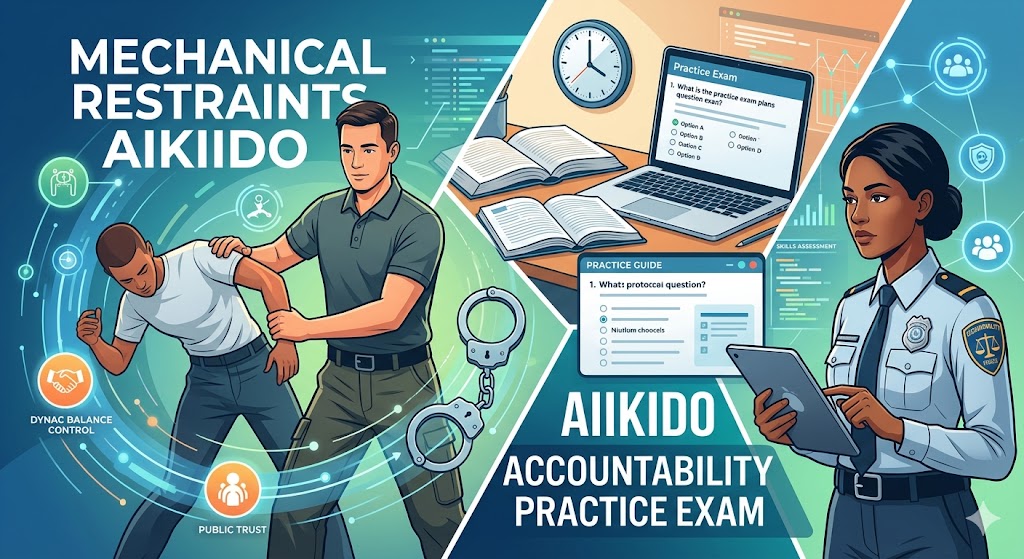
Additional Information
What the Course Entails and Exam Details
This examination is typically the capstone of an intensive
training program. Candidates must demonstrate deep knowledge and applied skill
across several critical domains:
Mechanical Restraints: Understanding the various
types of mechanical restraint equipment, their safe application, legal and
policy limitations, risk factors, and medical implications for individuals
being restrained.
Aikido Principles in Control: Integrating fundamental
concepts from Aikido, such as non-resistance, using dynamic balance to control
an opponent's energy, redirecting force without applying injury-prone joint
locks, and maintaining a calm, centered presence under pressure.
De-escalation and Communications: Techniques for
verbal command and non-verbal communication, managing adrenal response, and
strategies to resolve conflict before resorting to physical force.
Accountability and Legal Frameworks: Comprehensive
understanding of the legal basis for using force, professional ethics,
use-of-force continuums, dynamic risk assessment, documentation requirements,
and personal and organizational accountability following an incident.
Physical Control Techniques: Applied dynamic
techniques for controlling subjects while standing or in different
orientations, ensuring control without unnecessary impact or joint
manipulation, and coordinating dynamic team control scenarios.
Scenario-Based Application: Demonstrating the
seamless integration of all the above skills in complex, realistic,
high-pressure scenarios that test judgement, technique, and communication
simultaneously.
What to Expect in the Final Exam
The final certification exam for Mechanical Restraints,
Aikido, Accountability and Control is a rigorous, composite assessment designed
to test both theoretical understanding and practical skill. Candidates should
be prepared for a multi-stage examination process.
Written Examination (Theory): This component
typically consists of multiple-choice questions, true/false, and short answer
questions covering all theoretical aspects of the course. It assesses knowledge
of legal frameworks, accountability principles, restraint specifications, and
the ethics of dynamic control. Candidates often have a time limit (e.g., 60-90
minutes) and must achieve a passing score (typically 75-80%).
Practical Skill Assessment (Physical): This is the
core of the exam. Candidates are individually evaluated while performing a
range of restraint and control techniques on a cooperative partner or examiner.
You will be graded on the safety, efficacy, and correct application of
mechanical restraints, and your ability to demonstrate smooth physical control
using Aikido principles.
Scenario-Based Evaluation: Finally, candidates will
participate in one or more complex, immersive dynamic scenarios where they must
integrate communication, de-escalation, physical control, restraint
application, and post-incident procedures, showing full operational readiness.
Examiners assess dynamic risk management and ethical decision-making. Passing
requirements for the practical parts usually involve successful completion of
all core competencies with high proficiency and a demonstration of complete
safety awareness.
How to Study and Exam Centers
Effective preparation for this comprehensive certification
requires a balance of rigorous study and intensive physical practice.
Review All Course Materials: Your primary resource is
the detailed study guides, technical manuals, and policy documents provided
during your dynamic control and restraints training. Thoroughly understand all
written content first.
Intensive Practical Practice: You cannot pass the
practical assessment without hands-on practice. Utilize study partners to drill
dynamic Aikido-style control, joint positioning for non-injury control, and the
dynamic application of different types of mechanical restraints. Practice the
full movement from control to secure restraint repeatedly.
Utilize Practice Exams: Practice tests, like the one
associated with this study guide, are invaluable for reinforcing theoretical
knowledge and identifying knowledge gaps. Take them under simulated exam
conditions to manage your time and pressure.
Role-Play Scenarios: Practice realistic use-of-force
and restraint scenarios with partners, focusing on de-escalation, clear
communication, and the step-by-step application of control in response to
varied behaviors. Practice ethical dynamic decision-making under stress.
Access Exam Centers: The exam is typically
administered by the training provider or authorized external testing centers
that have the necessary physical facilities and equipment for both written and
practical assessments.
- Theory
Only (Written): Often, the theoretical written component can be taken
online through secure learning portals managed by your training
organization.
- Physical/Scenario
Assessment: The practical dynamic skill and scenario assessments must
be conducted in person at physical testing locations equipped with
appropriate safety mats, training aids, dynamic control partners, and
expert evaluators.
- Authorization:
Always confirm with your course administrator for specific locations,
dates, and online access porta
- Job Opportunities from the Course
Su
ccessfully achieving certification in Mechanical Restraints,
Aikido, Accountability and Control significantly enhances your career prospects
in various high-responsibility fields where dynamic control and ethical
physical management are critical skills.
You will find that this unique, integrated qualification is
highly valued for numerous roles, including:
- Private
Security Contractor
- Loss
Prevention Specialist
- Law
Enforcement Officer (LEO)
- State
and Federal Correctional Officer
- Detention
Center Supervisor
- Psychiatric/Mental
Health Security Professional
- Campus
Public Safety Officer
- High-Profile
Executive Protection Agent
- Event
and Venue Security Staff
- Crisis
Intervention Team (CIT) Member
- Youth
Services Officer in Secure Settings
- Corporate
Security Manager with Field Operations
- Control
and Restraints Instructor
Frequently Asked Questions
Reviews
5.0
Based on 0 reviews
Leave a Review
No reviews yet. Be the first to review!