
Media and Crime Practice Test
$69.00
- Buy to unlock unlimited access to all Quiz questions and Answers in this Quiz.
- After purchase you can print a PDF of the whole quiz at any point. The PDF will contain the questions and the correct answers.
About this Exam
The Media and Crime certification exam evaluates your understanding of the complex relationship between mass media, public perception, and the criminal justice system.
It is designed primarily for criminology students, journalism professionals, sociologists, and legal analysts who want to validate their expertise in how crime is reported, fictionalized, and consumed by society.
By mastering this subject, professionals can better navigate media ethics, understand the psychological impact of true crime, and critically analyze the societal effects of news coverage on criminal proceedings.
Ready to test your knowledge?
Buy Now to Access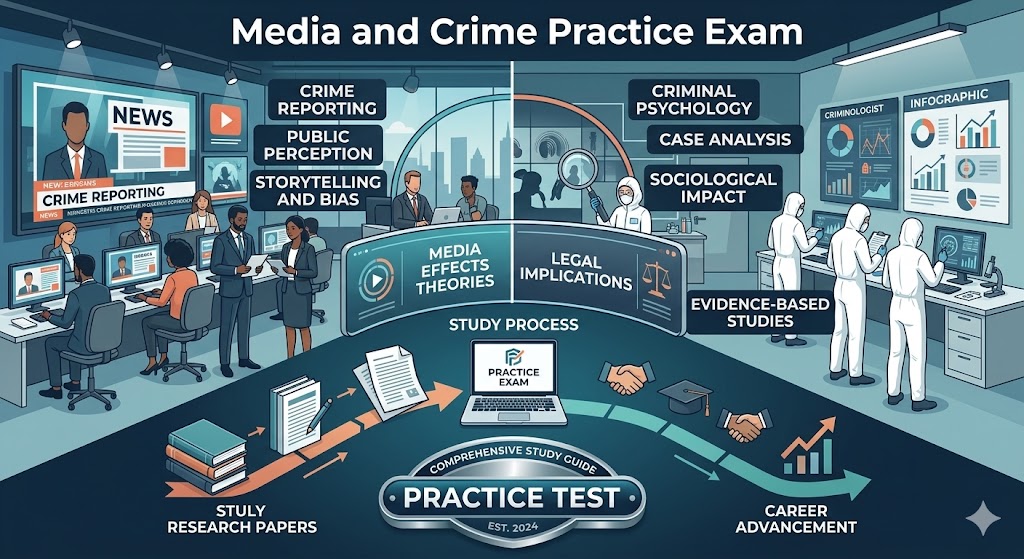
Additional Information
What the Course Entails and Exam Details
Preparing for the Media and Crime exam requires a deep dive
into sociological theories and modern media practices.
The syllabus covers the historical evolution of crime
reporting, exploring how sensationalism and "yellow journalism" shape
public fears and policy-making.
Core topics include the study of "moral panics,"
the portrayal of law enforcement in popular culture, and the systemic biases
present in mainstream news media.
Furthermore, the course delves into the digital age,
examining the role of social media in cybercrime, digital vigilantism, and the
viral nature of modern criminal investigations.
Candidates are also tested on media ethics, specifically the
balance between the public's right to know and the privacy or presumption of
innocence of the accused.
What to Expect in the Final Exam
The final exam is a rigorous assessment designed to test
both your theoretical knowledge and your ability to apply it to real-world
media landscapes.
Candidates can expect a comprehensive 120-minute test
consisting of 75 multiple-choice questions and three short-answer essay
prompts.
The multiple-choice section focuses on key definitions,
media theories, and historical case studies, while the essay questions require
critical analysis of provided media excerpts or news articles.
To pass the exam, candidates must achieve a minimum score of
70%.
The exam is strictly closed-book, and candidates are
expected to rely entirely on their prepared knowledge without the aid of
outside resources or internet access during the testing period.
How to Study and
Exam Centers
Success in this exam requires a strategic blend of reading
theoretical texts and analyzing current media trends.
Begin by actively reviewing seminal case studies where media
coverage significantly impacted a trial's outcome, and cross-reference these
with established criminological theories.
Practice by taking timed mock exams to build your pacing
skills and get comfortable with the multiple-choice format.
Additionally, we highly recommend forming study groups to
debate and dissect modern true crime documentaries or news cycles, which will
sharpen your analytical skills for the essay portion.
You can take the exam through official university testing
centers or authorized academic testing partners globally.
For maximum flexibility, the exam is also available via
secure, remote online proctoring portals like Pearson VUE or ProctorU, allowing
you to test from the comfort of your home using a monitored webcam and lockdown
browser.
Job Opportunities
from the Course
Earning a credential in Media and Crime opens the door to a
variety of specialized, high-impact careers at the intersection of law,
sociology, and communications.
Professionals with this expertise are highly sought after by
news organizations, government agencies, and non-profit advocacy groups.
This certification effectively unlocks the following career
paths:
- Crime
Journalist or Investigative Reporter
- Media
Analyst for Law Enforcement Agencies
- Public
Relations Specialist in the Legal Sector
- Criminologist
or Sociological Researcher
- Policy
Advisor on Criminal Justice Reform
- True
Crime Content Producer or Consultant
Frequently Asked Questions
Reviews
5.0
Based on 0 reviews
Leave a Review
No reviews yet. Be the first to review!