
Medical Assistant Law And Ethics Practice Test
$69.00
- Buy to unlock unlimited access to all Quiz questions and Answers in this Quiz.
- After purchase you can print a PDF of the whole quiz at any point. The PDF will contain the questions and the correct answers.
About this Exam
The Medical Assistant Law and Ethics Practice Exam is a comprehensive tool designed to prepare aspiring medical assistants for a critical portion of their national certification exams. In the healthcare industry, mastery of legal and ethical principles is not just a regulatory requirement; it is the foundation of safe, respectful, and professional patient care.
Ready to test your knowledge?
Buy Now to Access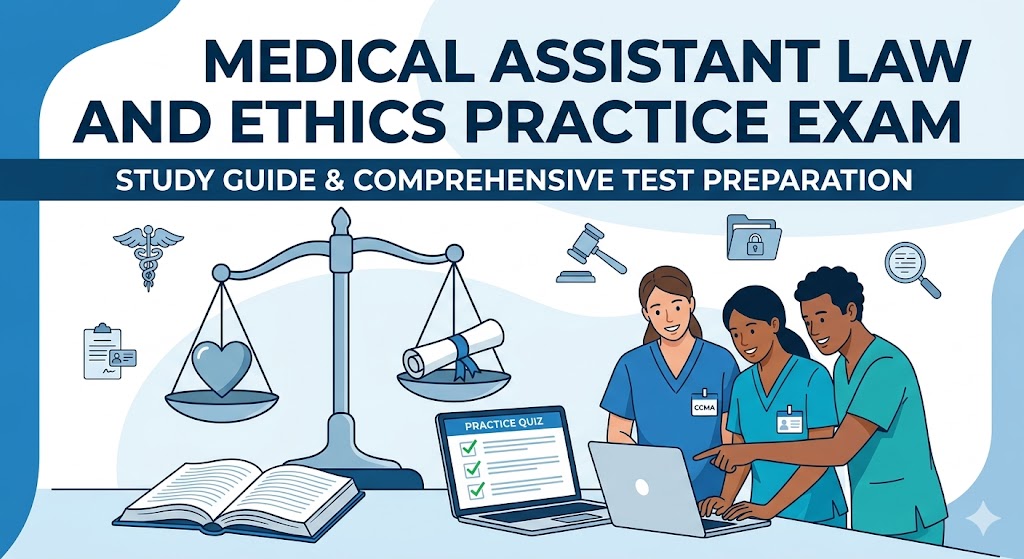
Additional Information
What the Course Entails and Exam Details
This practice test replicates the content and challenge
level found in the legal and ethical modules of the main national certification
exams. It focuses on the core competencies required of a medical assistant when
navigating the complex legal landscape of healthcare delivery.
The core topics and skills practiced include:
- Legal
Foundations: Understanding sources of law (statutory, common), courts,
subpoenas, and the trial process.
- Healthcare
Regulations: In-depth review of major federal and state laws,
including the Medical Practice Acts, Controlled Substances Act, OSHA, and
ADA.
- Professional
Liability: Mastery of concepts like negligence, malpractice, torts,
and the elements needed to establish professional liability.
- Patient
Rights and Consent: Differentiating between implied and informed
consent, understanding patient rights, and the correct way to handle
consent or refusal.
- Confidentiality
and Privacy (HIPAA): Comprehensive understanding of the Health
Insurance Portability and Accountability Act (HIPAA), defining Protected
Health Information (PHI), and proper data retention.
- Reporting
Requirements: Knowing when and how to legally mandate reporting of
abuse, communicable diseases, and other public health concerns.
- Scope
of Practice: Clearly defining the legal boundaries of what a medical
assistant is permitted to do.
- Bioethics
and End-of-Life: Exploring the ethical dilemmas in healthcare
surrounding informed consent, confidentiality, end-of-life choices, and
the Uniform Anatomical Gift Act.
What to Expect in
the Final Exam
While the "Medical Assistant Law And Ethics Practice
Test" is a practice tool, it is essential to understand the format of the
official certification exam it simulates. Typically, the legal and ethical
issues section is one component of a larger, single-sitting examination.
Here is what candidates can generally expect on their final
certification day (with slight variations depending on the chosen body, like
AAMA or NHA):
- Exam
Format: The vast majority of national medical assistant certification
exams consist entirely of multiple-choice questions. These questions range
from direct recall of definitions to complex, scenario-based problems
requiring critical application of law and ethics.
- Passing
Score Requirements: Scoring methods are often scaled, falling into a
specified range (e.g., 200–800), with a minimum threshold required to pass
(e.g., 405). This component's score is combined with clinical and
administrative sections.
- Time
Limits: Certification exams are strictly timed. Candidates should
practice pacing themselves to allow about one minute per question, as
common time limits range from two to three hours for the entire test.
- Specific
Rules: On test day, standard proctored exam rules apply: candidates
must present official identification, sign a log, and are prohibited from
bringing personal items (including cell phones and study materials) into
the testing room.
How to Study and Exam Centers
Successfully passing the law and ethics component requires a
dynamic approach that balances deep content knowledge with test-taking
strategy.
Actionable Study Strategies:
Take Diagnostic Practice
Tests: Begin by taking a full-length "Medical Assistant Law And Ethics
Practice Test." Use the results to identify weak content areas
immediately.
Focus on Wrong Answers and
Explanations: Do not just check your score. Meticulously review every
question you missed, and understand why the correct answer is right and
why your choice was incorrect.
Use Official Body Study
Guides: Supplement your practice with the official study resources provided
by the AAMA, AMT, or NHA. These are the single most accurate sources for exam
content outlines.
Create Legal Terminology
Flashcards: Law is a language of its own. Make digital or physical
flashcards for definitions like negligence, malpractice, abandonment, HIPAA
terms, and the differents types of consent.
Analyze Real-World Scenarios:
The hardest questions ask you to apply the law. Practice by analyzing medical
assisting case studies that involve legal or ethical dilemmas.
Simulate Test Day: As you
get closer to the final exam, take several timed practice tests under strict
conditions—no open books, no distractions, and a single sitting.
Exam Centers:
This practice test is typically available through online
training programs, certified study guide portals, or within official
certification body review materials. You can take it anywhere with internet
access.
For the final official certification exam, you will
need to schedule a proctored, in-person test through a registered testing
provider, such as:
- Pearson
VUE
- Prometric
- PSI
Candidates will select their preferred site and date from a
list of official physical testing centers after their application for
certification is approved.
Job Opportunities from the Course
Earning a national medical assistant certification, which
validates your legal and ethical foundational knowledge, significantly
increases your employability and can lead to various specialized paths.
Unlocking these job opportunities requires a strong grasp of
healthcare law and ethics:
- Certified
Medical Assistant (CMA AAMA)
- Registered
Medical Assistant (RMA AMT)
- Certified
Clinical Medical Assistant (CCMA NHA)
- Medical
Office Manager
- Clinical
Team Leader
- Healthcare
Compliance Assistant
- Health
Information Management (HIM) Clerk
- Medical
Records Coordinator
Frequently Asked Questions
Reviews
5.0
Based on 0 reviews
Leave a Review
No reviews yet. Be the first to review!