
Medical Billing and Coding Certificate Practice Exam
$69.00
- Buy to unlock unlimited access to all Quiz questions and Answers in this Quiz.
- After purchase you can print a PDF of the whole quiz at any point. The PDF will contain the questions and the correct answers.
About this Exam
The Medical Billing and Coding Certificate is a critical credential for individuals seeking to enter the administrative side of the healthcare industry.
This certification validates that a professional possesses the specialized skills required to translate medical, services, procedures, and diagnoses into universal alphanumeric codes used for billing and insurance reimbursement.
It is designed for aspiring healthcare administrative professionals, including recent high school graduates, career changers, or current healthcare workers looking to upskill.
Ultimately, this exam ensures that candidates can handle sensitive patient data accurately while maintaining compliance with rigorous federal regulations, making them invaluable assets to any medical facility.
Utilizing a comprehensive practice exam is an essential step to familiarize yourself with the material and boost your confidence before taking the official test.
Ready to test your knowledge?
Buy Now to Access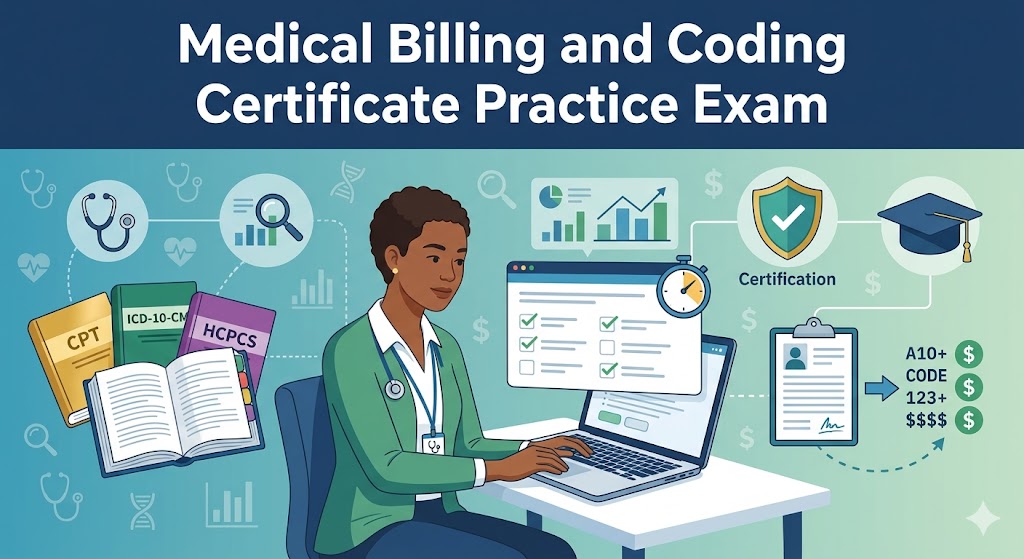
Additional Information
What the Course Entails and Exam Details
Preparing for this exam requires a mastery of several
distinct but related competencies.
Candidates must have a strong foundation in medical
terminology, anatomy, and physiology to correctly interpret provider notes.
The core of the curriculum involves proficiency in the three
primary code sets: ICD-10-CM (International Classification of Diseases, 10th
Revision, Clinical Modification), CPT (Current Procedural Terminology), and
HCPCS Level II (Healthcare Common Procedure Coding System).
Beyond coding mechanics, the course covers the entire
revenue cycle process, including insurance claim submission, analyzing
Remittance Advices (RAs), and handling claim denials or appeals.
Furthermore, dynamic knowledge of regulatory compliance,
specifically HIPAA (Health Insurance Portability and Accountability Act), is
crucial to ensure patient privacy and prevent fraud.
Most practice exams are designed to mimic the content
breakdown of the major certifying bodies to provide a realistic assessment of
your readiness.
What to Expect in
the Final Exam
While exact details depend on the specific certifying body
you choose (such as the AAPC or AHIMA), general expectations for the final
certification exam are fairly standard.
The final exam is typically a challenging, timed event
consisting almost entirely of multiple-choice questions.
Candidates can generally expect between 100 and 150
questions, and they are usually allotted substantial time, often ranging from
two to four hours, to complete the test.
It is vital to understand that this is largely an "open
book" style exam; you will be permitted—and expected—to use official
coding manuals (ICD-10, CPT, and HCPCS) to find the correct codes during the
test.
While exact passing scores vary slightly by year and
certifying organization, a score of approximately 70% or higher is usually
required to earn your certification.
Standard testing rules strictly prohibit cheating, sharing
information, or the use of unauthorized electronic devices during the session.
How to Study and
Exam Centers
Effective preparation for this exam requires a strategic
combination of conceptual understanding and rapid information retrieval from
code books.
You should establish a structured study schedule and utilize
flashcards to master medical terminology and anatomy, as this knowledge speeds
up your ability to decipher scenarios.
One of the most effective study strategies is to take
multiple practice exams under timed conditions to simulate the pressure of the
actual testing day.
When taking practice tests, focus heavily on timing,
ensuring you are not spending too long on any single question, and practice
looking up codes quickly in your manuals.
Regarding the final official exam, you typically have two
main options for testing.
Many major certifying organizations now offer secure,
proctored online exams that you can take from your own home or office, provided
you have a compatible computer, webcam, and reliable internet connection.
Alternatively, you can choose to take the exam in person at
authorized physical testing centers, such as Pearson VUE centers, or at
specific educational institutions and authorized schools that hold group
testing events.
Job Opportunities
from the Course
Earning your certification drastically improves your job
prospects, proving to employers that you possess verified skills in a field
where accuracy is paramount.
Here is a clear list of potential job titles and career
paths this certification unlocks:
- Medical
Coder: Translates patient charts into official codes for
reimbursement.
- Medical
Biller: Submits claims to insurance providers and follows up on
payments.
- Health
Information Technician: Manages and organizes electronic health
records (EHRs) and patient data.
- Medical
Records Coordinator: Handles the organization, retrieval, and
maintenance of all patient records within a facility.
- Revenue
Cycle Specialist: Focuses on managing the entire administrative and
clinical functions that contribute to the capture, management, and
collection of patient service revenue.
- Claims
Analyst: Reviews insurance claims for accuracy, completeness, and
eligibility before they are paid.
- Healthcare
Reimbursement Specialist: Specializes in ensuring a facility is
correctly compensated by federal and private insurance programs.
Frequently Asked Questions
Reviews
5.0
Based on 0 reviews
Leave a Review
No reviews yet. Be the first to review!