
Medical College Admission Test (MCAT) General Chemistry Practice Exam
$69.00
- Buy to unlock unlimited access to all Quiz questions and Answers in this Quiz.
- After purchase you can print a PDF of the whole quiz at any point. The PDF will contain the questions and the correct answers.
About this Exam
The Medical College Admission Test (MCAT) is a standardized, multiple-choice examination designed to assess your problem-solving, critical thinking, and knowledge of natural, behavioral, and social science concepts and principles prerequisite to the study of medicine.
Ready to test your knowledge?
Buy Now to Access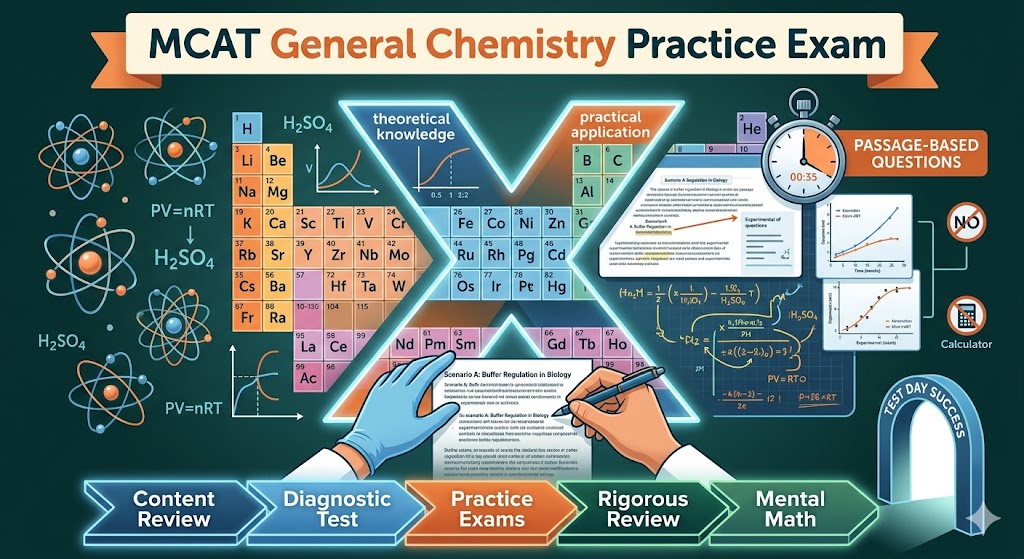
Additional Information
What the Course
Entails and Exam Details
While this practice tool is formatted as an exam, success
requires a deep understanding of standard undergraduate introductory general
chemistry. This preparatory "course" involves a rigorous review of
foundational principles and their application to complex, often biologically
relevant scenarios. A full preparation plan will ensure mastery of the
following core topics and skills:
Core Chemistry Topics:
- Atomic
Structure and Periodic Trends: Subatomic particles, electron
configuration, orbital diagrams, isotopes, and patterns like atomic
radius, ionization energy, and electronegativity.
- Chemical
Bonding and Molecular Structure: Ionic vs. covalent bonds, Lewis
structures, VSEPR theory, molecular geometry, and intermolecular forces
(hydrogen bonding, dipole-dipole).
- Stoichiometry
and Reactions: Balancing equations, the mole concept, empirical and
molecular formulas, limiting reagents, theoretical yield, and types of
chemical reactions.
- Chemical
Kinetics: Reaction rates, rate laws, collision theory, activation
energy, and the role of catalysts and enzymes.
- Chemical
Equilibrium: The equilibrium constant (K), Le Châtelier's principle,
and applications to heterogeneous equilibria.
- Thermodynamics
and Thermochemistry: State functions, enthalpy (ΔH), entropy (ΔS),
Gibbs free energy (ΔG), Hess's law, and calorimetry.
- Phases
and Gases: Gas laws (Ideal Gas Law, Dalton's Law), kinetic molecular
theory, and phase diagrams.
- Solutions
and Solubility: Concentration units (molarity, molality), solubility
rules, Ksp, and colligative properties.
- Acids
and Bases: Bronsted-Lowry and Lewis theories, pH/pOH calculations,
strong vs. weak species, buffer systems, and titration curves.
- Electrochemistry:
Oxidation-reduction reactions, assigning oxidation numbers,
electrochemical cells (galvanic and electrolytic), and Nernst equation.
Scientific Inquiry and Reasoning Skills:
The MCAT does not just test rote recall; it requires you to
apply knowledge. You will need to demonstrate:
- Knowledge
of scientific concepts and principles.
- Scientific
reasoning and problem-solving.
- Reasoning
about the design and execution of research.
- Data-based
and statistical reasoning.
What to Expect in
the Final Exam
The actual MCAT is a brutal test of stamina and critical
thinking, administered over a full day. The "Chemical and Physical
Foundations of Biological Systems" section, which includes General
Chemistry, is the first section you will face.
- Format:
The section consists of 59 multiple-choice questions. It includes both
passage-based sets and discrete questions.
- Passage-Based
Questions: You will be presented with scientific passages describing
experiments, studies, or scenarios, often with graphs or tables. A set of
questions follows, requiring you to interpret the data and apply your
chemistry knowledge to answer.
- Time
Limit: You have 95 minutes for this section, giving you an average of
just under 1 minute and 37 seconds per question, including reading time
for passages.
- Calculator
Policy: Absolutely NO calculators are permitted on the MCAT. You must
be prepared to perform all mathematical calculations, including mental
math and estimations, by hand on the provided scratch paper.
- Periodic
Table: A simplified periodic table will be available as a clickable
pop-up during the exam.
- Scoring:
There is no "passing" or "failing" score. Each of the
four sections is scored on a scaled range from 118 to 132, for a total
total score ranging from 472 to 528. The 50th percentile is approximately
500, with competitive medical school applicants often aiming for a score
above 510.
How to Study and
Exam Centers
Preparation for the MCAT, and the General Chemistry portion
specifically, requires a structured, multi-month study plan. Taking practice
exams is the cornerstone of this process.
Actionable Study Strategies:
Diagnostic Test First:
Begin your prep with a full-length, timed diagnostic test to establish your
baseline and identify your weakest content areas.
Focus on Content Gaps: Use
your diagnostic results to prioritize your content review, spending more time
on difficult areas like electrochemistry or acid-base equilibria.
Emphasis on Application over
Memorization: While you must memorize equations, focus on why they
are used and how to apply them to novel passage-based scenarios. Practice
linking chemistry concepts to biological systems.
Simulate Test Conditions:
When taking our [Medical College Admission Test (MCAT) General Chemistry
Practice Exam], do so under strict timed conditions. Sit in a quiet room, take
your full scheduled breaks, and use no outside resources, including a
calculator.
Rigorous Review: The most
critical part of your practice is the review. Spend at least as much time
reviewing a practice test as you did taking it. Analyze every single
question—why you got it right, why you got it wrong, and why every other answer
choice was incorrect.
Practice Math Skills:
Dedicate time to improving your mental math, scientific notation, and
estimation skills to handle calculations quickly and accurately without a
calculator.
Exam Center Details:
The official MCAT is not administered through online
portals or remotely. It is a highly secure, in-person exam.
- Testing
Centers: The AAMC partners with Pearson VUE to administer the MCAT at
hundreds of authorized, secure testing centers across the United States,
Canada, and select international locations.
- Registration:
You must register for your exam date and location through the AAMC
website. We highly recommend registering as early as possible, as seats
fill up months in advance.
Job Opportunities
from the Course
Successfully passing the MCAT and achieving a competitive
score is the prerequisite gatekeeper for the final career path. While it does
not unlock immediate "job titles" itself, a high MCAT score is the
definitive first step toward entering a career with a Medical Degree (MD or
DO).
The medical degree unlocked by your MCAT performance opens
doors to numerous diverse career paths:
- Physician
(Clinical Practice): Working in a wide array of specialties, such as
Primary Care, Surgery, Pediatrics, Emergency Medicine, Cardiology,
Neurology, etc.
- Physician-Scientist
(Research): A career combining patient care with leading biomedical
research, often at academic medical centers, NIH, or in the pharmaceutical
industry.
- Academic
Medicine (Teaching): Educating the next generation of physicians as a
professor or clinical instructor at a medical school.
- Healthcare
Executive/Hospital Administrator: Leading large healthcare systems,
managing policy, and overseeing institutional strategy.
- Public
Health Official/Advocate: Working in government agencies like the CDC,
WHO, or non-profits to manage health crises, shape public health policy,
or advocate for community wellness.
- Political
Advocate/Medical Journalist: Utilizing medical expertise to
communicate science to the public or advocate for healthcare-related
legislation.
- Medical
Informaticist: A growing field focused on leveraging data science and
technology to optimize patient care and hospital systems.
- Medicolegal
Consultant: Providing medical expertise and record review for legal
cases or insurance companies.
Frequently Asked Questions
Reviews
5.0
Based on 0 reviews
Leave a Review
No reviews yet. Be the first to review!