
Medical Dosimetry Certification Practice Test
$69.00
- Buy to unlock unlimited access to all Quiz questions and Answers in this Quiz.
- After purchase you can print a PDF of the whole quiz at any point. The PDF will contain the questions and the correct answers.
About this Exam
Embarking on the journey to become a Certified Medical Dosimetrist (CMD) is a significant and rewarding decision for individuals dedicated to the vital field of radiation oncology. This certification, administered by the Medical Dosimetrist Certification Board (MDCB), serves as a rigorous validation of the knowledge and clinical skills essential for success in this demanding role. A medical dosimetrist is a critical member of the radiation oncology team, working alongside radiation oncologists and medical physicists to design and implement precise radiation treatment plans for cancer patients. This comprehensive study guide and the concept of a "Medical Dosimetry Certification Practice Test" are meticulously designed to empower candidates who have completed the necessary educational prerequisites and are striving to achieve professional recognition and unlock their full potential in the healthcare sector. The certification not only demonstrates professional competence but also signifies a commitment to patient safety, accuracy, and the highest standards of care.
Ready to test your knowledge?
Buy Now to Access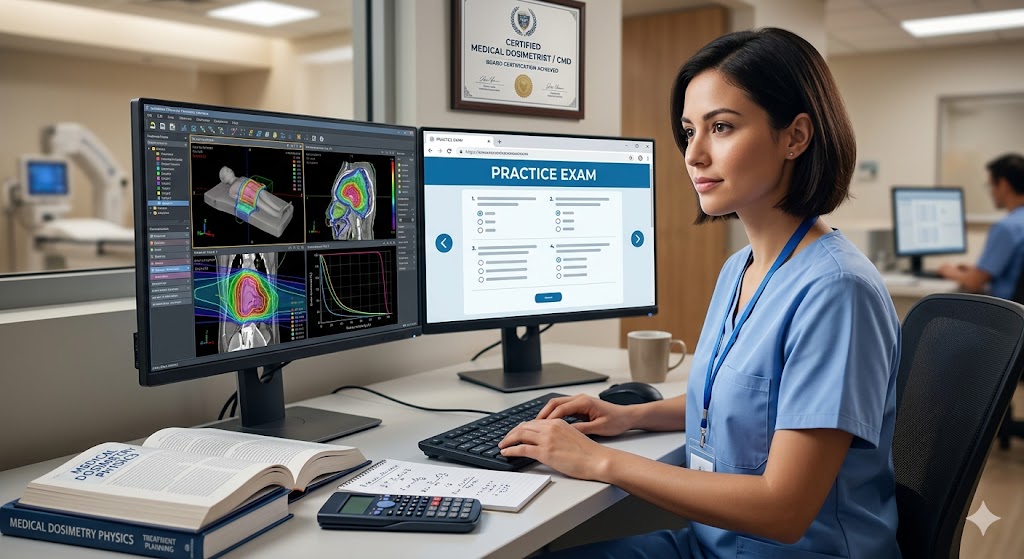
Additional Information
What the Course Entails and Exam Details
To even qualify for the certification exam, aspiring
dosimetrists typically must complete a formal, Joint Review Committee on
Education in Radiologic Technology (JRCERT)-accredited medical dosimetry
program, which is often a robust 12 to 24-month curriculum. These programs are
rigorous, combining intensive classroom instruction with extensive hands-on
clinical experience to develop proficiency in key areas. The standard course
syllabus and the content domains covered in the CMD exam reflect this depth, focusing
heavily on specialized knowledge. Key areas include:
- Treatment
Planning (a significant portion of the exam, typically around 42%):
Understanding various techniques and advanced algorithms for external
beam, IMRT, VMAT, and brachytherapy. This includes the ability to
translate a physician's prescription into a safe and effective plan,
meticulously considering patient anatomy and critical structures.
- Radiation
Physics & Radiobiology: A foundational pillar, covering principles
of radiation physics, beam properties, and how radiation interacts with
tissue on a cellular level.
- Dose
Calculation Methods: Mastering the complex mathematical formulas and
computational methods for precisely determining dose distribution.
- Localization
& Cross-sectional Anatomy: Developing a keen understanding of
intricate human anatomy in three dimensions, critical for accurate
contouring and planning.
- Quality
Assurance & Standards of Care: Implementing precise protocols and
maintaining stringent quality standards to ensure safe and accurate
treatments.
- Radiation
Protection: Prioritizing safety through understanding and applying
core principles to protect both patients and healthcare personnel from
excessive exposure.
The "course" you undertake isn't just about
passing a single test; it's a comprehensive educational journey that equips you
with the multi-faceted expertise to excel in this precise and impactful
profession.
What to Expect in
the Final Exam
When you finally sit for the Medical Dosimetry Certification
Board (MDCB) exam, you should be thoroughly prepared for a precise,
challenging, and extensive assessment designed to ensure only truly qualified
individuals earn the CMD designation. The exam is typically a comprehensive
computer-based test, structured as follows:
- Format:
The exam consists of approximately 155 multiple-choice questions. It's
important to note that a small number of these may be experimental
questions that do not contribute to your final score but are used for
statistical analysis on future tests.
- Time
Limit: Candidates are typically given 3 hours and 50 minutes to
complete the entire exam. This time pressure, combined with the complex
nature of the questions, makes time management a crucial skill during your
preparation and on the actual test day.
- Passing
Score: To pass and achieve certification, a candidate must obtain a
minimum scaled score of 600 out of a possible 800. This is not a simple
percentage; the scaled score accounts for varying degrees of difficulty
across different versions of the exam.
- Rules
& Security: Standard, secure testing protocols are strictly
enforced. You can expect thorough identity verification and prohibitions
on bringing unauthorized materials into the testing area, ensuring the
integrity of the process.
How to Study and Exam Centers
Effective preparation for this comprehensive exam is
essential. A robust strategy that incorporates various learning methods will
significantly improve your chances of success.
Actionable Study Strategies:
- Leverage
Practice Tests: Actively seeking out multiple "Medical Dosimetry
Certification Practice Tests" is highly recommended. These tools help
you familiarize yourself with the question style, format, difficulty
level, and the time constraints you will face, allowing you to build both
knowledge and test-taking confidence.
- Review
Textbooks & Core Resources: Dive deep into foundational texts in
radiation physics (like Gibbons' Khan's The Physics of Radiation Therapy),
treatment planning, anatomy, and standard clinical guidelines.
- Use
MDCB Study Materials: The MDCB website offers invaluable resources,
including a content outline/syllabus, a study guide, and potentially
retired test questions, which are essential for understanding exactly what
is expected.
- Group
Study & Discussion: Collaborating with peers allows you to discuss
complex concepts, share different perspectives on clinical scenarios, and
quiz each other on key knowledge areas, reinforcing learning.
- Practice
Calculations: Master the required formulas and calculations under
timed conditions to ensure accuracy and speed. Review any errors
meticulously.
- Analyze
Practice Results: Do not just take practice tests; thoroughly review
every question you answer, especially the ones you get wrong. Understand
the underlying principles and why the correct answer is the most
appropriate.
Exam Centers and How to Take the Exam:
- Testing
Provider: The MDCB exam is typically administered globally through
major authorized testing organizations, most commonly Pearson VUE.
- Scheduling:
Once your application and eligibility are confirmed by the MDCB, you will
receive instructions on how to schedule your exam appointment through the
Pearson VUE website.
- Location:
Pearson VUE has a vast network of physical testing centers located in
major cities across the world, and you can usually find a convenient
location to take your test. The entire process, from registering to
selecting your center and time, is generally managed through their online
portal, making booking straightforward. It is wise to book well in
advance, especially during popular testing windows, to secure your desired
time and location.
Job Opportunities from the Course
Successfully navigating the educational requirements and
passing the MDCB certification exam opens the door to a wide array of dynamic
and well-compensated career opportunities within the specialized field of
radiation oncology. While many individuals begin their careers as a certified
dosimetrist, this path is just the beginning.
Career Paths and Job Titles for Certified Medical
Dosimetrists:
- Staff
Medical Dosimetrist: The primary role for many, working in hospitals,
cancer centers, or private clinics to create precise treatment plans.
- Proton
Dosimetrist: Specializing in the development of treatment plans for
advanced proton beam therapy, which requires further specialized
knowledge.
- Lead
or Chief Dosimetrist: With experience and demonstrated leadership,
transitioning into a supervisory or management role within a dosimetry
department, overseeing teams, protocols, and workflows.
- Vendor
Applications & Sales Specialist: Working for companies that
manufacture radiation therapy equipment and software, providing technical
support, training, and consultation to clinical staff, or driving sales
through expert knowledge.
- Department
Manager or Administrator: Progressing into a broader leadership role
within a radiation oncology department, managing operations, budgets, and
personnel.
- Research
& Development: Playing a key role in clinical research, publishing
articles, developing new treatment techniques, and advancing the science
of radiation therapy.
- Locum
Tenens Work: Enjoying flexibility and diverse experiences by working
temporary or contract assignments in different facilities across the
country or world.
- Educator
or Program Director: Sharing knowledge and training the next
generation of medical dosimetrists and radiation oncology professionals in
academic settings.
- Clinical
Preceptor: Combining clinical work with mentoring students during
their rotations, directly contributing to their professional development.
Frequently Asked Questions
Reviews
5.0
Based on 0 reviews
Leave a Review
No reviews yet. Be the first to review!