
Medical Gas Line Practice Test
$69.00
- Buy to unlock unlimited access to all Quiz questions and Answers in this Quiz.
- After purchase you can print a PDF of the whole quiz at any point. The PDF will contain the questions and the correct answers.
About this Exam
The Medical Gas Line certification exam is a specialized credential designed for professionals who install, maintain, inspect, or verify medical gas and vacuum systems.
This certification is essential for plumbers, pipefitters, healthcare facility engineers, and quality inspectors who work on critical infrastructure within hospitals, dental clinics, and surgical centers.
Because medical gases like oxygen, nitrous oxide, and medical air directly impact patient health and safety, this exam ensures that workers possess the absolute highest level of technical competence.
Earning this credential demonstrates that you fully understand the strict safety guidelines and mechanics required to prevent contamination and system cross-connections.
Ready to test your knowledge?
Buy Now to Access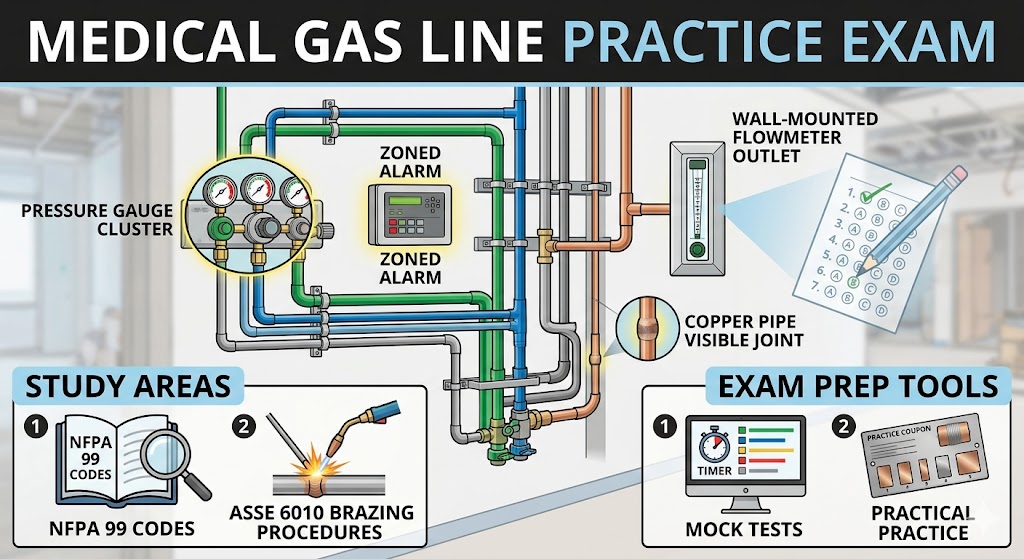
Additional Information
What the Course Entails and Exam Details
The preparation course and the accompanying exam cover a
highly rigorous technical syllabus derived from industry standards, primarily
the National Fire Protection Association (NFPA 99) Health Care Facilities Code
and ASSE International standards.
Key topics included in the curriculum focus on system
components, station outlets, gas cylinders, and central supply systems.
You will study the deep mechanics of medical air
compressors, vacuum pumps, and the intricate pipeline distribution networks
that run through healthcare walls.
A heavy emphasis is placed on installer requirements,
specific brazing procedures for medical gas copper piping, and safety
documentation.
Additionally, the syllabus covers the installation of master
and area alarm panels, pressure testing sequences, and final verification
protocols before a system can be safely cleared for patient use.
What to Expect in the Final Exam
The final certification exam evaluates both your theoretical
knowledge and your practical application of medical gas infrastructure safety
rules.
The written portion of the exam typically consists of
multiple-choice questions that test your ability to recall and apply NFPA 99
codes under pressure.
Depending on the specific level of certification you are
seeking—such as the ASSE 6010 Installer or ASSE 6020 Inspector credential—the
exam may also include a practical hands-on demonstration, such as completing an
acceptable vertical up-flow braze joint.
Candidates are generally given a strict time limit, often
ranging between two to three hours, to finish the written computer-based test.
A passing score usually requires achieving at least 70% to
80% correct answers, and compliance with all safety and testing center rules is
strictly enforced.
How to Study and Exam Centers
Successfully passing the test requires a structured study
plan that balances reading official codebooks with taking targeted practice
exams.
Begin by thoroughly reviewing the latest edition of the NFPA
99 textbook and the ASSE Series 6000 Professional Qualifications Standard.
Utilizing online practice tests is highly recommended, as
mock exams help familiarize you with the wording of test questions and improve
your time-management skills.
Many candidates choose to enroll in a formal training
program approved by the Medical Gas Training Institute (MGTI) or the National
Inspection-Testing-Certification Corporation (NITC).
The exam itself can be scheduled and taken at authorized
physical testing locations, including Pearson VUE centers, computerized testing
facilities run by the NITC, or directly at certified trade school testing
locations.
Job Opportunities from the Course
Holding a medical gas certification opens doors to highly
specialized, lucrative career paths within the mechanical, plumbing, and
healthcare engineering industries.
Certified Medical Gas Installer
Medical Gas Systems Inspector
Healthcare Facilities Maintenance Engineer
Hospital Maintenance Technician
Medical Gas Verification Specialist
Plumbing Project Manager
Mechanical Systems Quality Control Inspector
Commercial Plumbing Foreman
Frequently Asked Questions
Reviews
5.0
Based on 0 reviews
Leave a Review
No reviews yet. Be the first to review!