
Medical Gas Systems Certification Practice Exam
$69.00
- Buy to unlock unlimited access to all Quiz questions and Answers in this Quiz.
- After purchase you can print a PDF of the whole quiz at any point. The PDF will contain the questions and the correct answers.
About this Exam
The Medical Gas Systems Certification Practice Exam is a robust study resource designed for individuals seeking formal certification in the installation, maintenance, or inspection of medical gas and vacuum systems. This certification, typically governed by ASSE Standard 6000 (such as ASSE 6010 for installers or 6030 for verifiers) or based on the NFPA 99 Health Care Facilities Code, is essential for professional competence and patient safety.
The exam targets plumbers, pipefitters, HVAC technicians, engineers, and healthcare facility maintenance personnel who require the specialized knowledge needed to work on systems carrying critical substances like oxygen, medical air, vacuum, and nitrous oxide within healthcare environments. This comprehensive practice exam simulates the rigor and content of the official certification, ensuring candidates are fully prepared to demonstrate their mastery of these complex systems.
Ready to test your knowledge?
Buy Now to Access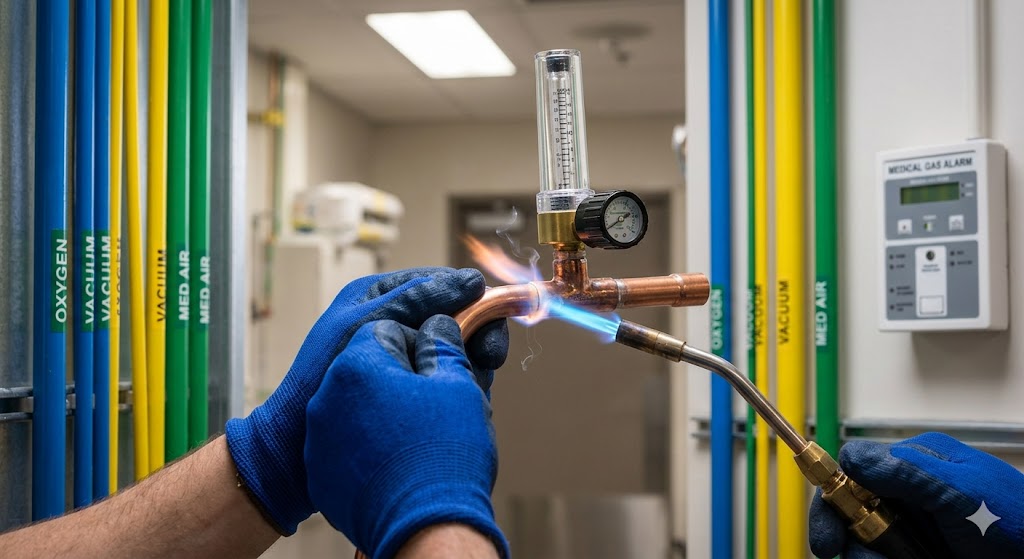
Additional Information
What the Course
Entails and Exam Details
This examination course and practice program comprehensive
cover the essential regulations, procedures, and practical skills detailed in
code requirements.
Candidates will delve into:
- NFPA
99 and ASSE 6000 Standards: Understanding and applying the fundamental
codes governing medical gas and vacuum systems.
- System
Design and Sizing: Learning the principles of distribution, flow, and
appropriate material selection (copper piping, fittings, etc.).
- Source
Equipment: Detailed study of medical air compressors, vacuum pumps,
manifold systems (gases like oxygen and nitrous oxide), and bulk liquid
systems.
- Pipeline
Installation and Brazing: Understanding the techniques and strict
cleanliness standards required for jointing (specialized brazing).
- Warning
Systems (Alarms): Master the installation, operation, and verification
of master alarms and area alarms.
- Valves
and Outlets/Inlets: Principles of zone valve box placement and
patient-connection points.
- Testing
and Verification: Procedures for initial testing, final pressure
testing, documentation, and operational verification (e.g.,
cross-connection testing, particulate tests).
- Documentation
and Reporting: Legal and safety requirements for maintaining system
records.
The practice exam consists of multiple-choice questions
designed to mirror the topics and difficulty level of the official
certification test. It focuses on applying the code and making correct
technical judgments.
What to Expect in the Final Exam
The actual Medical Gas Systems Certification Exam (such as
the ASSE 6010) is typically a multiple-choice assessment that tests both
knowledge and code application. While specifics can vary slightly by certifying
agency (like NITC or others), candidates can generally expect the following
format:
- Format:
Multiple-choice questions.
- Question
Count: Typically ranging from 80 to 120 questions.
- Time
Limit: Generally between 2 to 4 hours, requiring time management and
rapid code referencing.
- Passing
Score: Usually a minimum of 70% to 80% correct answers.
- Rules:
Depending on the testing standard, it may be open-book, allowing specific
references like NFPA 99 and ASSE 6000. Practical components, such as a
witnessed brazing test, are sometimes separate prerequisites for full
installation certification.
- Mode:
Often delivered via secure online platforms or proctored computer-based
testing.
This structure emphasizes accuracy and the ability to find
and interpret the relevant codes efficiently.
How to Study and
Exam Centers
Effective preparation for this certification requires a
combination of self-study, training, and practice.
Actionable study strategies include:
- Review
Code Books: Master the NFPA 99 Health Care Facilities Code and the
applicable ASSE 6000 standard (e.g., ASSE 6010, 6030, or 6040).
- Take
Training Courses: Enroll in authorized medical gas systems
certification courses provided by trade organizations, community colleges,
or specialized private training providers.
- Use
the Practice Exam: Take full-length, timed practice tests (like this
one) to assess your knowledge, identify weak areas, and practice managing
your time.
- Focus
on Code Application: Practice solving scenarios by locating the
specific answer within the code text.
- Form
Study Groups: Collaborating with peers preparing for the same exam can
provide new perspectives and motivation.
Authorized Testing Methods and Centers:
The official certification exam is administered through
authorized testing organizations, including specialized private providers and
established testing networks. Examples include:
- NITC
(National Inspection Testing Certification): A major provider using a
wide network of proctored testing centers or online remote proctoring
options.
- Authorized
School/Trade Testing: Many localized medical gas training programs are
authorized to proctor the exam upon completion of their course.
- Online
Proctored Platforms: Some certifying bodies use specialized online
testing services that allow candidates to take the exam remotely with live
proctoring.
It is crucial to verify the specific requirements and
delivery methods of your chosen certifying organization.
Job Opportunities
from the Course
Earning a Medical Gas Systems Certification validates highly
specialized technical skills and knowledge that are in significant demand
within the healthcare construction and maintenance sectors. This qualification
opens doors to a variety of focused career paths and increases earning
potential.
Specific job titles and career paths this certification
unlocks include:
- Medical
Gas Systems Installer (ASSE 6010): Specializing in the skilled
installation and brazing of pipework and components in hospitals and
clinics.
- Medical
Gas Systems Verifier (ASSE 6030): Conducts mandatory inspections and
testing of systems to certify compliance before patient use.
- Healthcare
Facility Maintenance Technician/Engineer: Responsible for the ongoing
operation, testing, and maintenance of existing medical gas
infrastructure.
- Mechanical
Contractor specializing in Healthcare Projects: Bidding and overseeing
large-scale hospital construction or renovation contracts.
- Plumbing/Pipefitting
Foreman specializing in Medical Gas: Supervise teams of certified
installers on construction sites.
- Code
Compliance Inspector: Working for municipalities or healthcare
regulatory bodies ensuring adherence to standards.
- Medical
Gas System Design Engineer: Utilizing knowledge of codes to design
safe and efficient distribution systems.
- Maintenance
Supervisor/Manager in Healthcare Facilities: Overseeing all
engineering systems within a medical complex.
Frequently Asked Questions
Reviews
5.0
Based on 0 reviews
Leave a Review
No reviews yet. Be the first to review!