
Medical Priority Dispatch System (MPDS) Practice Exam
$69.00
- Buy to unlock unlimited access to all Quiz questions and Answers in this Quiz.
- After purchase you can print a PDF of the whole quiz at any point. The PDF will contain the questions and the correct answers.
About this Exam
The Medical Priority Dispatch System, commonly known as MPDS, is a world-renowned, logic-based system designed to guide Emergency Medical Dispatchers (EMDs) in providing essential, life-saving assistance and effectively prioritizing emergency medical calls. This certification is a critical qualification for professionals working in emergency call centers and public safety answering points (PSAPs). The exam is designed for individuals seeking to become certified EMDs or to renew their existing certification, verifying their proficiency in the system's protocols and their ability to handle high-stress situations with precision and care.
Ready to test your knowledge?
Buy Now to Access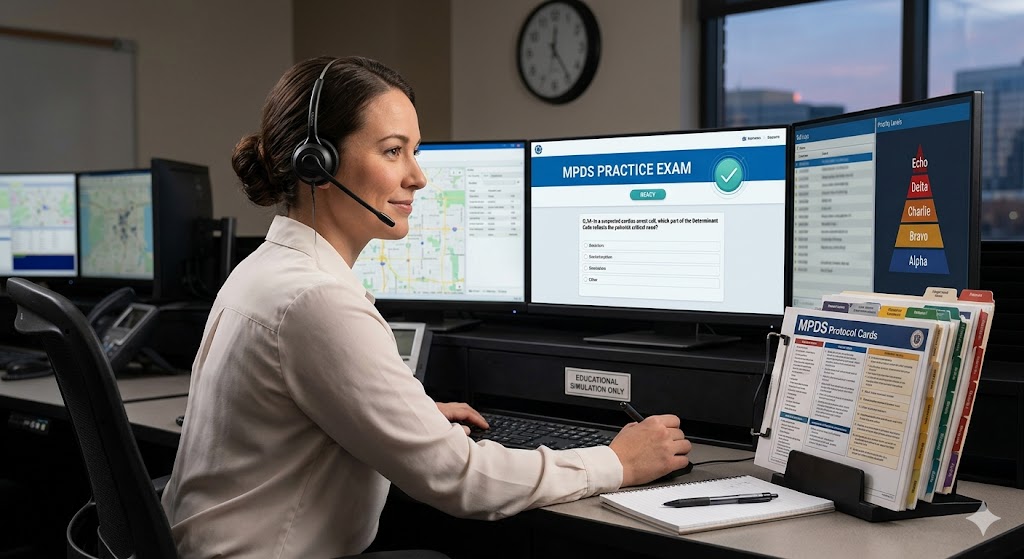
Additional Information
What the Course Entails and Exam Details
Preparing for the MPDS exam generally begins with a
comprehensive EMD certification course, often accredited by the International
Academies of Emergency Dispatch (IAED). These courses delve into the intricate
protocols that define the system. You will learn the entire structure,
including the initial Case Entry questions, the specific Chief Complaint
protocols, and the critical categories of determinants: Echo, Delta, Charlie,
Bravo, Alpha, and Omega, each reflecting the potential severity and resource requirements.
Key areas covered include how to deliver crucial Pre-Arrival Instructions
(PAIs) and Post-Dispatch Instructions (PDIs), effectively prioritizing
symptoms, and understanding the medical-legal aspects of dispatching. The MPDS
Practice Exam itself serves as a vital tool to assess your knowledge of
these core areas. It typically mirrors the actual certification exam's
structure and content, often featuring multiple-choice questions that test your
understanding of protocol usage, terminology, determinant coding, and
appropriate responses in simulated scenarios.
What to Expect in
the Final Exam
The final MPDS certification exam is a rigorous assessment,
typically delivered in a computerized, multiple-choice format. You can expect a
standard passing score, which will be specified by the certifying body,
typically in the range of 80% or higher. There is usually a set time limit,
often around 60 to 90 minutes, requiring you to work efficiently and accurately
through a substantial number of questions. The exam is often closed-book, with
strict proctoring and integrity rules to ensure the validity of your
certification. You will need to demonstrate your ability to correctly apply the
system's logic, prioritize effectively, and recall essential protocols and
instructions within the allotted time. It is crucial to verify the specific
exam details, passing score, and rules with your training provider or the
official certification body.
How to Study and Exam Centers
Effective preparation is key to success. Engaging in active
study is highly recommended. Take advantage of authorized MPDS practice
exams repeatedly to get familiar with the types of questions and to
pinpoint areas where you need further review. Go through your training
materials, paying careful attention to the nuances of each protocol card or
software section. Participate actively in scenario-based training and
simulations if they are part of your course, as this develops practical
call-handling skills and decision-making under pressure. Review the MPDS
principles and commandments. Dedicate specific study time to memorizing key
instructions and deterministic codes, especially those related to critical
conditions. As for testing, the official final exam is usually administered
through an authorized online portal or at specific physical locations. These
can include certified training institutes, authorized employer dispatch
centers, or occasionally third-party computer-based testing centers. Your
course provider or thertifying organization will guide you on the registration
process and the available exanters, ensuring you take the final step of your
certification journey correctly.
Job Opportunities
from the Course
Obtaining your MPDS certification opens doors to impactful
career paths in public safety and emergency services. This qualification is
highly sought after and often a requirement for various vital roles. Your
skills in prioritized dispatching can lead to positions such as:
- Emergency
Medical Dispatcher
- Emergency
Medical Call Taker
- Telecommunicator
(with a medical focus)
- Dispatch
Operations Officer
- PSAP
(Public Safety Answering Point) Dispatcher
- Lead
Dispatcher
- Dispatch
Supervisor
- Communications
Center Manager
- EMD
Instructor
Frequently Asked Questions
Reviews
5.0
Based on 0 reviews
Leave a Review
No reviews yet. Be the first to review!