
Medication Administration Program (MAP) Knowledge Practice Test
$69.00
- Buy to unlock unlimited access to all Quiz questions and Answers in this Quiz.
- After purchase you can print a PDF of the whole quiz at any point. The PDF will contain the questions and the correct answers.
About this Exam
The Medication Administration Program (MAP) certification is a vital credential for unlicensed personnel working in community-based settings, such as group homes, residential programs, and day habilitation centers.
It is designed to train and certify direct care staff to safely and accurately administer medications to individuals in their care, following strict legal and regulatory guidelines.
This [Medication Administration Program (MAP) Knowledge Practice Test] is your essential first step in preparing for the final certification exam.
It is not the official exam but a preparatory tool to help you identify knowledge gaps and build confidence.
Successful completion of the MAP certification process ensures that all individuals receive their medications as prescribed, significantly reducing the risk of medication errors and enhancing the quality of care.
Ready to test your knowledge?
Buy Now to Access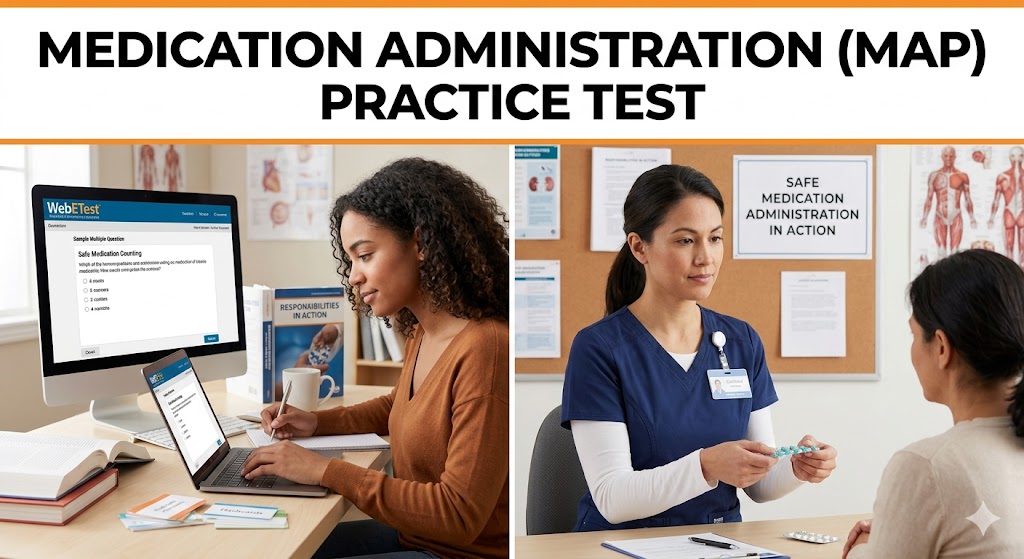
Additional Information
What the Course Entails and Exam Details
The official MAP training course provides a comprehensive
foundation for unlicensed personnel.
The curriculum covers a broad range of topics that are
critical to safe medication administration.
Key areas of focus in the course include:
- The
Principles of Medication Administration: A core understanding of the
essential tenets: Mindfulness, Supporting Abilities, and Communication.
- Medication
Laws and Regulations: Familiarization with the legal framework
governing medication administration for unlicensed staff in your specific
state.
- Medication
Classifications and Types: Distinguishing between controlled
(countable) and non-controlled substances, and understanding common forms
of medication like tablets, liquids, and topical applications.
- Observing
and Reporting: Training on how to identify and report changes in an
individual's physical or behavioral health that could relate to medication
effects.
- Using
and Handling Prescriptions: How to read and interpret a Health Care
Provider's (HCP) order and pharmacy labels correctly.
- Documentation:
Mastery of the Medication Administration Sheet (MAS), count books, and the
importance of precise, timely records.
- Safe
Storage, Security, and Disposal: Protocols for securing medications
and destroying them in compliance with regulations.
Exam Details:
This study guide is focused on preparing you for the Knowledge
Test component of the MAP certification.
While this article discusses a Practice Test, the actual
final knowledge exam for certification typically involves a set number of
multiple-choice questions (often 50), a strict time limit (such as 75 minutes),
and is taken via a state-approved computer portal (like WebETest or TMU) or in
paper format at an approved center.
A passing score of 80% or higher is a common standard.
What to Expect in the Final Exam
When you move from the practice test to the final
certification Knowledge Exam, you must be prepared for a rigorous assessment.
The exam focuses heavily on your ability to apply safety
principles in real-world scenarios.
You can expect to encounter the following in the final
knowledge portion:
- Format:
Multiple-choice questions designed to test both factual recall and
critical application of MAP principles.
- Passing
Score: A minimum overall score, often 80% or higher, is typically
required. Crucially, some specific safety questions must be answered with
100?curacy to pass.
- Time
Limit: A strictly enforced time limit, generally around 75 minutes, is
the norm for a 50-question knowledge exam.
- The
Six Rights: The exam will heavily test your knowledge and application
of the "Six Rights of Medication Administration." These include:
The Right Person, The Right Medication, The Right Dose, The Right Route,
The Right Time, and The Right Documentation. Missing just one of these
"Rights" is a critical failure in a practical sense and will be
heavily scrutinized in the knowledge exam's scenarios.
- State-Specific
Components: Depending on your state, MAP certification may include two
other required components following a successful Knowledge Test: a Transcription
Task (correctly transcribing an order onto a Medication Administration
Sheet) and a Medication Administration Demonstration Task (a
hands-on skills test where you demonstrate the process to a certified
tester).
How to Study and Exam Centers
Effective preparation is the key to passing the MAP
Knowledge Test on your first attempt.
Actionable study strategies include:
- Utilize
Practice Tests Multiple Times: This [Medication Administration Program
(MAP) Knowledge Practice Test] is your best tool. Take it multiple times
to become comfortable with the question style, identify the topics you
struggle with, and practice managing your time.
- Master
the "Responsibilities in Action" (RIA) Curriculum: For many
states, this is the definitive study material. Review the official
curriculum guide, notes from your training, and all handouts provided by
your MAP Trainer.
- Create
Flashcards: Flashcards are excellent for memorizing the "Six
Rights," common medication classifications, medical abbreviations,
and safety protocols.
- Scenario-Based
Study: Read sample scenarios of difficult situations (e.g., a person
refuses medication, you find a counting error, a new prescription arrives)
and walk through the correct MAP protocols to resolve them.
- Study
in Groups or with a MAP Trainer: Discussing concepts with peers or
clarifying complex points with an authorized MAP trainer can provide new
perspectives and solidify your understanding.
Exam Centers and Registration:
All candidates must complete an approved MAP training
program before they are eligible to take the certification exam.
Registration for the final test is typically handled through
your employer or your MAP training provider.
The MAP Knowledge Test is almost always computer-based (CBT)
and is taken in proctored settings such as:
- State-Approved
Agency Testing Sites: Many agencies with large staff numbers are
authorized to host the knowledge test internally.
- Authorized
Schools or Community Colleges: Educational institutions that partner
with the state are often regional hubs for testing.
- Dedicated
Testing Centers: Some states contract with professional testing
services (like D&S Diversified Technologies' TMU system) to administer
MAP exams. Pearson VUE is a common vendor for many types of
certifications, but MAP exams are frequently delivered through state-specific
or specialized platforms.
Your MAP trainer or supervisor will provide specific
instructions and a "Candidate Handbook" which details your nearest
exam location and how to access the online portal.
Job Opportunities
from the Course
Earning your Medication Administration Program (MAP)
certification significantly enhances your employability and unlocks career
advancement within the human services sector.
The course is essential for many positions that require
providing direct, hands-on care.
Job opportunities accessible with a MAP certification
include:
- Direct
Support Professional (DSP): Working in group homes, day programs, and
community-based residences.
- Residential
Counselor: Supporting individuals with developmental disabilities or
mental health challenges in a residential environment.
- Home
Health Aide (HHA) / Personal Care Attendant (PCA): Providing in-home
care, including medication administration.
- Unlicensed
Medical Assistant: Working in certain clinic or ambulatory settings
under the supervision of a licensed professional.
- Certified
Nursing Assistant (CNA): While a CNA has an independent license, MAP
is often a mandatory addition for CNAs working in residential care
settings that operate under state-specific MAP guidelines.
- Facility
Manager / Program Coordinator: MAP certification is often a
requirement for supervisory and managerial roles within community
programs.
- Child
Care Worker: Specifically in facilities or programs where medication
must be administered to children.
- Activity
Director or Activity Coordinator: Working in residential or assisted
living settings.
Frequently Asked Questions
Reviews
5.0
Based on 0 reviews
Leave a Review
No reviews yet. Be the first to review!