
Medication Technician State Certification Practice Exam
$69.00
- Buy to unlock unlimited access to all Quiz questions and Answers in this Quiz.
- After purchase you can print a PDF of the whole quiz at any point. The PDF will contain the questions and the correct answers.
About this Exam
The Medication Technician State Certification is a professional designation required in many states to work in healthcare environments, primarily assisted living facilities, skilled nursing homes, and residential care settings. It is designed for individuals who have already received foundational healthcare training (often as a Certified Nursing Assistant or similar) or who are undertaking a designated training program to administer routine medications safely to residents under the supervision of a licensed nurse. Passing the comprehensive state exam is the crucial final step to becoming a certified Medication Technician. This guide and its accompanying practice materials are explicitly crafted to help you understand the path to certification, grasp the exam's format and content, and provide actionable strategies and simulation through practice exams to ensure your success on test day.
Ready to test your knowledge?
Buy Now to Access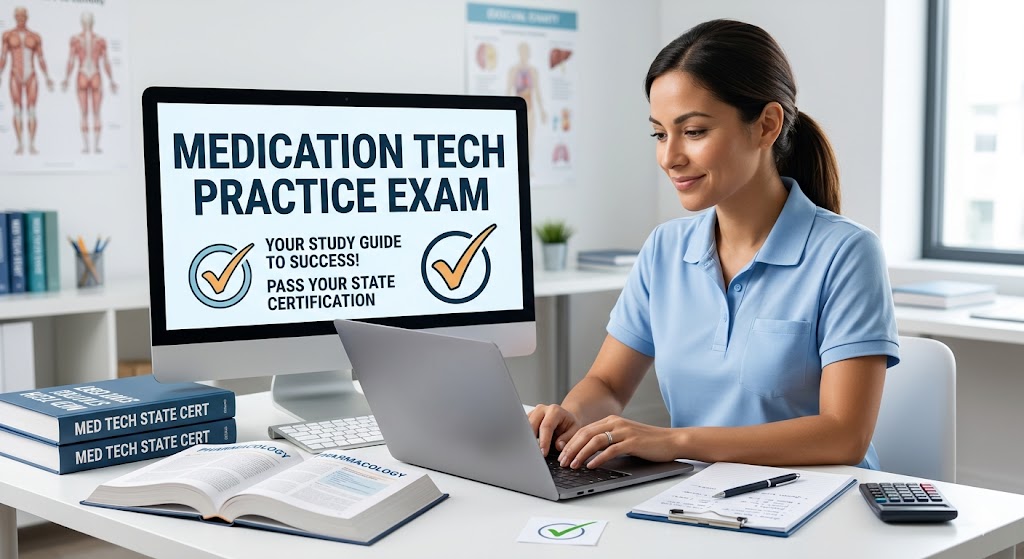
Additional Information
What the Course Entails and Exam Details
A standard Medication Technician training course covers a
critical blend of theoretical knowledge and practical application. Expect to
study: Basics of Pharmacology, including different medication classes, common
drugs, and their purposes. The absolute rules for safe administration known as
the Six Rights of Medication Administration: right patient, right medication,
right dose, right route, right time, and right documentation. Accurate dosage
calculations, including measurement systems and essential safety checks.
Comprehensive understanding of legal and ethical considerations, client rights,
confidentiality, and relevant state regulations. Proper documentation
practices, including Medication Administration Records (MARs). Recognition of
potential side effects, adverse reactions, and emergency protocols. Specific
administration techniques for various routes such as oral, topical, inhaled,
ophthalmic (eye), and otic (ear) medications. The state exam details generally
involve a comprehensive written (often computer-based) assessment that covers
these essential topics. Some jurisdictions or specific settings may also
require a distinct practical skills evaluation, though this guide and practice
exam are designed to prepare you for the vital knowledge-based component of
state-level certification. Understanding both the real exam structure and the
curriculum is key to effective preparation.
What to Expect in
the Final Exam
The actual Medication Technician State Certification final
written exam will test your understanding through a structured, objective
format, predominantly consisting of multiple-choice questions. You will need to
demonstrate your proficiency across the key curriculum areas previously
detailed. Common passing score requirements often range between 70% and 80%,
though you should always verify the precise requirement for your specific state
or certifying body. The exam will have a designated time limit, typically a few
hours, designed to ensure both thorough assessment and time management under
potential pressure. Be prepared for a testing environment where specific rules
will apply, including strict identification verification, arrival time
protocols, and a clear policy against bringing personal study materials or
electronic devices into the testing area. Your success hinged on not just
knowing the content but also being familiar with the types of questions and the
overall test-taking experience. This is where comprehensive practice exams are
incredibly valuable, simulating the format, types of questions, and constraints
you'll face on the real test.
How to Study and Exam Centers
Preparation is paramount for success, and a multi-faceted
approach will yield the best results. Here is how to effectively study:
- Take
Multiple Practice Exams: Utilize high-quality practice exams specific
to your state or a standard, nationally recognized model. They are your
most powerful tool! Analyze your results for each attempt, focusing on
weak areas and understanding the rationales for correct and incorrect
answers. Timed practice sessions are also highly recommended.
- Review
All Course Material: Revisit your textbook, class notes, study guides,
and any state-provided regulations or resources. Make detailed summaries
and flashcards.
- Focus
on Calculations: Dedicate sufficient time to mastering dosage
calculations. Practice these problems regularly until they become second
nature.
- Study
the Six Rights: Know them thoroughly and understand how they apply to
every scenario.
- Use
Active Study Methods: Participate in study groups, teach concepts to
others, use flashcards, and quiz yourself or others using practice
questions.
- Simulate
Test Conditions: When taking practice exams, do so in a quiet space,
adhere to time limits, and minimize distractions to build your stamina and
confidence.
Regarding Exam Centers: The specific locations and
methods for taking the exam vary. Registration typically occurs through your
state’s regulatory body (e.g., Board of Nursing or Department of Health), your
approved training program, or dedicated testing organizations like Pearson VUE.
Exams are often administered at physical testing centers in key locations
across the state, at community colleges, or within approved healthcare training
schools. Some processes might be initiated online through the state’s or
testing provider’s portal, followed by scheduling a test time at a suitable
physical center. Always consult your training program coordinator or the
appropriate state regulatory website for precise registration instructions and
a list of authorized testing sites near you.
Job Opportunities from the Course
A Medication Technician certification unlocks a growing
range of career paths in various healthcare and residential settings. Demand is
particularly high due to an aging population requiring more consistent care and
medication support. Potential job titles include:
- Medication
Technician (Med Tech)
- Medication
Aide (Med Aide) / Certified Medication Aide (CMA) / Qualified Medication
Aide (QMA)
- Assisted
Living Caregiver (with Medication Technician certification)
- Memory
Care Medication Technician
- Skilled
Nursing Facility (SNF) Medication Staff
- Home
Health Aide (if specifically certified for medication administration in
that setting)
- Personal
Care Assistant (PCA) (with Med Tech designation in some environments)
Frequently Asked Questions
Reviews
5.0
Based on 0 reviews
Leave a Review
No reviews yet. Be the first to review!