
Medtronic Basic Pacing Practice Test
$69.00
- Buy to unlock unlimited access to all Quiz questions and Answers in this Quiz.
- After purchase you can print a PDF of the whole quiz at any point. The PDF will contain the questions and the correct answers.
About this Exam
The Medtronic Basic Pacing certification is a highly regarded educational milestone designed to test your foundational knowledge of cardiac rhythm management.
It is tailored for allied health professionals, electrophysiology (EP) technicians, cardiac nurses, and medical representatives entering the medical device industry.
By mastering the principles of artificial pacing, candidates demonstrate their readiness to handle life-saving cardiac devices in real-world clinical environments.
This exam acts as a critical stepping stone for anyone looking to build a robust and rewarding career in cardiology and electrophysiology.
Ready to test your knowledge?
Buy Now to Access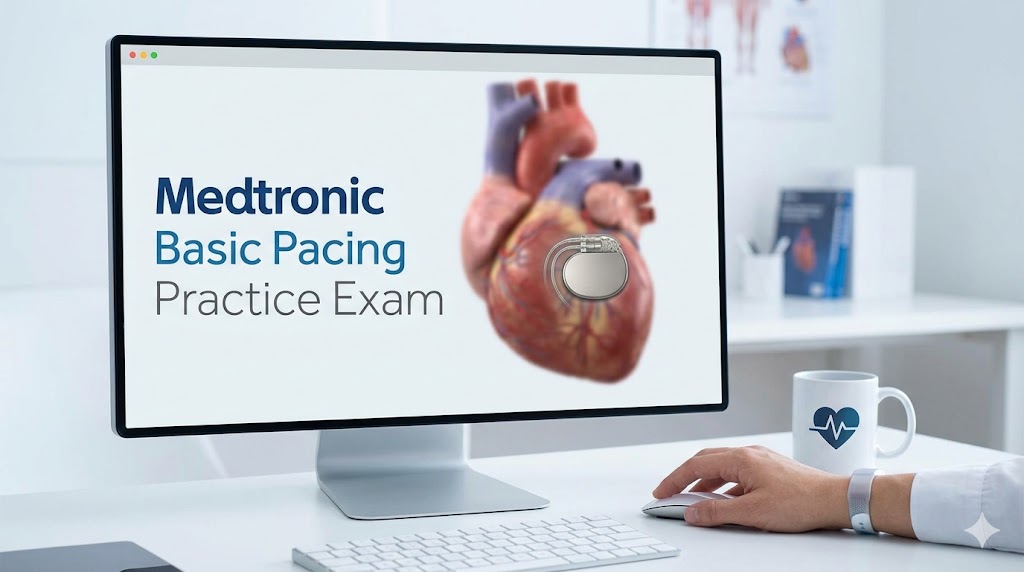
Additional Information
What the Course Entails and Exam Details
The core syllabus delves deep into the fundamental concepts
of cardiac anatomy, electrophysiology, and artificial pacing.
Students will thoroughly explore the principles of basic
electricity, including Ohm's law, and how it directly applies to pacemaker
programming and battery longevity.
You will be required to understand NBG pacing codes (such as
VVI and DDD), pacing modes, and the indications for single versus dual-chamber
pacemakers.
Furthermore, the curriculum covers vital technical skills
like assessing capture, understanding sensing thresholds, measuring lead
impedances, and performing basic troubleshooting for device malfunctions.
What to Expect in the Final Exam
The final exam is a rigorous assessment designed to simulate
the clinical problem-solving required in the field.
It typically consists of a multiple-choice format, often
incorporating practical scenarios where you must analyze ECG strips and
interpret pacemaker interrogation data.
Candidates are generally given a strict time limit, usually
ranging between 90 to 120 minutes, to complete the exam.
To achieve certification, students are typically expected to
reach a passing score of at least 80%, reflecting the high standards required
in patient care settings.
How to Study and
Exam Centers
To succeed, you should actively utilize the Medtronic
Academy online portal, which offers comprehensive modules, video tutorials, and
interactive learning tools.
Make sure to practice reading numerous ECG strips to
identify loss of capture, undersensing, and oversensing anomalies.
Creating flashcards for NBG codes and pacing parameters is a
highly effective way to memorize complex technical abbreviations.
When you are ready to take the test, the exam is most
commonly administered through secure online portals connected to the Medtronic
Academy.
In some cases, depending on your region and employer, you
may take proctored exams at authorized physical testing centers, specific
medical schools, or corporate Medtronic training facilities.
Job Opportunities
from the Course
Successfully passing this exam unlocks a variety of
specialized roles in the rapidly growing field of cardiac rhythm management.
You can pursue a career as a Clinical Specialist, where you
will work alongside physicians in the operating room to program devices during
implants.
Another excellent path is becoming a Cardiac Device
Specialist or Pacemaker Clinic Nurse, responsible for monitoring patients,
analyzing device data, and adjusting settings during routine follow-ups.
Additionally, this certification strengthens the resume of
any Electrophysiology (EP) Technician, paving the way for senior roles in the
cath lab.
For those leaning toward the business side, it provides the
essential clinical foundation needed to become a highly effective Medical
Device Sales Representative for cardiovascular technologies.
Frequently Asked Questions
Reviews
5.0
Based on 0 reviews
Leave a Review
No reviews yet. Be the first to review!