
Mental Health Correctional Officer Practice Test
$69.00
- Buy to unlock unlimited access to all Quiz questions and Answers in this Quiz.
- After purchase you can print a PDF of the whole quiz at any point. The PDF will contain the questions and the correct answers.
About this Exam
The Mental Health Correctional Officer certification is a specialized credential designed for corrections professionals who work directly with incarcerated individuals experiencing psychiatric disorders.
This rigorous exam and its corresponding certification ensure that officers are fully equipped to manage, support, and protect vulnerable inmate populations safely.
It is ideal for aspiring correctional officers, current law enforcement personnel seeking a specialized promotion, and criminal justice students who want to focus on mental health advocacy within the penal system.
By taking this certification, you demonstrate a profound commitment to rehabilitative justice, facility security, and compassionate crisis management.
Ready to test your knowledge?
Buy Now to Access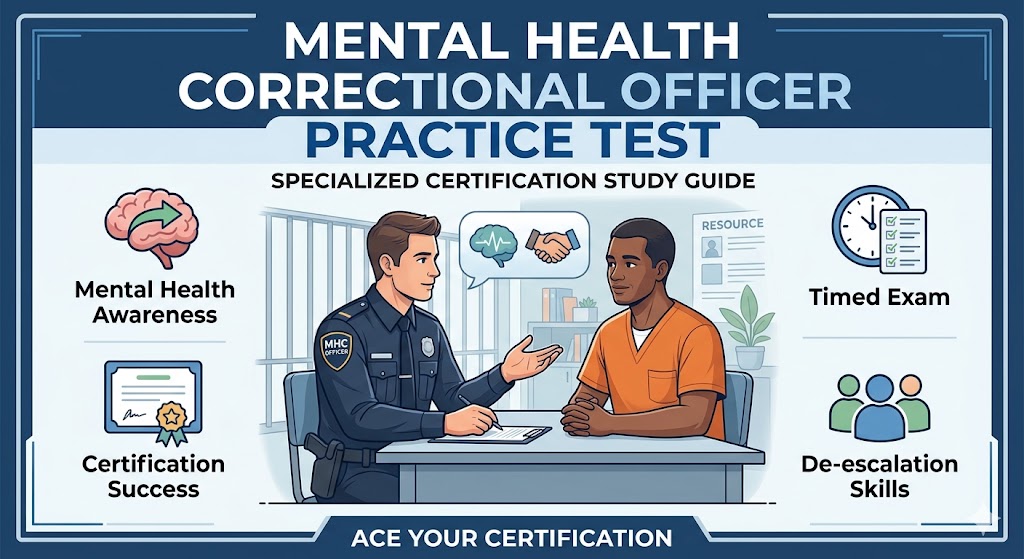
Additional Information
What the Course Entails and Exam Details
The course syllabus for a Mental Health Correctional Officer
focuses heavily on the intersection of criminal justice and abnormal
psychology.
Candidates will dive deep into recognizing the signs and
symptoms of common mental illnesses, such as schizophrenia, bipolar disorder,
severe depression, and PTSD.
A significant portion of the training entails mastering
de-escalation techniques, suicide prevention protocols, and non-lethal crisis
intervention strategies.
Furthermore, the curriculum details the legal and ethical
guidelines surrounding the rights of inmates with mental health conditions.
You will also learn about psychopharmacology awareness,
enabling you to understand the effects and side effects of psychiatric
medications commonly administered in correctional facilities.
What to Expect in the Final Exam
When you sit for the final Mental Health Correctional
Officer exam, you should prepare for a comprehensive, scenario-driven
assessment.
The exam typically consists of 100 to 150 multiple-choice
questions that test both your theoretical knowledge and your practical judgment
in high-stress situations.
You will be given a strict time limit, usually ranging
between two to three hours, which requires you to manage your time effectively
while reading complex behavioral scenarios.
To achieve a passing score, most certification boards
require a minimum of 70% to 75%, though this can vary slightly depending on
your specific state or licensing agency.
There are strict rules against bringing outside materials
into the testing room, and you will likely need to present two forms of
government-issued identification before beginning the proctored test.
How to Study and
Exam Centers
Successfully passing this specialized exam requires a blend
of textbook memorization and practical application.
Begin by utilizing high-quality practice tests to
familiarize yourself with the phrasing of the multiple-choice questions and to
identify your weak areas.
Create flashcards for essential legal definitions, mental
health disorder symptoms, and standard operating procedures for crisis
intervention.
Forming study groups with fellow candidates can also be
incredibly beneficial, as it allows you to role-play behavioral scenarios and
discuss the best de-escalation tactics out loud.
When you are ready to test, exams are typically administered
at authorized physical testing centers, such as Pearson VUE, or at your state's
specific Department of Corrections training academy.
Additionally, many certification boards now offer secure,
online proctored exams, allowing you to take the test from the comfort of a
quiet room in your own home using a webcam.
Job Opportunities
from the Course
Earning this certification unlocks a wide array of rewarding
and highly specialized career paths within the criminal justice and
rehabilitation sectors.
Here are the primary job titles you can pursue after passing
your exam:
- Mental
Health Correctional Officer: Your primary role will be supervising and
supporting inmates housed in psychiatric wards or specialized mental
health units within state and federal prisons.
- Crisis
Intervention Team (CIT) Officer: You will act as a first responder
within the facility for emergencies involving inmates experiencing acute
psychiatric distress or self-harm episodes.
- Psychiatric
Security Attendant: Working in forensic hospitals or secure
psychiatric facilities, you will ensure the safety of both the medical
staff and the patients committed to state care.
- Correctional
Counselor: With further experience, you can transition into a role
where you conduct individual evaluations, facilitate group therapy
sessions, and help design rehabilitation plans for inmates.
- Rehabilitation
Specialist: You will work directly with soon-to-be-released inmates,
helping them manage their mental health needs as they transition back into
society to reduce recidivism rates.
Frequently Asked Questions
Reviews
5.0
Based on 0 reviews
Leave a Review
No reviews yet. Be the first to review!