
Mental Health Nursing Practice Exam
$69.00
- Buy to unlock unlimited access to all Quiz questions and Answers in this Quiz.
- After purchase you can print a PDF of the whole quiz at any point. The PDF will contain the questions and the correct answers.
About this Exam
The Mental Health Nursing Practice Exam is an expertly crafted assessment tool specifically created for nursing students and practicing nurses looking to validate or enhance their knowledge in the specialized field of mental health and psychiatric nursing. This comprehensive practice exam covers a broad spectrum of mental health disorders, therapeutic approaches, legalities, ethics, and patient care strategies essential for safe and effective practice in this demanding yet rewarding area of healthcare. For aspiring mental health nurses, this practice exam is a pivotal stepping stone, offering a safe environment to experience the types of questions and topics they can expect on official certification tests. By engaging with this practice resource, individuals can boost their confidence, sharpen their clinical reasoning, and optimize their preparation for formal exams and their future careers in mental health.
Ready to test your knowledge?
Buy Now to Access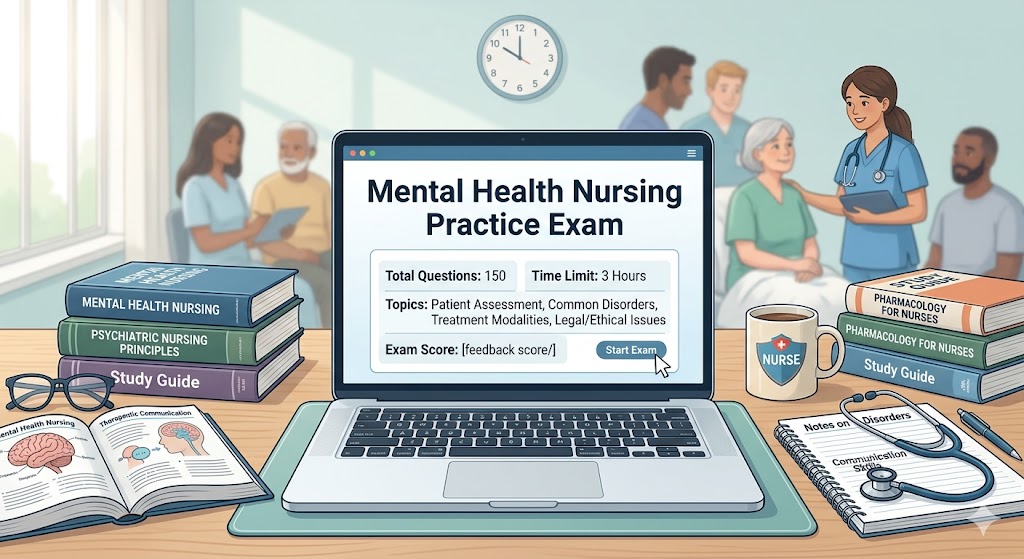
Additional Information
What the Practice Exam Entails and Details
The content of this Mental Health Nursing Practice Exam is
meticulously designed to encompass the core competencies and knowledge areas
critical for mental health nursing. It covers key topics that you would
typically find in a comprehensive mental health nursing curriculum or major
certification blueprints. Expect to encounter questions related to various
mental health conditions such as mood disorders, anxiety disorders,
schizophrenia, personality disorders, substance-related and addictive
disorders, and geriatric mental health. Furthermore, the exam evaluates your
understanding of therapeutic communication techniques, patient assessment
methods, treatment modalities including psychopharmacology and counseling,
crisis intervention, patient advocacy, legal and ethical considerations
specific to psychiatric care, and self-care strategies for mental health
professionals.
In terms of specific exam details, this comprehensive
practice exam typically features 150 multiple-choice questions. You are
allotted a total of 3 hours to complete the entire exam. Please be aware
that while this information gives you a clear expectation of this practice
test's structure, individual official certification exams or other practice
platforms may vary slightly in their composition, time limits, and specific
focus areas. Always refer to the specific guidelines and blueprint of the
official certification body you intend to eventually pursue.
What to Expect in the Final Practice Exam
When you undertake this comprehensive Mental Health Nursing
Practice Exam, you can anticipate a realistic simulation of a formal testing
environment. The exam consists entirely of multiple-choice questions, which may
include clinical scenarios demanding critical thinking and application of
nursing knowledge. Questions are designed to test not only recall of facts but
also your ability to prioritize care, make safe clinical decisions, and
demonstrate sound judgment in various mental health nursing situations. The
practice exam format includes:
- Number
of Questions: 150 Multiple-Choice Questions
- Time
Limit: 3 Hours
- Administration:
Conducted fully online through a dedicated platform, providing convenience
and flexibility. You should ensure a stable internet connection and a
quiet, distraction-free space for optimal focus.
A key advantage of this practice exam is that you often
receive detailed feedback upon completion. While it may not have a strict
"passing score" in the same way an official certification does, it
typically provides a percentage score along with insights into your correct and
incorrect answers. This feedback is invaluable for identifying areas of
strength and weakness, allowing you to tailor your subsequent study efforts.
Many students find it beneficial to treat the practice exam with the same
seriousness as a final official test, utilizing the time limit and rules (like
no external aids) to simulate real test-day conditions as closely as possible,
excluding breaks unless you take them informally. Remember, specific details
of this particular practice exam may differ slightly based on the provider, so
always review their instructions carefully.
How to Study and
Practice Exam Settings
Effectively studying for the Mental Health Nursing Practice
Exam requires a proactive and structured approach:
Review Core Concepts:
Thoroughly go through your mental health nursing textbooks, class notes, and
relevant official blueprints. Focus on understanding the core topics listed
earlier. Pay special attention to common disorders, pharmacological treatments,
therapeutic communication, and legal/ethical principles. Create flashcards for
key terms, medications, and therapeutic techniques.
- Practice
Consistently: Engage with numerous practice questions and tests.
Repetition builds familiarity with question formats and strengthens your
knowledge recall. Treat initial practice attempts as learning
opportunities to identify weaknesses, and later attempts as timed simulations
of the actual exam.
Analyze Mistakes: Utilize
the detailed feedback from your practice exams. Don't just check if you got a
question right; understand why the correct answer is right and why your
wrong choices were incorrect. Review corresponding study materials to reinforce
understanding in weak areas.
Practice Therapeutic
Communication: Dedicate study time specifically to practicing therapeutic
communication techniques. This is a core skill evaluated both in exams and in
real-world practice. Consider role-playing scenarios or reviewing practice
scenarios to enhance your skills.
Review Common Medications:
Memorize the common classes of psychotropic medications, including their
mechanisms, side effects, nursing considerations, and patient teaching points.
Pharmacology questions are frequent in mental health nursing assessments.
Simulate Test Conditions:
When taking full practice exams, create an environment that mimics official
testing conditions. Set aside uninterrupted time, avoid using outside
resources, and practice managing your time efficiently across the questions.
Regarding practice settings and access, this specific Mental
Health Nursing Practice Exam detailed here is typically accessible online
through reputable educational platforms, test preparation websites, or
sometimes integrated into larger nursing education programs. You can access it
from any computer or device with reliable internet access after completing any
required registration or purchase. Ensure you create a suitable study and
testing environment—a quiet, well-lit space—to enhance focus and get the most
accurate reflection of your preparation level. While this practice test
provides excellent online convenience, remember that official certification
exams are usually administered in specific authorized testing centers, such as
Pearson VUE, or occasionally through strictly proctored online systems, each
with their own set of rules and required procedures.
Job Opportunities and Career Paths from the Course
Successfully navigating mental health nursing education and
certification (a path supported by this practice exam) opens doors to a variety
of impactful and specialized career roles. Here are some key job opportunities
available to qualified individuals:
- Staff
Nurse / Clinical Nurse (Mental Health / Psychiatric) - Providing
direct patient care in inpatient psychiatric units, residential
facilities, or acute care settings.
- Charge
Nurse (Mental Health Unit) - Supervising staff and managing the
operations of a mental health nursing unit.
- Mental
Health Case Manager - Coordinating care and resources for individuals
with chronic mental health conditions in community or outpatient settings.
- Community
Mental Health Nurse - Working in community clinics or agencies to
provide outreach, education, and nursing care.
- Substance
Abuse Treatment Nurse - Specializing in the care of individuals
undergoing addiction treatment in detoxification units or rehab centers.
- Geriatric
Psychiatry Nurse - Focusing on the unique mental health needs of older
adults in hospitals, nursing homes, or memory care units.
- Forensic
Nurse (Mental Health Specialization) - Applying nursing expertise
within the legal and correctional systems, often working with individuals
with both mental illness and legal issues.
- Nursing
Educator (with focus on Mental Health) - Teaching and mentoring future
generations of nurses in academic or clinical settings.
- Researcher
(Mental Health Nursing) - Contributing to the body of knowledge in
mental health nursing through research studies.
- Consultant
/ Mental Health Nurse Consultant - Providing expert advice and
guidance to healthcare organizations or other practitioners regarding
mental health nursing practices.
- Crisis
Intervention Team Member - Responding to mental health crises and
providing immediate assessment and intervention, often alongside law
enforcement.
- Telehealth
Mental Health Nurse - Delivering remote nursing care and support
through telecommunication technologies.
- Private
Practice Nurse (after advanced certification/licensure) - Providing
counseling and psychotherapy services in a private practice setting.
Frequently Asked Questions
Reviews
5.0
Based on 0 reviews
Leave a Review
No reviews yet. Be the first to review!