
Metal Inert Gas (MIG) Welding Practice Exam
$69.00
- Buy to unlock unlimited access to all Quiz questions and Answers in this Quiz.
- After purchase you can print a PDF of the whole quiz at any point. The PDF will contain the questions and the correct answers.
About this Exam
The MIG Welding Practice Exam is an essential tool designed for students, entry-level welders, and professionals aiming to solidify their knowledge of Metal Inert Gas (MIG) welding, also known as Gas Metal Arc Welding (GMAW). This practice exam is specifically structured for individuals preparing for formal certification tests, such as those offered by the American Welding Society (AWS) or similar regulatory bodies. It is an invaluable resource for anyone seeking to validate their technical skills in a process widely used across automotive, manufacturing, and construction industries, ensuring they are well-prepared for the rigors of a standardized qualification.
Ready to test your knowledge?
Buy Now to Access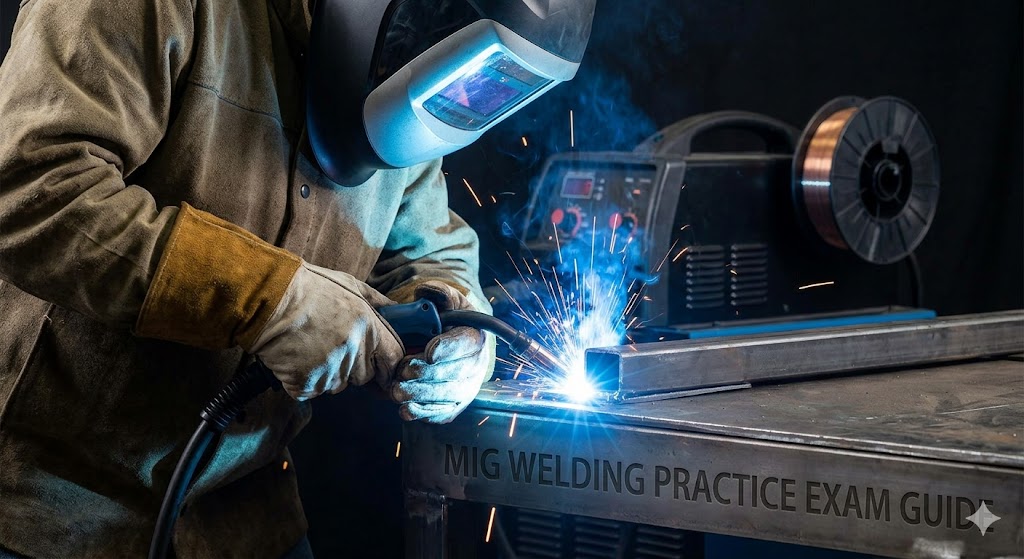
Additional Information
What the Course
Entails and Exam Details
To excel in this examination, candidates must possess a
comprehensive understanding of the entire MIG welding process ecosystem. The
theoretical course material and subsequent exam focus heavily on the
fundamental setup of GMAW equipment, including the complex wire feed systems,
voltage settings, and proper shielding gas selection (such as Argon/CO2 mixes).
Critical skills covered include reading complex blueprint welding symbols,
understanding metallurgy basics for various steel and aluminum grades, and mastering
distinct transfer modes like spray, globular, and short-circuit. Safety is
paramount; therefore, the syllabus rigorously details Personal Protective
Equipment (PPE) requirements, hazardous fume management, and electrical safety
standards essential for a secure working environment.
What to Expect in the Final Exam
While the format of the formal certification can vary, the
official MIG welding exam typically consists of two distinct components. The
first part is a written or computer-based multiple-choice test, focusing on
theory, safety protocols, and troubleshooting equipment issues, often required
to be completed within a 60 to 90-minute time limit. Following the theoretical
component, the practical "hands-on" exam requires candidates to
perform specific welds (such as vertical, horizontal, or overhead groove and fillet
welds) on standardized test plates. These test coupons are then subjected to
visual inspections and destructive testing, such as a bend test, where any
discontinuities or defects exceeding code allowances will result in failure. A
passing score usually requires at least 70–80% on the written portion and zero
defects in the practical assessment.
How to Study and Exam Centers
Effective preparation for the MIG Welding exam requires a
strategic blend of intense theoretical study and extensive hands-on practice.
For the written section, utilize a focused MIG Welding Practice Exam to
identify knowledge gaps and familiarize yourself with the question formats.
Study core texts like the AWS Welding Handbook and memorize key charts relating
to wire feed speeds and voltage relationships. For the practical exam, dedicate
significant time in a shop setting, practicing crucial joints in every position
(1G through 4G) until you consistently achieve sound weld beads. Official exams
are rarely taken online; you must schedule your test through authorized AWS
Accredited Test Facilities (ATFs), local community colleges, or specialized
trade schools equipped with standardized testing booths.
Job Opportunities
from the Course
Earning a formal MIG welding certification opens a robust
pathway to diverse and well-paying career opportunities across numerous
industrial sectors. Certified MIG welders are in high demand for positions such
as:
- Production
Welder
- Automotive
Manufacturing Welder
- Aerospace
Structural Welder
- Structural
Steel Fabricator
- Shipyard
Welder
- Pipefitter-Welder
- Maintenance
Repair Welder
- Weld
Inspector (with additional experience)
- Robotic
Weld Cell Operator
Frequently Asked Questions
Reviews
5.0
Based on 0 reviews
Leave a Review
No reviews yet. Be the first to review!