
MFRI Rescue Technician Vehicle and Machinery Extrication (VME) Practice Test
$69.00
- Buy to unlock unlimited access to all Quiz questions and Answers in this Quiz.
- After purchase you can print a PDF of the whole quiz at any point. The PDF will contain the questions and the correct answers.
About this Exam
The Maryland Fire and Rescue Institute (MFRI) Vehicle and
Machinery Extrication (VME) certification is a premier qualification for
dedicated emergency responders.
This highly respected program is explicitly designed for
firefighters, rescue personnel, and emergency medical technicians who want to
elevate their life-saving capabilities.
It equips first responders with the critical knowledge
required to safely and efficiently remove trapped victims from complex
automobile accidents and industrial machinery entanglements.
By taking this certification, you are stepping up to master specialized, high-stakes rescue scenarios where every second counts
Ready to test your knowledge?
Buy Now to Access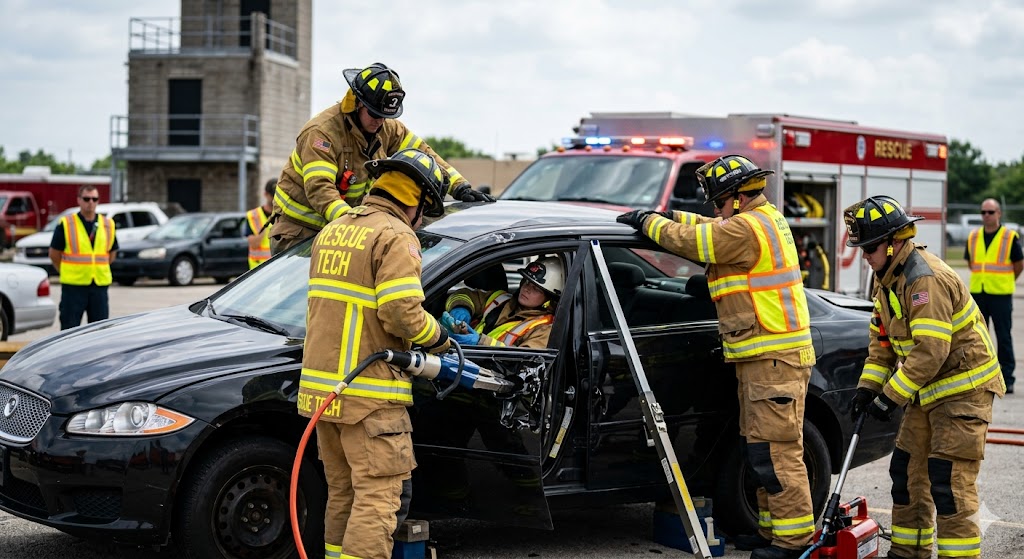
Additional Information
What the Course Entails and Exam Details
The VME course provides an intensive dive into both the theoretical and practical mechanics of modern heavy rescue.
You will learn comprehensive scene size-up techniques to identify hazards such as undeployed airbags, high-voltage vehicle systems, and unstable terrain.
The syllabus heavily covers vehicle stabilization, ensuring that a wrecked car or piece of heavy machinery does not shift while rescuers are operating.
Students are trained in the advanced operation of hydraulic, pneumatic, and specialized hand tools, commonly known as the "Jaws of Life."
Furthermore, the curriculum addresses crucial victim management and disentanglement strategies to ensure patients are protected during the cutting and prying processes.
What to Expect in the Final Exam
To earn your certification, you must successfully navigate both a written exam and a rigorous practical skills evaluation.
The written exam typically consists of multiple-choice questions designed to test your understanding of incident command, tool maintenance, anatomy of modern vehicles, and safety protocols.
You generally need to achieve a passing score of 70% or higher on this written assessment.
The time limit for the written portion is strictly enforced, usually giving candidates between one to two hours to complete the test.
Following the written exam, you must pass a hands-on practical evaluation where evaluators score your ability to safely execute stabilization and extrication techniques in real-time under simulated emergency conditions.
How to Study and Exam Centers
Success on the VME exam requires a balanced blend of academic review and hands-on muscle memory.
Start by thoroughly reading the required course textbooks, such as the IFSTA or Jones & Bartlett technical rescue manuals, paying special attention to chapter summaries and safety warnings.
Taking a high-quality practice exam is one of the most effective strategies to familiarize yourself with the phrasing of technical multiple-choice questions.
For the practical portion, spend as much time as possible in the drill yard with your department, practicing cribbing, glass management, and hydraulic tool operation.
The exams are typically administered in person at designated regional MFRI training centers across Maryland or at authorized local fire academies with the proper vehicle props and safety supervision.
Job Opportunities from the Course
Achieving this certification proves your competency in high-stress technical environments and opens up several advanced career paths.
Heavy Rescue Technician
Technical Rescue Specialist
Career Firefighter or EMT
Industrial Emergency Responder
Urban Search and Rescue (USAR) Team Member
Motor Sports Safety Team Responder
Frequently Asked Questions
Reviews
5.0
Based on 0 reviews
Leave a Review
No reviews yet. Be the first to review!