
MICCC Threat Tactics Practice Test
$69.00
- Buy to unlock unlimited access to all Quiz questions and Answers in this Quiz.
- After purchase you can print a PDF of the whole quiz at any point. The PDF will contain the questions and the correct answers.
About this Exam
Mastering adversary methodologies is the key to tactical
overmatch on the modern battlefield.
The Military Intelligence Captains Career Course (MICCC)
Threat Tactics module is a critical phase of professional military education.
This assessment is specifically designed for newly commissioned or senior
Military Intelligence Captains preparing for company command and crucial staff
positions at the Battalion and Brigade levels. Success in this validation,
confirmed by achieving proficiency on the diagnostic MICCC Threat Tactics
Practice Exam, evaluates an officer's ability to analyze, anticipate, and
counteract the doctrine and capabilities of varied threat actors.
It goes beyond simple equipment recognition. It demands a
sophisticated understanding of how adversaries organize, move, and employ
forces within the multi-domain Operational Environment (OE). High performance
on this practice test signifies you possess the analytical sharpness necessary
to advise commanders effectively and achieve mission success.
Ready to test your knowledge?
Buy Now to Access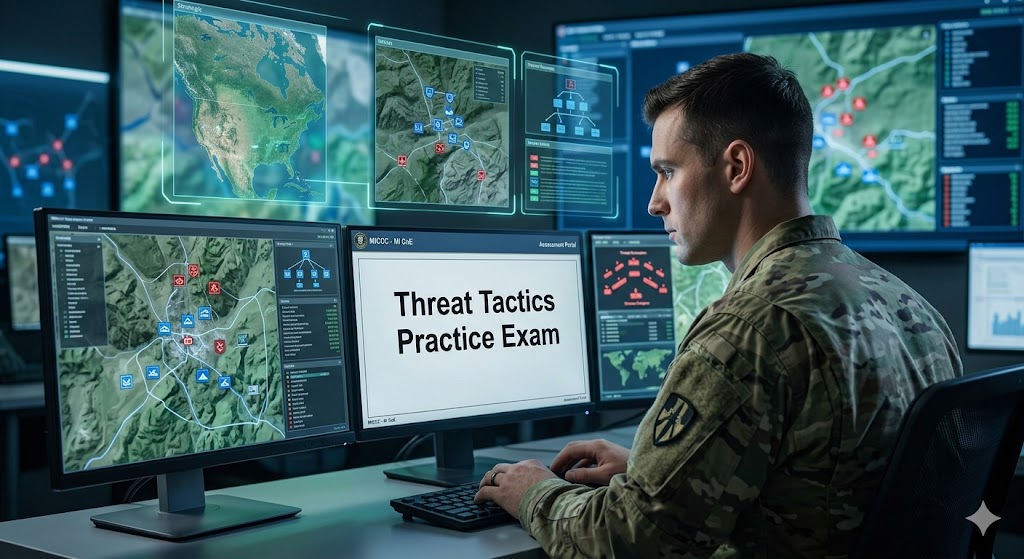
Additional Information
What the Course Entails and Exam Details
This intensive curriculum bridges advanced doctrinal
concepts with practical analytical applications. The primary focus is
understanding and applying the principles of Threat Doctrine and Tactics to
complex scenarios. You are not just learning facts; you are learning how an
adversary thinks and acts under varying conditions.
The core domains covered include:
- Threat
Doctrine Analysis: In-depth study of the organization, equipment, and
fighting philosophies of peer, near-peer, and hybrid threats (e.g.,
analyzing Offensive and Defensive Operations sequences).
- Order
of Battle (OB): Analyzing the structure, strength, and composition of
specific threat organizations.
- Tactical
Employment: Evaluating how threat units are used in the offense,
defense, and specialized operations (e.g., tactical aviation, fires,
electronic warfare, and special purpose forces).
- Operational
Environment (OE) Integration: Understanding how terrain, weather, and
civil considerations influence threat tactical decision-making and
capabilities.
- High-Value
Target Identification: The ability to determine which threat assets
are critical to their success and vulnerable to friendly action.
What to Expect in the Final Exam
The main assessment for this module is a rigorous
examination designed to simulate the pressures of tactical intelligence
analysis. It is primarily a written or computer-based test requiring both
declarative knowledge and applied reasoning. You must expect a comprehensive
evaluation of the materials covered throughout the instruction.
Here are the vital details:
- Exam
Format: Expect a significant percentage of complex, scenario-based
multiple-choice questions. These will require you to analyze a given
tactical situation (often involving a map overlay or situation report) and
predict the threat’s most likely or most dangerous course of action.
- Applied
Knowledge: Questions often ask you to identify a specific threat unit
based on its composition (the 'Sustainment' question). Others may ask you
to identify which principle of doctrine the threat is demonstrating in a
scenario.
- Passing
Score Requirements: Candidates are generally required to achieve a
minimum passing score of 70% or 80% (depending on the specific course
iteration and command guidance) to continue progression within MICCC.
Achieving a high score demonstrates true mastery.
- Time
Limits: The examination is timed to reflect the operational tempo of
real-world analysis, typically offering between 60 and 120 minutes
depending on the test version.
- Rules:
The exam is typically administered as a closed-book assessment within a
controlled environment, adhering to strict academic integrity standards.
How to Study and
Exam Centers
Preparation for the MICCC Threat Tactics examination demands
focused dedication to the doctrine and a consistent application of the
analytical process. Rote memorization of acronyms is insufficient. You must
dedicate extensive time to active study and practical application.
- Master
the Doctrine: Your absolute primary resources are the official
publications (e.g., relevant Army Techniques Publications (ATP) and Field
Manuals (FM) concerning the Operational Environment and specific threats).
Study these thoroughly. Analyze the organizational charts and tactical
diagrams.
- Use
the Practice Test: The MICCC Threat Tactics Practice Exam is
your best diagnostic tool. Treat it like the final assessment. Take it
multiple times under timed conditions. Analyze not just what
questions you missed, but why you missed them—did you misunderstand
the scenario, misapply the doctrine, or misread the map overlay?
- Form
Study Groups: Collaborating with your peers is invaluable. Quiz each
other on adversary capabilities, run through hypothetical tactical
scenarios, and debate the threat's likely reactions. This deepens
understanding and exposes alternative analytical perspectives.
- Create
Visual Aids: Develop flashcards for doctrinal definitions and key
adversary systems. Draw your own situational templates based on various
mission types to visualize threat tactics.
Exam Centers:
This exam is taken while enrolled in the official
Military Intelligence Captains Career Course. It is administered directly at
the training location (e.g., Fort Huachuca, AZ) or through the military's
secure, authorized online learning platforms (like the Army Learning Management
System - ALMS) during distance learning (DL) phases. It is not an exam you can
walk in and take at a commercial testing center.
Job Opportunities from the Course
Mastering Threat Tactics within the MICCC doesn't just
ensure course completion; it represents a critical milestone in a Military
Intelligence Officer’s career progression. This skill set is required for
advanced leadership and staff responsibilities, paving the way for numerous
high-impact roles.
This knowledge directly qualifies you for the following
positions:
- Intelligence
Officer (S-2) (Battalion or Brigade Level): Serving as the principal
advisor to the commander on all matters concerning the enemy, terrain, and
operational environment.
- Company
Commander (Military Intelligence Company): Leading intelligence
professionals in a tactical environment and guiding their analytic
production.
- Operations
Officer (S-3) or Operations Staff (at echelon): Utilizing knowledge of
threat capabilities to aid in the creation of comprehensive friendly
operation plans (OPLANs).
- Collection
Manager: Directing and optimizing the employment of intelligence,
surveillance, and reconnaissance (ISR) assets based on understanding
threat vulnerabilities.
- Threat
Analyst / Fusion Cell Leader: Leading multi-discipline teams to
synthesize complex data and produce predictive intelligence on adversary
activity.
- Targeting
Officer: Providing critical threat analysis to drive the targeting
process and achieve synchronized effects.
Frequently Asked Questions
Reviews
5.0
Based on 0 reviews
Leave a Review
No reviews yet. Be the first to review!