
Michigan Boating License Practice Test
$69.00
- Buy to unlock unlimited access to all Quiz questions and Answers in this Quiz.
- After purchase you can print a PDF of the whole quiz at any point. The PDF will contain the questions and the correct answers.
About this Exam
The Michigan Boater Safety Certificate is an essential credential for recreational boaters and personal watercraft (PWC) operators in the state of Michigan.
The course is designed for a broad audience, including both younger, novice operators and experienced boaters. Specifically, Michigan law requires boater safety education for certain age groups to operate PWCs and for youth (generally ages 12-15) to operate certain larger motorboats without direct supervision. Even for those not strictly mandated by age, completing this course is highly recommended. It equips participants with invaluable knowledge, boosts on-water confidence, demonstrates a commitment to water safety, and can even lead to potential reductions in boat insurance premiums.
Ready to test your knowledge?
Buy Now to Access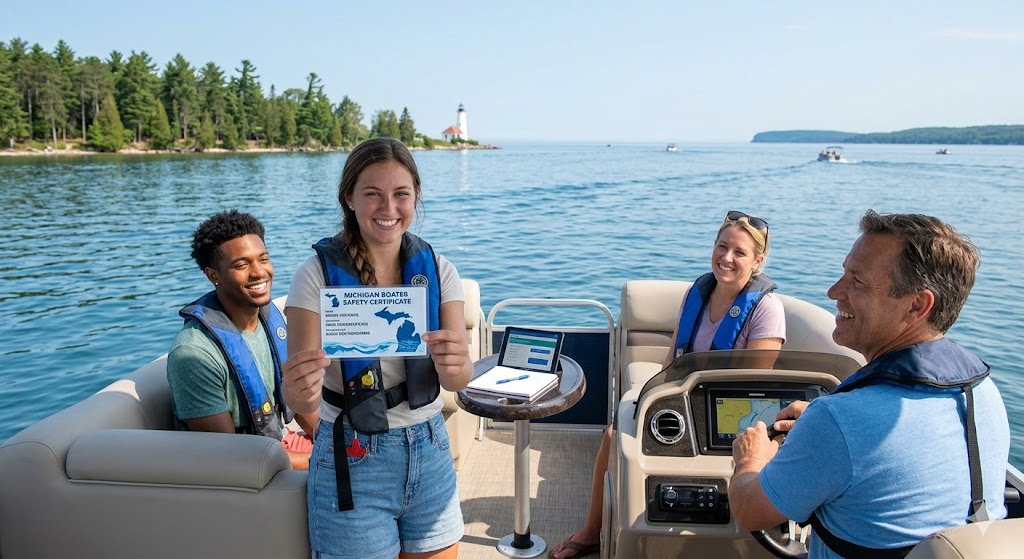
Additional Information
What the Course Entails and Exam Details
To earn your Michigan Boating Safety Certificate, you must
complete a state-approved boater safety course, with the final exam typically
taken online. The comprehensive course curriculum covers critical modules and
topics, ensuring a well-rounded understanding of safe boating.
Core topics include:
- Michigan
Boating Laws & Regulations: In-depth knowledge of registration
requirements, required safety equipment, operating rules (speed limits,
wake restrictions, operating under the influence), and specific laws for
personal watercraft (PWC).
- Equipment
Requirements: Detailed guidance on mandatory safety gear, including
proper life jacket (PFD) selection and usage for all ages, fire
extinguishers, navigation lights, sound signaling devices, and distress
signals.
- Navigation
Rules ("Rules of the Road"): Understanding how to safely
interact with other vessels, interpreting navigation buoys and markers,
right-of-way rules, and safe speed considerations to prevent collisions.
- Operating
Your Vessel Safely: Practical skills for boat handling, docking,
launching, anchoring, fueling procedures, and managing weather conditions.
- Emergency
Procedures: Training on how to respond to common and critical
situations like capsizing, falling overboard, fires, running aground, and
administering basic first aid.
- Environmental
Responsibility: Information on preventing the spread of aquatic
invasive species, proper fuel and waste disposal, and general courteous
boating behavior.
The course itself is predominantly delivered through
self-paced, interactive online modules provided by authorized vendors. These
courses allow students to learn at their own speed, complete units, and take
quizzes along the way, with progress saved automatically. Most people can
comfortably complete the entire course in approximately three hours. Once all
course material is reviewed and all unit quizzes passed, students are eligible
to take the final examination.
What to Expect in the Final Exam
For the vast majority of students taking the online approved
course, the final exam is a multiple-choice, comprehensive test delivered
directly through the same secure online portal. The test is non-proctored,
meaning you can take it from the comfort of your own home, on your computer or
even a mobile device, without an official supervisor present. The number of
questions on the exam is substantial, ensuring thorough coverage of all the
essential safety knowledge you’ve learned.
- Format:
Online, non-proctored multiple-choice questions.
- Passing
Score: Students must achieve a minimum passing score of 80% to
successfully earn their certificate.
- Time
Limit: There is typically no overall time limit to complete the entire
course, and the final exam itself often does not have a strict countdown
timer once started, or if it does, it's very generous. You can complete
the final exam questions at your own careful pace.
- Rules
& Support: You generally take the final exam in one sitting.
However, most approved online providers allow students to review course
material before attempting the final test and often offer
unlimited, free retakes should you not pass on your initial attempt,
allowing you to learn from mistakes and demonstrate proficiency without
additional cost. Once you pass the final exam, you can immediately download
and print a temporary certificate, with your permanent boater education
card mailed afterwards.
How to Study and
Exam Centers
Preparation is key to both passing the exam and becoming a
safer boater. The primary and most recommended study method is to fully engage
with and complete the entire official, state-approved online boater safety
course.
Actionable study strategies include:
- Actively
Engage with Course Material: Don't just click through. Read all text,
watch videos carefully, and make sure you truly understand each concept.
Take notes on key laws, navigation rules, and safety equipment
requirements.
- Ace
the Unit Quizzes: Use the quizzes at the end of each unit as learning
tools. If you struggle, review the relevant material again until you have
a firm grasp before moving on to the next section.
- Take
Reputable Practice Tests: This is highly effective. Seek out
and take official or high-quality, relevant practice tests designed
specifically for the Michigan boater safety curriculum, just like the one
in the title of this guide. Repetitive practice with realistic question
formats is invaluable for building confidence and identifying weak points.
Look for practice questions covering all the core topics.
- Create
Your Own Study Aids: Consider making flashcards for key terms, buoy
meanings, navigation rules of the road (e.g., meeting, crossing,
overtaking rules), or specific legal requirements.
- Visualize
Real-World Application: Think about how the rules you are learning
apply to actual boating situations on Michigan's diverse waters, from busy
inland lakes to the expansive Great Lakes.
Regarding Exam Centers: For the convenient and
predominant online method, the "exam center" is simply your own
computer, tablet, or even smartphone with a stable internet connection. You
take the entire course, including the non-proctored final exam, through authorized
online course portals. Popular and reputable authorized providers often
identified by the Michigan Department of Natural Resources (DNR) include major
nationwide platforms that specialize in recreational safety education, ensuring
you have access to a smooth, validated testing experience directly on your
device.
While extremely rare compared to the online option,
occasionally specific local organizations like some sheriff's departments or
community groups might offer in-person classes, culminating in a
physically proctored exam at their designated location. However, this is far
less common and less convenient than the readily available and officially
recognized online courses. We strongly recommend the online approach for its
flexibility, accessibility, and standardized curriculum. Always check the
official Michigan DNR website for the absolute latest, verified information on
approved courses and any potential in-person options, ensuring you use a
legitimate path.
Job Opportunities
from the Course
While the Michigan Boater Safety Certificate is primarily a
recreational credential, successfully completing this course and obtaining
certification can be a valuable asset for several relevant job opportunities
and career paths, particularly in Michigan's vibrant maritime and recreation
sectors. Demonstrating significant boating safety knowledge and responsibility
can enhance your resume for:
- Boat
Rental Staff: Safely instructing customers, delivering required safety
briefings, launching, retrieving, and properly managing rental vessels
including PWCs and pontoon boats at diverse marinas and rental agencies.
- Marina
Attendant / Dock Hand: Assisting with boat docking, fueling, basic
maintenance, general upkeep, and interacting positively and safely with
numerous boaters.
- Water
Sports Instructor Assistant: Safely managing logistics, supporting
primary instructors, and ensuring student well-being during varied
water-based activities like jet ski tours, water skiing, wakeboarding, and
more.
- Seasonal
Water Safety Patrol: Working with relevant local agencies or state
parks, performing basic water monitoring, assisting with safe boating
information dissemination, and potentially operating small, relevant
patrol vessels for specific roles.
- Charter
Fishing/Sailing Crew Member: Gaining invaluable entry-level experience
in basic vessel safety, navigation, and customer interaction on commercial
recreational vessels, potentially leading to advanced maritime careers.
- Summer
Camp Boating Staff/Counselor: High-demand roles ensuring the absolute
safety and supervision of numerous children during diverse boating
activities, prioritizing strict adherence to water safety protocols. Boater
safety certification is virtually mandatory for these impactful positions.
- Marina
Operations Assistant: Providing comprehensive administrative support,
coordinating slip assignments, and safely managing varied interactions
within a complex marina environment.
Possessing this recognized certification demonstrates an
active commitment to safety, a foundational understanding of critical boating
principles, and a high level of responsibility – all highly desirable traits
for employers operating safely and successfully in on-water and near-water
environments.
Here is an image reflecting the successful achievement of
obtaining your Michigan Boater Safety Certificate after utilizing your practice
test:
Frequently Asked Questions
Reviews
5.0
Based on 0 reviews
Leave a Review
No reviews yet. Be the first to review!