
Michigan Court Reporting Certification Practice Exam
$69.00
- Buy to unlock unlimited access to all Quiz questions and Answers in this Quiz.
- After purchase you can print a PDF of the whole quiz at any point. The PDF will contain the questions and the correct answers.
About this Exam
The Michigan Court Reporting Certification, which often leads to the esteemed Certified Shorthand Reporter (CSR) or Certified Stenomask Reporter (CSMR) designations, is a critical credential administered by the Michigan Court Reporting and Recording Board of Review. This certification officially validates the advanced skills, speed, accuracy, and technical knowledge required to produce a verbatim record of legal proceedings, depositions, and court hearings. It is designed for individuals seeking a vital and respected role within the legal system, ensuring the integrity and accuracy of the official record. Candidates typically include graduates from court reporting programs and current reporters seeking state authorization, and must generally meet requirements such as being 18, having a high school diploma, and not having been under sentence for a felony within the past two years.
Ready to test your knowledge?
Buy Now to Access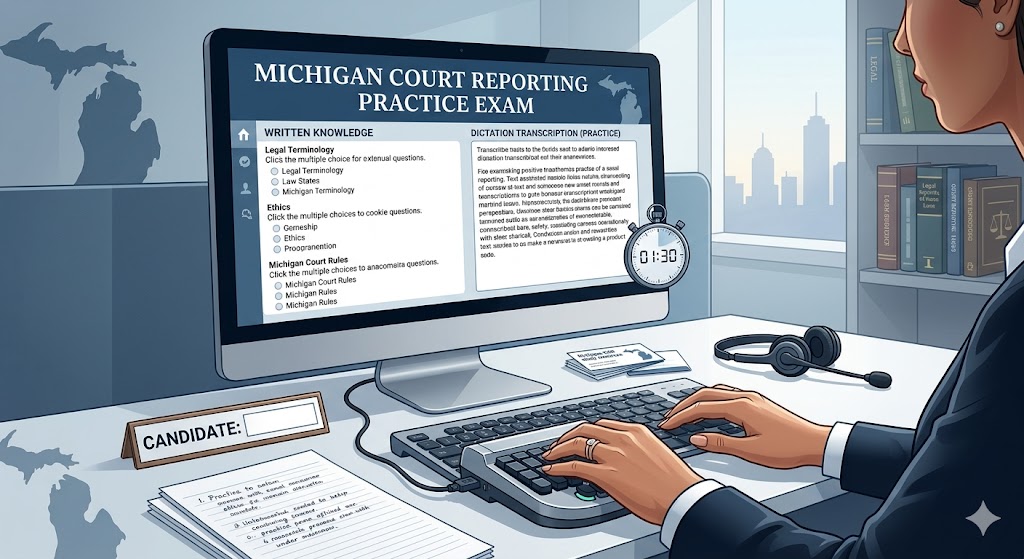
Additional Information
What the Course
Entails and Exam Details
To prepare for and obtain this certification, candidates
must complete rigorous educational training and verify specific core
competencies:
- Approved
Course of Study: Candidates must typically show proof of completing an
approved or accredited court reporting program from institutions like
Lansing Community College, Macomb Community College, or educational
providers like the Michigan Electronic Court Reporters Association
(MECRA).
- Comprehensive
Syllabus: These programs cover diverse topics, including:
- Stenotype
or Voice Writing Theory: Learning the specific systems and machinery
for real-time writing.
- Skill
and Speed Building: Extensive practice to achieve requisite speeds on
a steno machine or voicewriter.
- Terminology:
Mastering complex legal, medical, and technical vocabularies.
- Computer-Aided
Transcription (CAT): Using specialized software to convert notes to
text in real-time.
- Court
Procedures and Etiquette: Understanding the framework and conduct
expected in a legal setting.
- Ethics
and Regulations: Adhering to professional standards and
Michigan-specific rules for court reporters.
- Transcript
Preparation and Certification: Formatting and officializing the final
transcript.
The certification path commonly involves two distinct
components, often requiring external validation and a state knowledge test:
Written Knowledge Examination:
An assessment administered by or for the Michigan Board, testing knowledge of
law, terminology, ethics, court procedures, and professional practices.
Skills Verification
(externally validated): The Michigan CSR path often requires candidates to
provide verification from the National Court Reporters Association (NCRA) that
they have passed the Registered Professional Reporter (RPR) skills exam,
demonstrating speed and accuracy (Q&A at 225 wpm, Jury Charge at 200 wpm,
Literary at 180 wpm).
What to Expect in the Final Exam
When you are ready for the final certification stages in
Michigan, you can expect:
- Written
Knowledge Examination:
- Format:
Typically a proctored, multi-part, multiple-choice or written-response
knowledge test.
- Content:
Focuses on legal principles, terminology, court rules, ethical
considerations, and transcript standards.
- Passing
Score: Set by the Board, demanding high accuracy and knowledge
retention.
- Time
Limit: A specific, strictly enforced time duration for completion.
- Rules:
Photo ID required; no unauthorized materials or devices.
- Skills/Speed
Verification (NCRA RPR):
- Format:
Multi-segment dictation speed tests (Q&A, Jury Charge, Literary).
- Pass
Mark: Requires specified accuracy (e.g., 95% or more) under testing
conditions at mandated speeds.
- Equipment:
Strict requirements regarding your steno machine, laptop, software, and
test setup. The practical simulation aspects of a good Michigan Court
Reporting Practice Exam aim to mirror these time pressures and high
accuracy requirements.
How to Study and Exam Centers
Preparation for this challenging certification is critical
and should include:
- Consistent
Practice & Skill Building: Dedicate hours daily to dictation
practice, speed drills, and transcription to reach and maintain required
levels.
- Deep
Theory Review: Constantly revisit steno or voicewriting theory and
terminology.
- Utilize
a High-Quality Michigan Court Reporting Practice Exam: A focused,
high-quality Michigan Court Reporting Practice Exam is your best
tool to:
- Simulate
Test Conditions: Practice knowledge questions or speed transcription
under a timer, just like the real exam.
- Gauge
Readiness: Use practice results to pinpoint sections needing more
study.
- Build
Confidence: Familiarize yourself with the formats and content you
will face. Note that practice exams from reliable sources and educational
providers (like the Michigan Electronic Court Reporters Association,
which offers additional material and practice tests) can significantly
boost your preparedness.
- Join
Professional Associations: Organizations like MECRA and national
associations offer excellent support, resources, and networking
opportunities.
Exam Centers & Logistics:
- Michigan
Written Knowledge Exam: This official test is typically administered
at locations determined by the Michigan Courts and their administering
partners, which can include physical test sites or approved educational
settings like Lansing Community College, multiple times each year.
- NCRA
Skills Verification: The skills tests are often administered online
through secure, proctored platforms and processes (check the latest NCRA
requirements).
- Practice
Exams: While essential for preparation, a Michigan Court Reporting
Practice Exam tool is typically accessed online through educational
institutions, study services, or professional associations for
self-assessment and training; it is not the official final exam
administered by the state board. Always confirm the exact process, locations,
and schedules for both the official Michigan knowledge test and the
necessary skills verification exams on the official Michigan Courts
website.
- Job Opportunities from the Course
Earning your Michigan Court Reporting Certification makes
you an in-demand professional with various rewarding career opportunities:
- Official
Court Reporter
- Freelance
Court Reporter
- Closed-Captioner
(TV/Broadcast/Internet)
- CART
(Communication Access Realtime Translation) Provider
- Deposition
Reporter
- Arbitration
& Mediation Reporter
- Legislative
Reporter
- Hearing
Reporter (for administrative and government agencies)
- Legal
System Administrator
- Realtime
Specialist
- Judicial
Assistant (with transcription skills)
- Transcription
Business Owner/Manager
Frequently Asked Questions
Reviews
5.0
Based on 0 reviews
Leave a Review
No reviews yet. Be the first to review!