
Microbiology Practice Exam
$69.00
- Buy to unlock unlimited access to all Quiz questions and Answers in this Quiz.
- After purchase you can print a PDF of the whole quiz at any point. The PDF will contain the questions and the correct answers.
About this Exam
The Microbiology Practice Exam is a comprehensive assessment designed for students and professionals seeking to validate their foundational knowledge in microbiology. This exam serves as a critical step for individuals preparing for academic finals, prerequisite requirements for advanced health science programs, or foundational professional certifications in laboratory science. Whether you are a college student aiming for top marks, a pre-nursing candidate satisfying program requirements, or an aspiring medical laboratory technician, this practice exam offers a realistic simulation to gauge your readiness and identify areas for improvement.
Ready to test your knowledge?
Buy Now to Access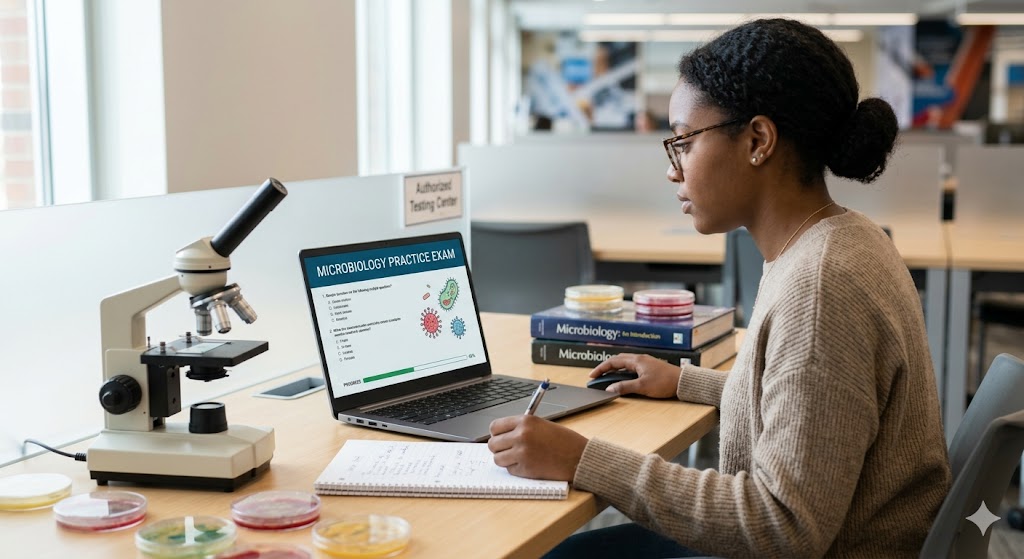
Additional Information
What the Course Entails and Exam Details
This practice exam covers the core competencies typically
found in an introductory-level microbiology course. The curriculum encompasses
a broad spectrum of topics, ensuring a thorough understanding of microbial life
and its interactions with the human host. Key areas include microbial structure
and function (bacteria, viruses, fungi, parasites), microbial metabolism and
genetics, principles of disease and epidemiology, immune system responses to
infection, and diagnostic methods. The material is structured to test both
theoretical knowledge and practical applications in clinical and laboratory
settings.
What to Expect in
the Final Exam
While individual final exams vary by institution or
certification body, this practice test accurately mirrors the structure and
complexity you can expect. A typical final microbiology exam will consist
primarily of multiple-choice questions designed to assess factual recall and
critical thinking. It may also include short-answer questions requiring
explanations of mechanisms, and potentially laboratory practical components
focusing on identification techniques. You should anticipate a timed
environment, with standard sessions lasting between two to three hours. A
passing score is typically set around 70% to 75% or equivalent to a C grade in
academic settings.
How to Study and
Exam Centers
Effective preparation for a microbiology exam involves a
combination of active learning strategies. To maximize your score, create
comprehensive flashcards for terminology and classifications. Dedicate
significant time to reviewing diagrams of microbial structures and metabolic
pathways, as visual questions are common. Utilize case studies to practice
applying your knowledge to real-world clinical scenarios. For the practice exam
itself, take it under timed, simulated conditions to build your testing stamina
and improve time management. Final exams are typically administered through
university testing centers for academic courses or authorized Pearson VUE
centers for professional certifications. Always check with your specific
program or board for approved testing locations and delivery methods.
Job Opportunities
from the Course
Mastery of microbiology concepts opens doors to numerous
career paths within health, science, and industry. Demonstrating competency
through this practice exam and the subsequent final can lead to positions such
as: Medical Laboratory Technician (MLT), Microbiology Laboratory Assistant,
Quality Control Analyst (Pharmaceutical or Food Industry), Research Assistant
(Academic or Biotechnology), Public Health Worker, and Food Safety Specialist.
Furthermore, this knowledge is a fundamental prerequisite for advanced roles
like Microbiologist, Medical Laboratory Scientist (MLS), and various
specialized healthcare professions.
Frequently Asked Questions
Reviews
5.0
Based on 0 reviews
Leave a Review
No reviews yet. Be the first to review!