
Midwifery Pharmacology Practice Test
$69.00
- Buy to unlock unlimited access to all Quiz questions and Answers in this Quiz.
- After purchase you can print a PDF of the whole quiz at any point. The PDF will contain the questions and the correct answers.
About this Exam
The Midwifery Pharmacology Practice Exam is a specialized preparatory resource designed for student midwives, certified nurse-midwives, and healthcare professionals seeking to master the complexities of medication management during pregnancy, labor, and the postpartum period. This certification review is crafted for those who are preparing for licensure or advanced practice exams and wish to bridge the gap between clinical knowledge and pharmacological application. It offers a structured approach to understanding drug interactions, dosage calculations, and the safety profiles of essential medications used in midwifery practice.
Ready to test your knowledge?
Buy Now to Access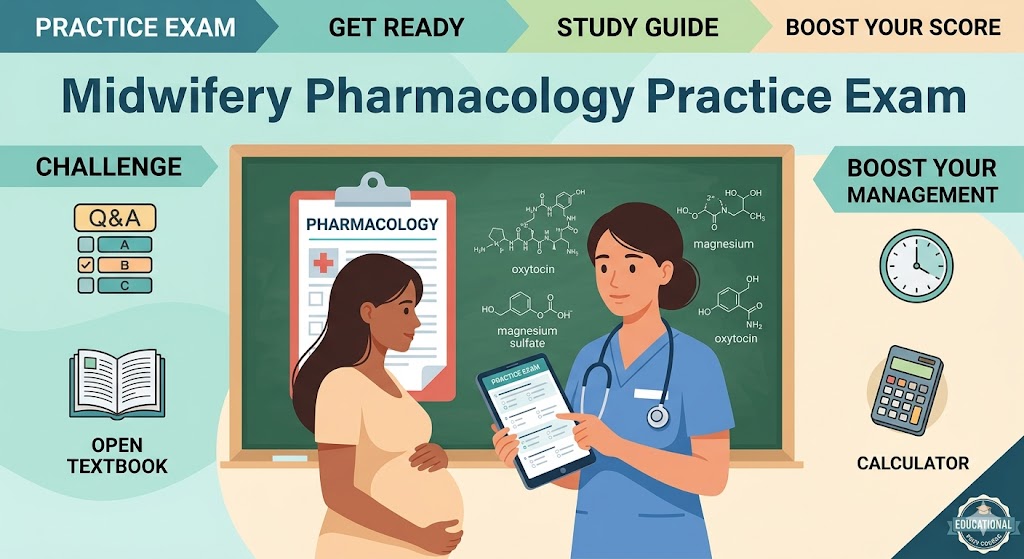
Additional Information
What the Course
Entails and Exam Details
The course and accompanying exam cover a robust syllabus
essential for safe midwifery practice. Core topics include the pharmacokinetics
and pharmacodynamics of medications in pregnancy and lactation, the
administration of oxytocics, anti-hypertensives for preeclampsia, antibiotics
for Group B Strep prophylaxis, and pain management strategies. The content
emphasizes evidence-based practice, safety protocols, and the ethical
considerations of prescribing. Students will develop proficiency in identifying
contraindications, managing adverse reactions, and understanding the legal
scope of practice regarding pharmacological interventions in various clinical
settings.
What to Expect in
the Final Exam
The final exam typically consists of multiple-choice
questions designed to assess both theoretical knowledge and clinical
decision-making skills. Depending on the specific accrediting body, the format
may also include dosage calculation problems and clinical case studies.
Candidates can expect a time limit usually ranging from two to four hours,
depending on the volume of the material covered. Passing score requirements
generally sit between 75% and 80%, reflecting the high standard of safety
required for midwifery practice. Rules are stringent: candidates are typically
monitored, and no unauthorized materials are permitted during the testing
period.
How to Study and Exam Centers
Effective study for this pharmacology exam requires a
multi-faceted approach. Begin by reviewing foundational pharmacology textbooks
and supplementing them with current clinical guidelines from organizations such
as the American College of Nurse-Midwives (ACNM). Utilize flashcards for drug
classifications and dedicate time to mastering dosage calculation formulas.
Practice tests are invaluable; take full-length mock exams under timed
conditions to improve your pacing. Regarding exam centers, most modern midwifery
certifications are administered through authorized digital testing platforms
like Pearson VUE or specialized institutional testing centers. Always verify
your specific exam’s location, whether it is hosted at a physical proctored
facility, an authorized university school of nursing, or via a secure remote
proctoring service.
Job Opportunities
from the Course
Earning certification in Midwifery Pharmacology enhances
your professional credibility and opens doors to advanced clinical roles. This
credential signals to employers that you possess the critical medication
management skills necessary for high-acuity labor and delivery environments.
Potential career paths and job titles include:
Certified Nurse-Midwife (CNM) in hospital-based birth
centers.
Clinical Midwifery Preceptor or educator.
High-risk pregnancy unit consultant.
Midwifery Practice Administrator with oversight of
medication safety protocols.
Public health advisor specializing in maternal and child
pharmacological safety.
Academic researcher or faculty member in a midwifery
education program.
Frequently Asked Questions
Reviews
5.0
Based on 0 reviews
Leave a Review
No reviews yet. Be the first to review!