
Military Ethics Practice Test
$69.00
- Buy to unlock unlimited access to all Quiz questions and Answers in this Quiz.
- After purchase you can print a PDF of the whole quiz at any point. The PDF will contain the questions and the correct answers.
About this Exam
Welcome to our comprehensive study guide for the Military Ethics Practice Test. This resource is designed to support current service members, candidates, and students of military science in their preparation for assessments on ethical principles. The actual exams for which this practice test prepares you are critical in evaluating a service member's understanding of the moral, legal, and professional obligations relevant to military operations and leadership. This practice test is a vital tool for reinforcing key concepts, testing knowledge, and enhancing the critical thinking skills required to navigate the complex ethical dilemmas encountered in the line of duty.
Ready to test your knowledge?
Buy Now to Access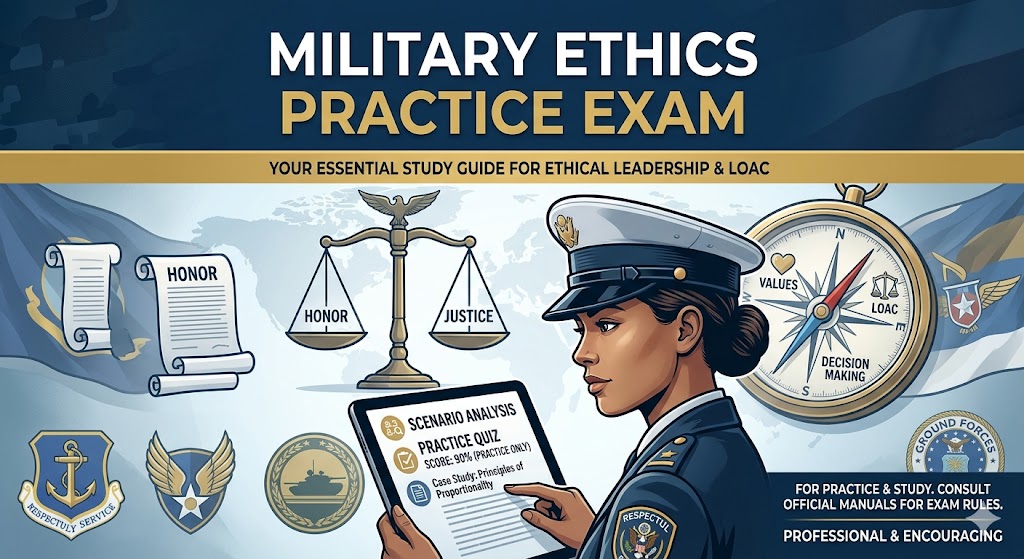
Additional Information
What the Course Entails and Exam Details
This practice guide encompasses the core areas typically
covered in a formal military ethics course and subsequent examination. Key
topics include:
- Foundations
of Military Ethics: Understanding the moral and philosophical grounds
for military service, the distinction between jus ad bellum (the
right to go to war) and jus in bello (the right conduct within
war).
- Just
War Theory: Examining the historically rooted principles used to
justify military conflict and evaluate the morality of specific actions.
- Law
of Armed Conflict (LOAC) and International Humanitarian Law (IHL): A
critical focus on the Geneva and Hague Conventions, rules of engagement,
and legal constraints designed to protect non-combatants and limit the
effects of warfare.
- Ethical
Leadership and Decision-Making: Analyzing dilemmas that leaders face,
including handling unlawful orders, balancing mission achievement with
safety, and maintaining discipline and honor.
- Military
Professionalism and Codes of Conduct: Reviewing core values specific
to service branches (e.g., Integrity, Honor, Respect, Duty, Courage,
Loyalty) and the historical/professional context of military oaths.
- Combat
and Dynamic Scenario Analysis: Applying theoretical knowledge to
simulated scenarios involving civilians, prisoners of war, emerging
technologies, and rules of engagement application.
- What to Expect in the Final Exam
While the exact structure of an actual military ethics
examination can vary depending on the service branch, course level, or
certifying body, this practice test is designed to provide realistic
expectations. Here is what you can commonly expect in the practice tool and the
official assessment it prepares you for:
- Format:
The practice test and many actual exams are primarily composed of
multiple-choice questions. This style effectively tests knowledge recall
and application to scenarios.
- Practice
Setup: Within a practice environment, you might encounter
approximately 40-50 multiple-choice questions designed to mirror the
breadth and depth of a typical official exam. The practice tool will often
allow for immediate feedback and explanations.
- Actual
Exam Expectations (Illustrative): An actual certification or
advancement exam might have a specified time limit (e.g., 60-90 minutes)
and require a minimum passing score (often 70% or higher, or a set
percentile for standardized tests).
- Specific
Rules: Official exams are usually administered in a proctored
environment, whether at a physical testing center, through accredited
military institutions, or via secure online platforms. All official
policies and academic integrity rules will strictly apply.
How to Study and Exam Centers
Preparation for a military ethics assessment requires both
knowledge absorption and critical application. Here are effective study
strategies:
- Engage
with Practice Questions: This practice test should be used multiple
times. Identify patterns in the questions and focus on areas where you
consistently struggle. Use the feedback feature to deepen your
understanding.
- Scenario
Role-Playing: Actively think through the scenarios presented in
questions and case studies. Discuss ethical dilemmas with peers and
consider how core military values and the LOAC apply.
- Active
Recall and Spaced Repetition: Instead of just reading, try recalling
key principles from memory. Flashcards (physical or digital apps like
Anki) for terms and laws are highly effective.
- Review
Official Military Manuals and Codes: Consult current publications from
your specific service branch regarding core values, codes of conduct, and
current guidelines on the Laws of Armed Conflict.
- Form
Study Groups: Discussions with fellow service members can provide
diverse perspectives and help articulate ethical arguments.
Exam Center Information (for the actual exam):
- Military
Personnel: Service members typically take official exams through
military learning management systems, during official training courses, or
at designated proctored facilities within their command structure. Check
with your superiors or educational office for specific testing pathways.
- Students:
Those in university-based military studies will take exams through their
institution's regular testing centers or as specified by the academic
department.
- General/Certification
(if applicable): While not all military ethics assessments lead to
external certification, if one is involved, exams may be proctored through
official testing companies, specific military online portals, or
accredited testing centers. Always verify the source and requirements of
the official examination you are preparing for.
Job Opportunities from the Course
A strong grasp of military ethics and performance on
relevant assessments is not just for advancement, it is crucial for a wide
array of career paths within the military and related fields. Opportunities
unlocked or enhanced by expertise in this area include, but are not limited to:
- Commissioned
Officer in any branch (where ethics is central to leadership).
- Non-Commissioned
Officer (NCO) Roles (key roles in enforcing conduct and guiding
personnel).
- Military
Chaplain (focus on moral guidance and ethical counseling).
- Judge
Advocate General (JAG) Corps (legal roles heavily dependent on the Law of
Armed Conflict).
- Military
Intelligence Analyst (ethics are vital in information gathering and
application).
- Special
Operations Roles (operating in ethically complex and dynamic
environments).
- Instructor/Educator
in Military Ethics and Leadership.
- International
Affairs Specialist (positions involving diplomacy and treaty adherence).
- Defense
Contracting Compliance Officer.
- Security
Operations Manager.
- Consultant
on military and humanitarian ethics for NGOs or think tanks.
- Civil
Service Roles in Defense, National Security, and International Relations.
- Law
Enforcement and Professional Standards Officers.
Frequently Asked Questions
Reviews
5.0
Based on 0 reviews
Leave a Review
No reviews yet. Be the first to review!