
Millwright Level 2 Bearings Practice Test
$69.00
- Buy to unlock unlimited access to all Quiz questions and Answers in this Quiz.
- After purchase you can print a PDF of the whole quiz at any point. The PDF will contain the questions and the correct answers.
About this Exam
The Millwright Level 2 Bearings Practice Test is an essential resource designed for aspiring industrial mechanics moving into the intermediate stage of their career. This course is for registered millwright apprentices or experienced workers seeking to validate their knowledge of advanced machinery maintenance. As a Level 2 candidate, you are ready to move beyond basic installation and focus on the precision, alignment, and failure analysis of critical moving parts. This specific practice test focuses heavily on the selection, installation, troubleshooting, and maintenance of all major bearing types used in heavy industrial settings. Master this exam to prove you have the technical knowledge required to minimize machinery downtime and maximize efficiency
Ready to test your knowledge?
Buy Now to Access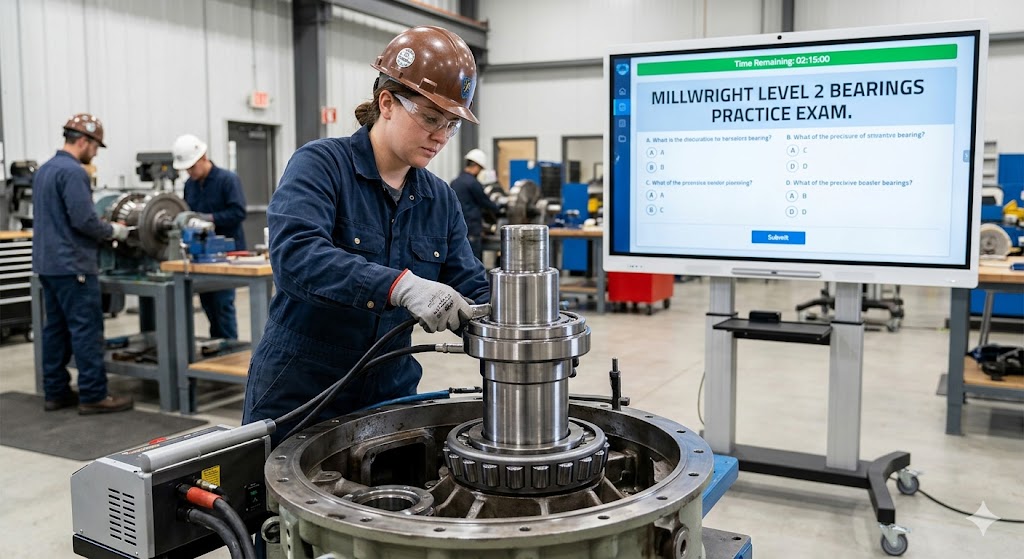
Additional Information
What the Course Entails and Exam Details
The comprehensive curriculum prepares you for a deep
understanding of shaft, bearing, and seal systems, which typically form a core
component of a Level 2 qualification. It ensures you can move from simple
observation to proactive maintenance and precise installation. You will cover a
detailed syllabus that includes, but is not limited to:
- Bearing
Classification and Identification: Distinguishing between Plain
Bearings (e.g., Babbitt, bronze bushings) and Anti-Friction Bearings
(e.g., ball, cylindrical roller, spherical roller, tapered roller,
needle). Decoding manufacturer catalogs and bearing codes.
- Installation
and Removal Techniques: Mastering proper fitting methods
(interference, clearance fits), using hydraulic presses, pullers,
induction heaters, and oil bath heating.
- Bearing
Housings and Seals: Understanding static, dynamic, and mechanical
seals and selecting appropriate housings for different load conditions.
- Lubrication
Management: Detailed study of lubricant properties, viscosity, extreme
pressure grease types, and complex lubrication systems (e.g., oil mist,
splash, pressurized).
- Failure
Analysis and Condition Monitoring: Identifying causes of bearing
failure (fatigue, corrosion, contamination, misalignment) and utilizing
basic predictive maintenance tools like vibration analysis indicators.
- Precision
Alignment: Procedures for shaft alignment using rim-and-face and dial
indicator methods to protect the integrity of your bearing systems.
What to Expect in
the Final Exam
The final qualification exam (such as the trade
certification exam that this practice test prepares you for) is typically a
rigorous, proctored test. While the specific format of your final exam is
determined by your local governing body or training authority, you can usually
expect a knowledge-based, Multiple-Choice Question (MCQ) format. These exams
are designed to test not only recall of facts but also your procedural
knowledge and critical thinking abilities. You will be presented with scenarios
and asked to select the most appropriate installation procedure, identify the
root cause of a specific failure pattern, or determine the correct bearing type
from technical specifications. A typical trade certification exam might
comprise 100–150 questions, with a standard time limit of 3 to 4 hours. A
passing score of 70% or higher is common for professional technical
certifications. Some level systems also require a practical hands-on assessment
separate from the knowledge exam. A practice test like this is your primary
tool for mastering the theoretical portion.
How to Study and Exam Centers
Successful completion of the Millwright Level 2 Bearings
examination requires a strategic blend of structured review and focused
practice. First, create a comprehensive study guide by reviewing all technical
documentation from your intermediate apprenticeship modules. Manufacturer
catalogs, like those from SKF or Timken, are invaluable and contain critical
fit tolerances and installation guides that you must know. Do not rely on
memory; focus on understanding the principles of why specific techniques are used.
Practice actively: work through this [Millwright Level 2 Bearings Practice
Test] multiple times to simulate the exam pressure and identify gaps in your
knowledge. Use visual study aids; create flashcards for bearing codes and
failure modes. Study cross-sectional diagrams of bearings and housings to
ensure you understand their internal geometry and lubrication paths.
Your actual final certification exam is administered through
specific authorized channels. While a "Practice Test" is typically
taken on a digital platform (e.g., an online portal or learning management
system), the official exam is given at recognized testing facilities. These can
include physical testing centers managed by organizations like Pearson VUE,
local colleges or polytechnic institutions, or union training halls. In many
jurisdictions, the Red Seal or provincial trade authority schedules and oversees
these final qualifications. Contact your local apprenticeship board, union
coordinator, or technical school to determine the nearest authorized testing
center and to understand how to register for your official exam.
Job Opportunities
from the Course
Obtaining your Millwright Level 2 certification, especially
with a verified specialization in bearings, significantly expands your career
horizons and increases your earning potential. You will no longer be seen as an
entry-level worker but as an intermediate-level specialist who can handle
complex machinery. This qualification unlocks a clear path to advanced and
highly sought-after industrial roles. The specific job titles this course helps
you secure include:
- Intermediate
Maintenance Millwright
- Industrial
Mechanic
- Bearing
Specialist
- Predictive
Maintenance Technician
- Vibration
Analyst (when combined with specialist certification)
- Packaging
Machinery Specialist
- Rotating
Equipment Technician
- Mine
Maintenance Mechanic
- Maintenance
Team Leader/Supervisor (as your experience grows)
Frequently Asked Questions
Reviews
5.0
Based on 0 reviews
Leave a Review
No reviews yet. Be the first to review!