
Millwright Power Transmission Practice Test
$69.00
- Buy to unlock unlimited access to all Quiz questions and Answers in this Quiz.
- After purchase you can print a PDF of the whole quiz at any point. The PDF will contain the questions and the correct answers.
About this Exam
This study guide focuses specifically on the mechanical power transmission systems that are the lifeline of modern industrial facilities.
Preparing for and excelling in power transmission assessments is paramount for anyone aspiring to a successful career as a millwright. This practice test is an essential resource designed for apprentices, seasoned professionals validating their skills, and candidates preparing for official journeyman, Red Seal, or other national certification exams (e.g., NCCER). This guide provides a focused overview of the primary subjects you must master.
Ready to test your knowledge?
Buy Now to Access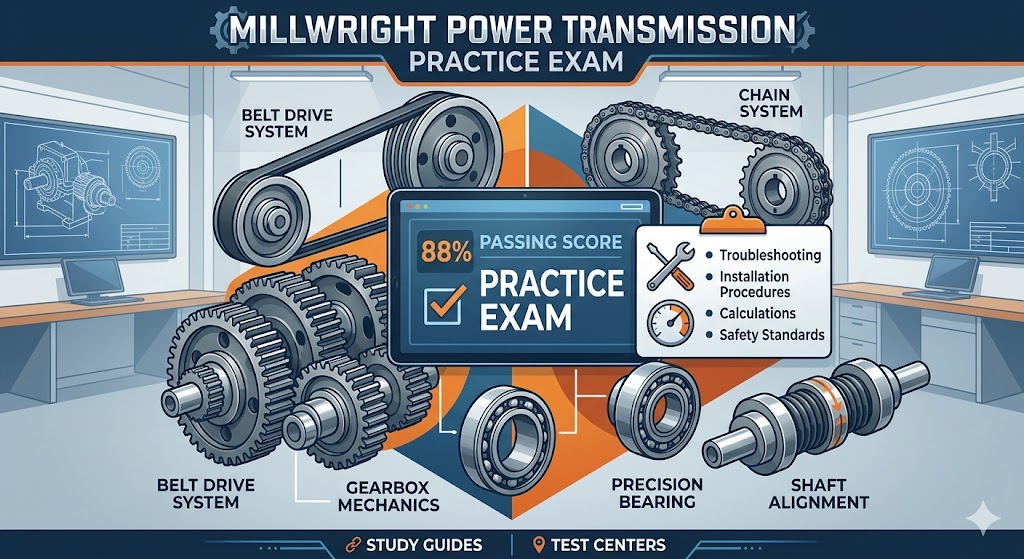
Additional Information
What the Course Entails and Exam Details
A comprehensive course leading to a power transmission
assessment, and therefore what this practice test covers, dives deep into the
theoretical and practical knowledge of mechanical drive components. Students
learn not just what components are, but how to accurately select, install,
align, maintain, and troubleshoot them according to precision engineering
standards.
The primary topics covered include:
- Mechanical
Drives: Detailed analysis of standard v-belt, synchronous belt, and
chain drive systems, including installation methods, correct tensioning
formulas, and common failure modes.
- Gearing:
Comprehensive understanding of gear types (spur, helical, bevel, worm),
gear terminology, gear ratio calculations, and the maintenance of
gearboxes and enclosed drives.
- Couplings
and Shafts: Proper methods for selecting, installing, and aligning
rigid and flexible couplings (e.g., jaw, grid, gear, disc). Understanding
shaft design, tolerances, and the critical importance of precision
alignment.
- Bearings
and Seals: In-depth knowledge of plain and anti-friction bearings
(ball, roller, needle). Mastering proper selection, lubrication methods,
installation, and failure analysis to prevent catastrophic machine
downtime.
- Clutches
and Brakes: Operational principles, installation, and maintenance of
diverse industrial clutch and brake systems for controlling motion.
- Lubrication
Systems: The science of selecting the right lubricants and
designing/maintaining systems (e.g., manual, splash, automated) to
minimize friction and wear.
What to Expect in
the Final Exam
When you move from practice to the official final exam (such
as a state licensing or national certification), you should be prepared for a
rigorous evaluation. The theoretical component typically comprises multiple-choice
questions. These questions do not simply ask for definitions; they assess
your ability to apply your knowledge to solve real-world problems.
Expect a significant number of scenario-based questions that
test your ability to diagnose potential failure modes or select the correct
procedure for a complex task, like diagnosing noise in a gearbox or
recommending a coupling replacement. Furthermore, you will need to perform
calculations related to gear ratios, belt lengths, and speed outputs.
Proficiency in reading complex schematics and blueprints is also vital.
Standard professional exams generally have a time limit,
often ranging from two to four hours, with passing scores set at 70% or higher.
It is essential to understand that while this practice test focuses on theory,
official certification routes often require you to pass a separate practical
skills assessment to demonstrate your ability to align shafts or install a
bearing correctly.
How to Study and Exam Centers
Effective preparation requires a structured study plan.
- Utilize
Practice Exams: Your primary strategy is identifying your weakest
areas. Use this "Millwright Power Transmission Practice Test" to
simulate exam conditions and identify specific topics where your knowledge
is lacking.
- Review
Textbooks and Manuals: Dedicate focus time to reviewing core
industrial maintenance textbooks. Pay close attention to standard
reference materials, such as the IPT manuals or manufacturer product
guides for bearings and belts.
- Focus
on Visual Aids: Master diagrams of component internal structures, gear
meshing patterns, and alignment procedures. Visual learning is critical
for power transmission.
- Hands-On
Learning: The best way to learn is by doing. If you are an apprentice,
focus on applying the theoretical principles you study to the actual
machines you service daily. Practice precision shaft alignment as often as
possible.
Regarding where to take the exam, official certifications
must be taken through approved organizations. The exact location will depend on
the certification body (e.g., NCCER, state boards, Canadian Red Seal). You can
typically find authorized testing opportunities at vocational and technical
colleges, union-affiliated training centers, or specialized commercial testing
facilities like Pearson VUE. Always refer to the official website of
your specific certification organization for a definitive list of approved test
centers and detailed registration instructions.
Job Opportunities from the Course
Successfully validating your expertise through power
transmission certifications significantly enhances your employability and opens
doors to multiple rewarding, high-demand career paths.
- Certified
Millwright / Journeyman Industrial Mechanic
- Industrial
Maintenance Technician (Specializing in Power Transmission Systems)
- Mechanical
Supervisor or Foreman
- Precision
Maintenance Specialist
- Field
Service Technician for Industrial Equipment Manufacturers
- Plant
Reliability Technician
- Equipment
Commissioning Agent
- With
experience: Maintenance Planner or Project Manager
Frequently Asked Questions
Reviews
5.0
Based on 0 reviews
Leave a Review
No reviews yet. Be the first to review!