
Minnesota Boiler License Practice Exam
$69.00
- Buy to unlock unlimited access to all Quiz questions and Answers in this Quiz.
- After purchase you can print a PDF of the whole quiz at any point. The PDF will contain the questions and the correct answers.
About this Exam
The Minnesota Boiler License is a crucial certification required for anyone seeking to operate or maintain boilers in the state of Minnesota.
This exam and the licensing process are overseen by the Minnesota Department of Labor and Industry (DLI) to ensure the safe and proper handling of these powerful systems. The license has multiple classes and sub-grades, ranging from Special to Chief Engineer, reflecting the type, pressure, and horsepower of the equipment you are authorized to manage.
This study guide and practice information are designed for aspiring boiler operators, engineers, and maintenance professionals looking to build a strong foundational knowledge and successfully pass the Minnesota DLI licensing exams. Achieving this license is a key step towards a rewarding and essential career in the building trades and industrial operations.
Ready to test your knowledge?
Buy Now to Access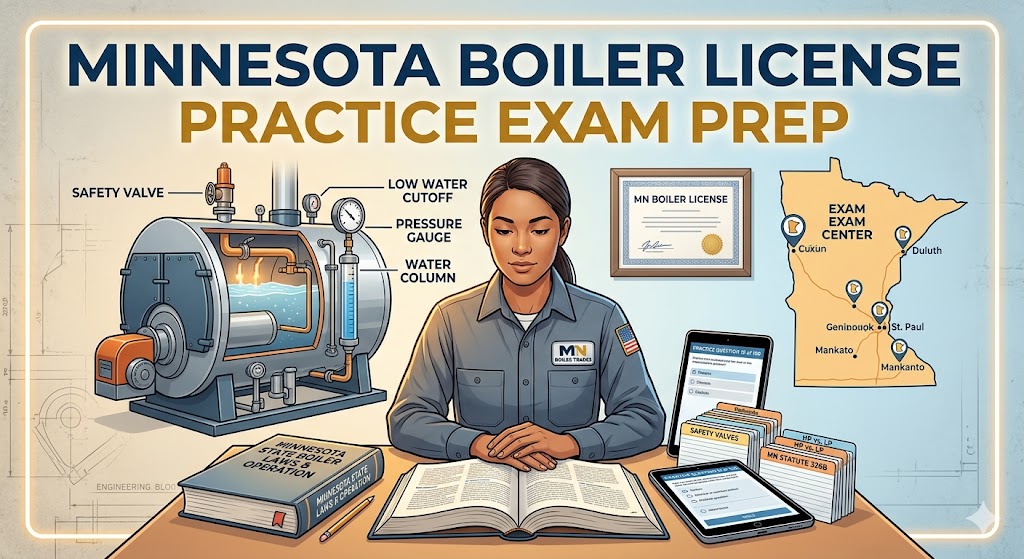
Additional Information
What the Course Entails and Exam Details
While there isn't one universal preparatory
"course" for all classes of the Minnesota Boiler License, many
technical colleges and industry organizations in Minnesota offer comprehensive
preparation programs. These typically 32-hour courses are designed to align
directly with the state's knowledge requirements and equip you with the skills
and theoretical understanding needed for your specific license.
The core topics covered in these courses and on the
licensing exams reflect the fundamental aspects of boiler systems and safety.
Here is what you can typically expect the content and official exam details to
encompass:
- Boiler
Safety and Fundamentals: The absolute highest priority, this area
covers essential safety procedures, accident prevention, emergency
protocols, and the understanding of the inherent risks associated with
high pressure and high temperatures.
- Boiler
Types and Components: You will learn about the detailed construction
and function of various boilers, including high-pressure steam,
low-pressure steam, hot water heating, and small mechanical-drive steam
turbines. Specific grades of license will focus more heavily on relevant
types.
- Operating
Procedures: Detailed instructions and best practices for pre-start,
startup, routine operation, and shutdown. This includes monitoring levels,
pressures, and efficiency.
- Maintenance
and Repair: A significant portion is dedicated to proper maintenance
routines, troubleshooting common issues, testing safety devices, and the
difference between routine maintenance and state-licensed repairs.
- Fittings,
Controls, and Instrumentation: Understanding the critical roles of
safety valves, low water cutoffs, feedwater regulators, and automatic
control systems.
- Minnesota
Statutes and Rules: Crucial legal and regulatory knowledge, focusing
on specific chapters of the Minnesota Statutes that detail boiler
licensing, inspection, and operational requirements.
- Environmental
Control Systems: Relevant for some higher class licenses, covering
environmental standards and the operation of associated control equipment.
- Exam
Duration: While specific time limits are determined by the DLI and can
vary, official testing sessions can be several hours, with some technical
license exams noted up to 5.5 hours in duration.
- Passing
Score: The typical passing score for Minnesota Department of Labor and
Industry licensing exams is at least 70% or 75%, and you should aim for a
higher score to be confident.
- Retesting:
If you do not pass on your first attempt, the state has specific waiting
periods before you can re-apply for and retake the exam (often 30 days for
engineering classes).
- What to Expect in the Final Exam
When you step into an official Minnesota Boiler License
Exam, you should be prepared for a focused testing environment. The specifics
of the final exam, especially for higher classes, can be demanding.
- Exam
Format: The primary official license exams are multiple-choice written
tests. The number of questions will vary based on the class of license.
It's a comprehensive check of your knowledge, from safety details to
complex operational scenarios and legal statutes.
- Focus
on Safety: Expect a substantial number of questions to be about safety
protocols, emergency responses, and the specific functions of critical
safety devices like low water cutoffs and safety valves.
- Calculation
and Understanding: While not heavily focused on complex mathematics,
there will be questions that require you to apply your knowledge, such as
determining appropriate settings or calculating required horsepower
ratings in specific scenarios relevant to your license class.
- Legal
& Regulatory Knowledge: A significant portion will test your
understanding of the relevant sections of the Minnesota state laws and
Department of Labor and Industry rules. Knowing which rule applies to what
situation is key.
- Class
Differentiation: The difficulty and specific content of the questions
will be tailored to the class of license you are seeking. Special and
Second Class exams will focus on the practical basics for typical systems,
while First Class and Chief Engineer exams will involve more complex
scenarios, management of multiple systems, higher horsepower requirements,
and potentially broader understanding including environmental systems and
broader codes.
- Strict
Rules: The testing centers maintain a professional environment with
specific rules regarding ID, time, and permitted materials (usually
minimal to none for open-book, but your official test instructions will
specify this).
How to Study and Exam Centers
Preparation is absolutely essential for succeeding on the
Minnesota Boiler License Exam. Approach your studies with a structured plan,
utilizing resources effectively.
Effective Study Strategies:
Take a Prep Course: Highly
recommended, even if not strictly mandatory. Enroll in a Minnesota-specific
boiler operator or engineer preparatory course. These offer structured
learning, expert instruction, and often provide simulated practice questions.
Utilize Official Manuals:
Focus heavily on the manuals typically recommended or provided by the courses
and the MN DLI. These often include publications from ATP (such as "Safe
Boiler Operation Fundamentals", "Low Pressure Boilers",
"High Pressure Boilers") and, most importantly, the specific chapters
of Minnesota Statutes relevant to boilers.
Take Practice Exams:
Dedicate significant time to taking practice exams. Look for resources specific
to Minnesota to get a sense of question style, focus areas (like state laws),
and typical difficulty. Time yourself to build stamina and identify weak
points.
Practice with Timing: Take
some practice tests in a single, timed setting to simulate the exam pressure
and time constraints.
Create Flashcards: Use
flashcards for key terms, safety definitions, code references, formulas (like
horsepower calculations, if applicable), and procedural steps.
Understand the Statutes:
Spend meaningful time reading and understanding the actual language of the
relevant Minnesota Statutes. Don't just memorize common interpretations; know
the specific legal requirements.
Identify Weak Areas:
Review your practice test results carefully to understand where you struggle.
Focus additional study time on those topics.
Get Hands-on Experience:
Practical experience is highly valuable and sometimes required, especially for
higher license classes. If possible, seek opportunities to observe or assist
(under licensed supervision) with boiler operation and maintenance.
Rest Well and Prepare: In the days leading up to the
exam, ensure you are well-rested. Plan your travel, arrive early, and bring all
necessary identification and materials specified in your confirmation.
Official Exam Centers in Minnesota:
The official Minnesota Boiler License exams are administered
and scheduled through the Minnesota Department of Labor and Industry. You must
apply for the license first, and once your application is approved, you will
receive instructions on how to schedule your exam through the DLI's online
licensing system (iMS).
Exams are administered at specific locations throughout the
state, including:
- DLI's
St. Paul office: (Metro area exams are typically held here)
- Bemidji:
Northwest Technical College
- Detroit
Lakes: Holiday Inn and MNDOT - Detroit Lakes
- Duluth:
The Inn on Lake Superior and MNDOT - Northeast District Headquarters
- Mankato:
MN DOT - Mankato
- Moorhead:
Moorhead Public School Operations Facility
- Rochester:
MNDOT - Rochester
- St.
Cloud: MNDOT - St. Cloud Training Center
Be sure to check your application approval email and the
official DLI website for the most up-to-date schedule and specific instructions
for your preferred location.
Job Opportunities
from the Course
Obtaining a Minnesota Boiler License opens doors to numerous
stable and essential career paths within the construction, maintenance, and
industrial sectors. The specific license class (Special, 2nd, 1st, Chief, and
corresponding grades A, B, C) directly impacts the scope of equipment you can
manage and your potential job titles. Here are some of the job opportunities
unlocked by these licenses:
- Boiler
Operator
- Boiler
Technician
- Stationary
Engineer
- Building
Engineer
- Maintenance
Mechanic
- Building
Superintendent
- Plant
Operations Supervisor
- Facilities
Manager (often requiring higher class licenses)
- Specialist
in Industrial/Commercial Laundry Maintenance (where large boilers are
common)
- Apartment/Residential
Complex Maintenance
- Industrial
Boiler Installation and Commissioning Technician (with specific grades)
- Utility
Plant Operator
- Control
Room Operator (in plant settings with boilers)
- Opportunities
for career progression from Special Engineer roles to Chief Engineer,
leading and managing teams of licensed professionals.
Frequently Asked Questions
Reviews
5.0
Based on 0 reviews
Leave a Review
No reviews yet. Be the first to review!